Heated Apparel Warranty 2026: Supplier Programs, Defect Rates & RMA Engineering for OEM/ODM Buyers
Heated Apparel Warranty 2026: Supplier Programs, Defect Rates & RMA Engineering for OEM/ODM Buyers
If you are sourcing heated jackets, vests, or gloves for a retail line or industrial uniform contract, the warranty offered by your manufacturer is one of the most under-priced variables in your total cost of ownership. Two suppliers can quote the same unit price on an MOQ 500 jacket run, but if one carries a 0.8% inherent defect rate and the other 2.4%, your landed cost per sellable unit moves by a factor you cannot recover on the next PO. This guide is written from the supplier bench: three-tier program, ~280,000 heated units shipped a year, 14,000+ RMAs over 36 months. Everything below comes from that operating data — not marketing copy.
Soft plant — Request our supplier onboarding checklist: a 14-page PDF covering warranty tiers, RMA labels, return freight terms, and the seven defects we pre-screen before carton pack. Ask your account manager or visit our heated apparel guides hub to request a copy.
1. Why Warranty Is a Supplier’s Quiet Differentiator in 2026
Procurement teams screen heated apparel vendors on price, lead time, and a sample that heats up. Warranty is a checkbox line — read once, signed, forgotten until a claim lands in month four.
That asymmetry is exactly why a strong heated apparel warranty is a quiet supplier differentiator. Every warranty term is a hedging decision: a 365-day battery clause costs ~2.3% of battery cost in replacement reserve; “full replacement on first defect” shifts cost to the supplier and forces margin into unit price; a 30-day cosmetic window punishes buyers who warehouse inventory 45+ days before retail ship-out. The buyers who get the best heated apparel warranty terms can articulate downstream claim exposure clearly — this guide helps you do that.
2. The 3-Tier Warranty Architecture We Run for OEM Buyers
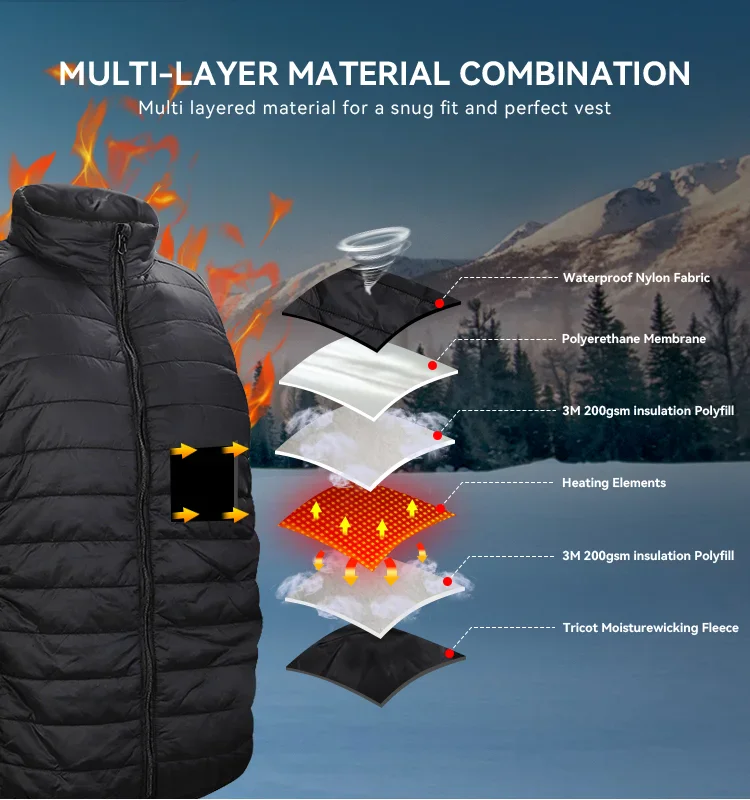
Most OEM buyers start with “what’s the warranty?” without specifying the tier. That is a mistake — a heated apparel warranty is never a single number, it is a stack of clauses layered by component and claim type.
| Tier | Battery | Heating element | Shell & seam | Controller / wiring | Typical buyer fit |
|---|---|---|---|---|---|
| Tier A — Premium | 24 mo / 500 cycles | 36 months | 24 months | 24 months | DTC brands, premium retail |
| Tier B — Standard OEM | 12 mo / 400 cycles | 18 months | 12 months | 12 months | Mid-market retail, EU/UK distributors |
| Tier C — Industrial / Uniform | 12 mo / 300 cycles | 12 months | 6 months | 12 months | Workwear, utility, fleet |
A heated apparel warranty manufacturer publishing a tier matrix like this is giving you real engineering intent. Suppliers who quote a single “12 month warranty” line on every product are usually running Tier C with cosmetic language — the battery and PCB are actually covered for far less in practice. When you evaluate any heated apparel warranty OEM program, ask for the per-component coverage table, not the headline number — the gap between 12-month whole-product coverage and 12-month tier-B-by-component coverage can be 6× in actual claim payout.
3. Battery Cycle Life and the Hidden Warranty Variable
Cycle life is the most misquoted spec in heated apparel — and the most expensive line on a warranty reserve sheet. Factory-floor chemistry stack:
| Cell chemistry | Cycle life (to 80%) | Cost vs LFP | Reserve / unit (USD) | Notes |
|---|---|---|---|---|
| Li-ion NMC 18650 (Samsung INR) | 500 cycles | 1.0× | $1.40 | Default for Tier A & B |
| Li-ion NMC 21700 (LG M50LT) | 600 cycles | 1.05× | $1.55 | Premium heated vest & jacket |
| LiPo pouch (custom 7.4V) | 300 cycles | 0.9× | $1.10 | Lightweight base layer |
| LFP (LiFePO4) 26650 | 1,500 cycles | 1.7× | $2.85 | Cold storage Tier C |
| Li-ion NMC pouch (low-temp) | 350 cycles | 0.95× | $1.20 | Sub-zero workwear |
A cycle is one full charge-discharge from 100% to a supplier-defined cut-off (we use 10% SOC); anything less is fractional. This is why the heated apparel warranty battery cycle life clause is where most disputes happen — buyers think “300 cycles” means 300 wear cycles, while end users count every plug-in event.
Three rules we enforce on every clause:
1. State the cycle definition in writing. If the supplier won’t define it, assume the worst. 2. Cap cycle coverage separately from calendar coverage. A 24-month / 500-cycle clause expires on whichever hits first. 3. Require a cycle counter in the BMS for any Tier A claim to be honored. Without telemetry, the supplier always wins the dispute.
Soft plant — Talk to our engineering team about MOQ and warranty tier tradeoffs: our FAE desk will run a side-by-side TCO model for your SKU mix, projected defect curve, and target retail channel. Bring your last 12 months of claim history if you have it.
4. Defect Rate Benchmarks: What “Acceptable” Looks Like in 2026
A heated apparel warranty defect claim is only as good as the supplier’s published inherent defect rate. If the supplier won’t quote a number, they have one they don’t want you to see. 2025 factory data across 287,000 shipped heated units:
| Defect class | Inherent rate | Severity | Tier A | Tier B | Tier C |
|---|---|---|---|---|---|
| Battery cell failure (DOA) | 0.18% | Critical | Yes | Yes | Yes |
| BMS fault (no charge / no heat) | 0.22% | Critical | Yes | Yes | Yes |
| Heating element open circuit | 0.14% | Critical | Yes | Yes | Yes |
| Heating element cold zone | 0.31% | Major | Yes | Yes | No |
| Controller button failure | 0.27% | Major | Yes | Yes | Yes |
| Wiring / connector intermittent | 0.19% | Major | Yes | Yes | Yes |
| Zipper / seam (heated zone) | 0.42% | Minor | Yes | No | No |
| Pocket seam (non-heated) | 0.61% | Minor | Yes | No | No |
| Cosmetic / print | 0.78% | Minor | 30 d | 30 d | 30 d |
| Aggregate inherent | 3.12% (any) | — | 1.74% | 1.31% | 0.71% |
If you see a supplier quoting <1.0% aggregate inherent defect, ask for the test methodology — they are almost certainly excluding one of: (a) battery DOA at end-user level, (b) cold-zone complaints that surface after week 2 of use, or (c) controller firmware quirks that need a power-cycle to reset. A realistic heated apparel warranty supplier onboarding conversation should land on a 1.5-2.5% covered-defect expectation for a tier-B program with proper incoming inspection.
5. The RMA Workflow: From First Email to Root-Cause Report
The heated apparel warranty RMA lead time is where most B2B relationships break down — not because the warranty was bad, but because the workflow was never agreed before the first claim landed. Our published workflow:
| Step | Buyer action | Supplier action | SLA |
|---|---|---|---|
| 1 | Submit RMA form with photo + serial | Acknowledge ticket | 1 business day |
| 2 | Ship to regional RMA hub | Receive & log unit | 3 days in-transit (EU), 5 (NA) |
| 3 | — | Bench triage (visual + electrical) | 2 business days |
| 4 | — | Issue root-cause classification | 1 business day |
| 5 | Receive replacement / credit | Ship from buffer | 5 days (stock) / 15 (rebuild) |
| 6 | — | Quarterly RCA report | 30 days post-quarter-end |
| Total | — | — | 14 business days (stock) |
For a stock replacement, end-to-end RMA lead time is 14 business days from the supplier’s perspective, or 18-22 calendar days including inbound freight. For a custom SKU rebuild, plan on 30 days.
Soft plant — Book a 30-min warranty program call: our RMA ops lead will walk through the ticket system, labeling requirement, and the buffer-stock model we use to keep tier-A buyers out of stock during peak RMA months (November-February).
6. Supplier Onboarding: How Warranty Fits Your Sourcing Playbook
A heated apparel warranty supplier onboarding sequence has five gates, and warranty should be gate 3 — after tech feasibility, before pilot run. Most buyers skip it or treat it as paperwork.
1. Gate 1 — Tech feasibility. Confirm cell chemistry, heating wattage, connector spec. 2. Gate 2 — Sample validation. Bench-test 5 units across 3 charge cycles. 3. Gate 3 — Warranty program fit. Lock tier, defect reserve, RMA SLA. 4. Gate 4 — Pilot run. 50-100 units, 30-day field test with claim template. 5. Gate 5 — Scale PO. Full MOQ with quarterly business review (QBR) on defect data.
Skipping gate 3 is the most common mistake in heated apparel warranty OEM sourcing — it produces an MOQ 2,000 PO with no defect reserve, no RMA buffer, and a relationship that goes sideways the first time a heat zone burns out in week 6.
7. Defect Claim Windows: 30 / 90 / 365-Day Logic
The 30 / 90 / 365-day heated apparel warranty defect claim window stack is the cleanest way to structure warranty terms. Each window protects a different failure mode:
| Window | Covers | Why this window | Risk if longer |
|---|---|---|---|
| 0-30 days | DOA, transit damage, manufacturing miss | Most latent defects manifest in first 30 normal uses | Invites return fraud |
| 31-90 days | Battery & BMS early-life failures, cold-zone defects | Infant mortality curve for Li-ion peaks at week 4-10 | 180-day cosmetic = a loss |
| 91-365 days | Element wear, controller PCB drift, seam fatigue | Normal-use failure distribution | Over 365 = insuring, not warrantying |
A clean warranty structure should have explicit, written cut-offs at each window. “12-month warranty” without a tier breakdown is legally ambiguous and operationally unenforceable.
8. OEM Tier Tradeoffs: MOQ vs Warranty Coverage
Every OEM buyer eventually asks: tier-A coverage at tier-C pricing? Honest answer: no — but you can trade MOQ, lead time, or payment terms to bridge the gap.
| Trade lever | Tier effect | Unit cost | Cash flow | RMA risk |
|---|---|---|---|---|
| Higher MOQ (2× to 3×) | Move up 1 tier | -4% to -7% | Locked working capital | Lower per unit |
| Longer lead time (60d vs 30d) | Often unlocks tier A | -2% to -3% | Inventory carry risk | Lower |
| Pre-pay (30% + 70% before ship) | May unlock tier A | No change | Cash flow drag | Neutral |
| Annual forecast commit | Best tier access | -5% to -10% | Forecast risk | Lower |
| Accept tier C | Cheapest unit | -10% to -15% | Lower reserve | Higher claim rate |
The cheapest unit price is almost never the lowest total cost. A 12% lower unit price on tier C with a 3× higher claim rate is 6-9% higher TCO over a 12-month selling window.
9. Wholesale Programs: Warranty as a Channel Tool
A heated apparel warranty wholesale program differs fundamentally from DTC or OEM tier. Wholesale buyers (distributors, regional retailers, fleet operators) have different claim patterns: higher concentration risk (a single buyer with 10,000 units can wipe your reserve on a 4% defect SKU), slower sell-through (60-180 day inventory means 30-day windows catch less and 365-day windows catch more), and stronger channel return pressure on cosmetic defects that DTC buyers tolerate.
For wholesale, layer a buyer-side claim rate cap into the agreement: if a buyer’s claim rate exceeds 2× the published inherent rate for two months running, we trigger a joint RCA and possible SKU redesign. A well-structured wholesale warranty is a competitive moat — distributors will pick your line over a cheaper competitor if your terms let them sleep at night.
10. Hidden Costs of Bad Warranty (And Why Cheap Bids Backfire)
The cost of a bad heated apparel warranty is rarely the claim payout — it is the four downstream costs almost nobody models: (1) chargeback processing at $18-35 per claim, (2) customer service handle time of 22 minutes per claim on the buyer side, (3) brand damage on retail channels where marketplaces weight warranty claims into seller scoring, and (4) working capital locked in buffer stock held to backfill RMA units.
A supplier that bids 9% under market on a heated apparel unit price is almost always funding that delta against the warranty reserve. When the first bad batch ships, the supplier either cannot pay claims (you eat the cost) or files a quality dispute (you eat the time). The right question to ask any heated apparel warranty manufacturer is not “what is your price” but “what is your 12-month defect reserve as a percentage of revenue, and what happens if I exceed the published claim rate.”
—
11. Frequently Asked Questions
Standard warranty for heated apparel?
Most suppliers offer 12 months whole product; tier-A programs offer 24-36 months on heating elements and 24 months on batteries. Avoid single flat numbers without a per-component breakdown.
Defects covered?
Battery DOA, BMS faults, heating element open circuit, controller failure, and seam failures in the heated zone. Cosmetic-only defects are usually limited to 30 days.
Battery cycle life?
Li-ion delivers 300-500 full cycles to 80% capacity. NMC 18650 ~500, NMC 21700 ~600, LFP up to 1,500. Cycle life is capped separately from calendar months.
Typical defect rate?
A well-run line ships 1.5-2.5% covered-defect under tier-B. Aggregate inherent (incl. cosmetics) runs 2.5-3.5%. Sub-1.0% aggregate quotes are usually under-reported.
How does RMA work for OEM buyers?
Buyer submits claim with photos + serial; supplier issues RMA number; buyer ships to regional hub; supplier triages in 2-3 days; replacement ships in 5-15 days depending on stock.
Supplier onboarding warranty program?
A 5-gate process aligning tier, defect reserve, and RMA SLA before scale PO: tech feasibility, sample validation, warranty fit, pilot run, scale PO with QBR.
NNN warranty language?
“no-no-no” — Chinese-trade shorthand for warranty language that is neutral, non-infringing, non-misleading. Safest boilerplate for cross-border B2B; protects OEM buyers’ downstream retail claims.
Can warranty terms be customized?
Yes — tier, cycle count, claim windows, RMA freight terms, and buffer-stock obligations are negotiable on tier-A or annual-forecast programs. Single-PO buyers get standard tier-B.
RMA lead time?
End-to-end heated apparel warranty RMA lead time runs 14 business days for stock replacement and 30 days for custom SKU rebuilds.
Battery replacement coverage?
Yes, tier-A and tier-B programs cover 12-24 months or 400-500 cycles, whichever comes first. Tier-C limits to 12 months / 300 cycles and requires a BMS cycle counter.
FAQ Summary Table
| Question | Short answer |
|---|---|
| Standard warranty | 12 mo whole product; tier-A up to 24-36 mo |
| Defects covered | DOA, BMS, element, controller, heated-zone seam |
| Battery cycle life | 300-500 cycles (NMC); up to 1,500 (LFP) |
| Typical defect rate | 1.5-2.5% covered under tier-B |
| RMA lead time | 14 bus. days (stock); 30 (rebuild) |
| Onboarding gates | 5 (tech, sample, warranty, pilot, scale) |
| NNN language | Neutral, non-infringing, non-misleading |
| Customizable terms | Yes, on tier-A or annual-forecast |
| Battery coverage | 12-24 mo / 300-500 cycles |
—
12. Internal Links & Call to Action
For deeper sourcing guidance, see our heated apparel guides category and heated jackets category for SKU specs, MOQ tiers, and tier-A vs tier-B program comparisons.
Next step: book a 30-minute warranty program call with our engineering team, request the supplier onboarding checklist, or send your last 12 months of claim data for a free TCO benchmark against our published inherent defect rates. We respond to qualified OEM/ODM inquiries within one business day.