Heated Apparel Pricing 2026: Factory Cost Breakdown & OEM Tier Guide
Heated Apparel Pricing 2026: Factory Cost Breakdown & OEM Tier Guide
Heated apparel pricing in 2026 is no longer a black-box number scribbled on a WeChat quote sheet. Lithium cell ASPs have stabilized, BMS chips are commoditized, and most heated apparel manufacturer cost lines are now line-item transparent — if you know where to look. This guide walks B2B buyers through the actual factory-side math: which cost lines move the needle, where the 5-tier OEM quote ladder creates real savings, how tariffs and currency drag land on the wholesale FOB number, and how to model the heated apparel OEM margin waterfall from FOB $18.50 to a $39.99 retail shelf price. If you are sourcing from a Chinese OEM/ODM factory and want to stop overpaying on the back end of a quote, bookmark this article. For the broader sourcing workflow, see our heated apparel guides hub.
Why Heated Apparel Pricing Is a 2026 Hot Topic
Three macro shifts are reshaping heated apparel pricing in 2026. First, 18650 cell ASPs dropped 8% year-over-year, locking a lower wholesale floor for heated apparel OEM buyers. Second, US Section 301 tariffs on HTS 6101/6110 knit categories remain at 25%, with EU CBAM-style drags emerging on textile imports. Third, factory overhead (rent, compliance staff, BMS lab) has climbed 12-15% since 2023, but most factories have absorbed it into margin rather than pushing it to the FOB line. The net effect: the heated apparel pricing band has widened at both ends — sample quotes as low as $14.80 for entry SKUs, and premium ODM builds pushing $48+ FOB. Knowing which lever to pull separates a profitable private label program from a margin-destroying one.
The Heated Apparel Manufacturer Cost Stack: 9 Cost Lines You Must Map
Every heated apparel manufacturer quote breaks down into nine cost lines. If your supplier quotes you a single number, walk away — they are hiding margin or, worse, they don’t know their own cost stack. From a vertical heated apparel manufacturer with element + battery + garment in-house, the typical 2026 cost split looks like this:
| # | Cost Line | Vest (Light) | Jacket (Heavy) | Glove | Sock |
|---|---|---|---|---|---|
| 1 | Fabric + trim (FOM) | $3.20 | $6.80 | $2.10 | $1.40 |
| 2 | Heating element | $1.85 | $2.95 | $1.40 | $0.95 |
| 3 | Battery pack (7.4V 5000mAh) | $4.50 | $5.20 | $3.80 | $3.20 |
| 4 | BMS + wiring harness | $0.85 | $1.10 | $0.65 | $0.55 |
| 5 | Direct labor (cut/sew/assemble) | $1.40 | $2.60 | $1.10 | $0.80 |
| 6 | Factory overhead | $1.10 | $1.80 | $0.90 | $0.70 |
| 7 | Packaging (PE bag + carton) | $0.30 | $0.45 | $0.25 | $0.20 |
| 8 | Compliance docs (UN38.3, MSDS) | $0.55 | $0.55 | $0.55 | $0.55 |
| 9 | Factory margin | $1.75 | $3.55 | $1.50 | $1.15 |
| **FOB Ningbo** | **$15.50** | **$25.00** | **$12.25** | **$9.50** |
These nine lines form the heated apparel cost breakdown skeleton. Every heated apparel pricing negotiation should anchor against lines 1, 3, and 9 — fabric, battery, and margin are where the real give-and-take lives. For deeper supplier-side process detail, browse our heated apparel guides.
Heated Apparel OEM Pricing Tiers: 5-Quote Ladder From Sample to 5000 Units
Heated apparel OEM pricing follows a 5-tier quote ladder. Most factories will not show all five tiers in a single email, but the math behind them is consistent across the industry:
| Tier | Volume | FOB Vest (Light) | FOB Jacket (Heavy) | Lead Time | Payment |
|---|---|---|---|---|---|
| 1 — Sample | 5-50 pcs | $28.00 | $42.00 | 15 days | 100% T/T |
| 2 — Pilot | 300 pcs | $19.50 | $31.00 | 35 days | 50/50 |
| 3 — Bulk | 1,000 pcs | $15.50 | $25.00 | 45 days | 30/70 |
| 4 — Scale | 2,000 pcs | $14.20 | $23.10 | 50 days | 30/70 |
| 5 — Mass | 5,000+ pcs | $13.10 | $21.40 | 55 days | LC at sight |
The 5-tier ladder is the operational backbone of heated apparel pricing. Buyers who push past 2,000 units unlock a 8-12% mass-production discount that simply does not exist below 1,000 units. That is the difference between a private label program that scales and one that stalls.
Heated Apparel Wholesale FOB Range by SKU Category
Heated apparel wholesale pricing varies sharply by SKU. A heated sock has a fundamentally different cost structure than a heated parka, and the FOB ladder reflects that:
| SKU | Fabric | Battery | Element | FOB @ 1k units | FOB @ 5k units |
|---|---|---|---|---|---|
| Heated vest (light) | Softshell 320D | 7.4V 5000mAh | Carbon fiber pad | $15.50 | $13.10 |
| Heated jacket (heavy) | 3-layer laminate | 7.4V 7500mAh | Carbon fiber + wire hybrid | $25.00 | $21.40 |
| Heated hoodie | Fleece 320gsm | 7.4V 5000mAh | Wire heating | $17.80 | $15.20 |
| Heated glove | Softshell + leather palm | 7.4V 2200mAh | Wire heating | $12.25 | $10.40 |
| Heated sock | Merino blend | 3.7V 2000mAh | Carbon fiber | $9.50 | $8.10 |
| Heated pant | Softshell | 7.4V 5000mAh | Wire heating | $19.20 | $16.50 |
Buyers building a heated apparel wholesale program should treat this matrix as a starting reference, not a fixed quote — every heated apparel manufacturer tier has its own yield curve.
Heated Vest Private Label Supplier Pricing: BOM, Battery Cost, Markup Bands
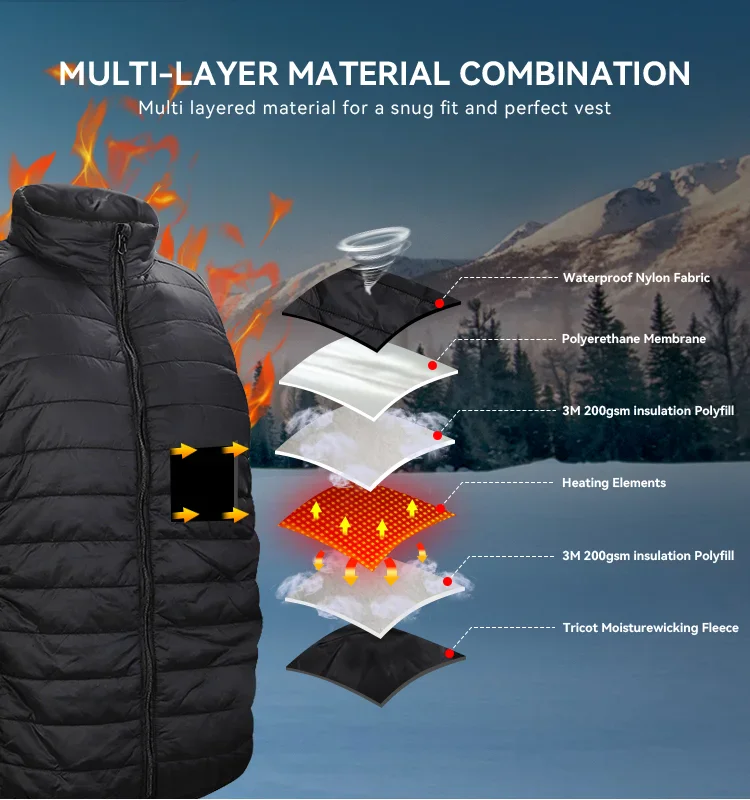
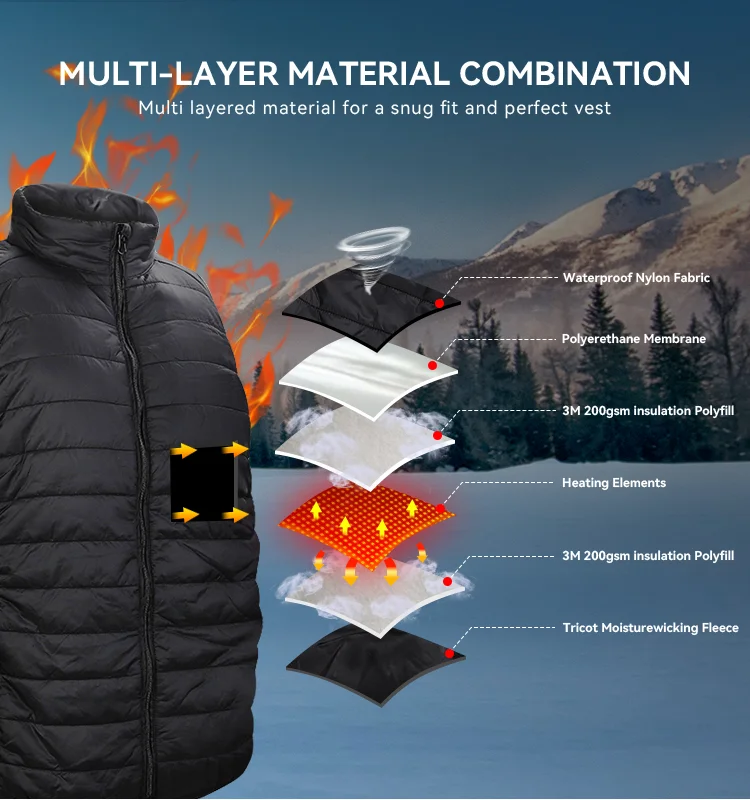
A heated vest private label supplier typically quotes on three markup bands: economy (15-18% margin), mid-market (22-26% margin), and premium (30-35% margin). The bands track directly to the BOM and battery cost composition. Economy builds lean on 320D polyester + wire heating + 4400mAh battery; mid-market uses softshell + carbon fiber + 5000mAh; premium adds 3-layer laminate + full-back carbon + collar zone + 7500mAh battery. The all-in FOB at 1k units runs $13.40, $15.50, and $22.10 respectively.
A heated vest private label supplier who can run all three bands in-house typically offers 6-10% better pricing than a trader who relabels white-box SKUs. That is the first question to ask on any supplier audit call.
Heated Jacket Brand Builder Cost: Heated Element, BMS, Labor Allocation
For a heated jacket brand builder, three cost lines dominate the cost math: the heating element (8-12% of FOB, ~$2.95 at 1k units for a 4-panel + collar zone carbon-wire hybrid), the BMS + harness (4-6%, ~$1.10 for a custom 4-mode controller), and direct labor (10-14%, ~$2.60 driven by 3-layer seam taping). The remaining ~73% ($18.35 at 1k units) flows through standard BOM + overhead lines. A heated jacket brand builder who designs for panel consolidation (e.g., dropping from 4 zones to 3 zones with one larger carbon pad) typically saves $0.40-0.65 per jacket on element cost alone. At 5k units, that is $2,000-3,250 in direct margin recovery.
Battery Pack UN38.3 Supplier Cost Premium: Test Reports, Class 9 Stickers, Logistics
A battery pack UN38.3 supplier absorbs substantial compliance overhead into the unit price. UN38.3 testing (T1-T8 altitude/thermal/vibration/shock/short/impact/overcharge/forced discharge) runs $4,500-8,000 per cell SKU, plus annual recertification costs of $1,200-2,000. The cost flows through to the wholesale FOB line in three forms:
| Compliance Item | Per-Unit Cost | Per-SKU Fixed | Annual Recurring |
|---|---|---|---|
| UN38.3 test report (T1-T8) | $0.10 | $6,500 | $1,800 |
| MSDS sheet | $0.02 | $250 | $120 |
| Class 9 hazmat sticker + UN box | $0.18 | $0 | $0 |
| Air-freight surcharge (Class 9) | $0.25/unit (air only) | $0 | $0 |
| Sea-freight Class 9 doc fee | $0.05 | $0 | $0 |
| **Total compliance drag** | **~$0.55-0.65** | **$6,750 first SKU** | **$1,920 recurring** |
For a battery pack UN38.3 supplier offering 3-cell variants (18650/21700/LiPo), the first-SKU compliance cost can exceed $20,000 before the first unit ships. Smart buyers split that cost across multiple SKUs by selecting one cell platform for the entire heated apparel program.
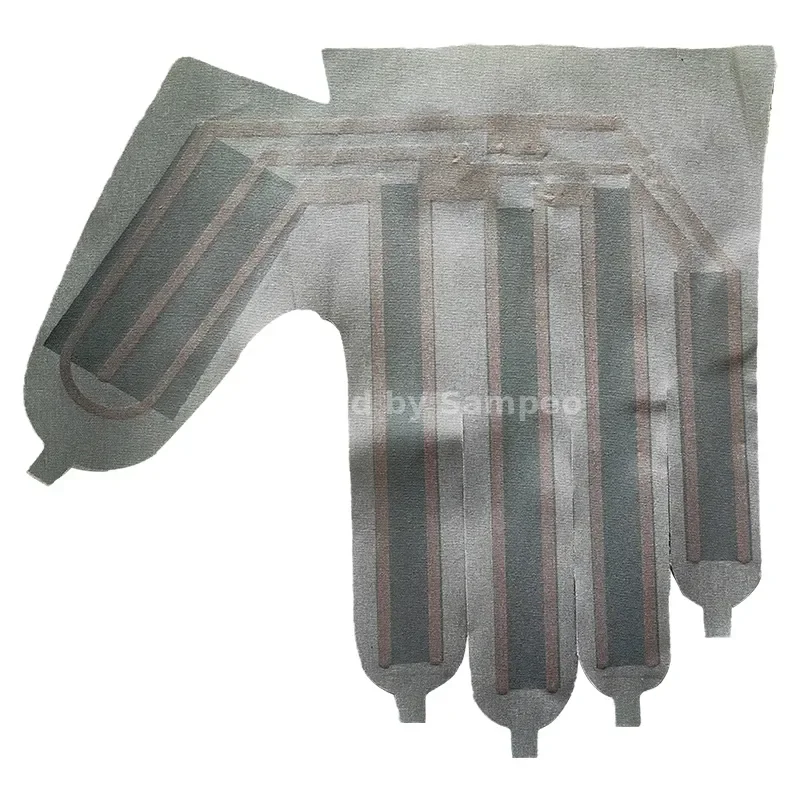
Carbon Fiber Heating Element Cost vs Wire Heating vs Graphene Pad: 2026 Comparison
The carbon fiber heating element vs wire heating vs graphene pad question is the single most-asked heated apparel pricing question in B2B RFQs in 2026. Here is the 2026 cost-per-unit comparison at 1,000-unit MOQ:
| Element Type | $/unit @ 1k | $/unit @ 5k | Wash Cycles | Heat-up Time | Flex Rating |
|---|---|---|---|---|---|
| Wire heating (alloy) | $0.85 | $0.62 | 50+ | 90 sec | Good |
| Carbon fiber pad | $1.85 | $1.45 | 80+ | 45 sec | Excellent |
| Carbon fiber + wire hybrid | $2.40 | $1.90 | 70+ | 60 sec | Excellent |
| Graphene pad (Chinese origin) | $3.20 | $2.65 | 100+ | 30 sec | Excellent |
| Graphene pad (Korean origin) | $4.80 | $4.10 | 120+ | 25 sec | Premium |
For most heated apparel OEM mid-market programs, the carbon fiber heating element offers the best cost-performance balance. Wire heating wins on price-sensitive glove/sock SKUs. Graphene remains a premium-positioning play — most buyers do not yet recover the cost delta at retail.
Heated Apparel OEM Pricing by Order Volume: 300 / 500 / 1000 / 2000 / 5000 Units
Order volume is the steepest lever in the heated apparel OEM pricing curve. Most factories will quote a near-flat curve between 300 and 500 units, then step the curve down hard at 1,000 units. For vest FOB, expect $19.50 at 300 units, $17.80 at 500, $15.50 at 1k, $14.20 at 2k, and $13.10 at 5k. Jackets follow the same shape: $31.00 → $28.40 → $25.00 → $23.10 → $21.40. Hoodies, gloves, and socks scale identically — typically 60-75% of vest FOB depending on the battery and fabric load.
The volume curve compresses most aggressively between 500 and 1,000 units — that is where heated apparel OEM pricing drops $2-3 per unit. The 1k-to-5k curve is flatter because factory setup costs are already amortized.
Wholesale Price Ladder Logic: Why 1000 Units ≠ 2× 500 Units
The wholesale price ladder does not behave like a simple linear function. Two 500-unit runs do not equal one 1,000-unit run in FOB terms, and the gap is wider than most heated apparel wholesale buyers realize. Here is why:
| Run Configuration | Total Units | FOB Vest | Total $ | Effective FOB | Savings vs 2× 500 |
|---|---|---|---|---|---|
| 1 × 500 units | 500 | $17.80 | $8,900 | $17.80 | — |
| 2 × 500 units (separate runs) | 1,000 | $17.80 + $18.50 (re-setup) | $18,150 | $18.15 | Baseline (worse) |
| 1 × 1,000 units (single run) | 1,000 | $15.50 | $15,500 | $15.50 | $2.65/unit saved |
The single-run 1k-unit quote saves $2.65/unit vs two 500-unit runs. That delta comes from fabric lot setup, BMS re-certification, heating element panel re-tooling, and a second round of QC sampling. Buyers running heated apparel wholesale programs should consolidate orders into single runs whenever possible — the math strongly rewards it.
Currency, Tariff, and HS Code Drag on Heated Apparel Wholesale Pricing 2026
Heated apparel wholesale pricing in 2026 carries a meaningful currency, tariff, and HS-code drag. The tariff line alone can swing 8-25% of the landed cost depending on the destination market:
| Market | HS Code | Tariff Rate | Currency Drag | Total Drag vs FOB |
|---|---|---|---|---|
| USA | 6101.30 / 6110.30 | 25% Section 301 | USD/CNY volatility ±2% | ~27% landed drag |
| EU | 6101.30 / 6110.30 | 12% MFN + VAT | EUR/CNY volatility ±1.5% | ~14% landed drag |
| UK | 6101.30 / 6110.30 | 8% UKGT | GBP/CNY volatility ±1.5% | ~10% landed drag |
| Canada | 6101.30 | 17.5% MFN | CAD/CNY volatility ±1% | ~19% landed drag |
| Australia | 6101.30 | 5% MFN | AUD/CNY volatility ±1% | ~7% landed drag |
A heated apparel wholesale buyer shipping to the US effectively pays an extra 25% before the product touches a US port. That is why many US buyers are routing through Mexico or Vietnam for finished goods assembly — the heated apparel pricing math flips significantly once Section 301 is removed.
Heated Apparel Pricing Add-Ons: Private Label, Packaging, Custom Battery, Compliance Docs
Heated apparel add-ons are where many buyers lose visibility into total cost. A factory will quote a clean FOB line, then pile up add-ons that quietly push 4-9% onto the unit cost. The four most common add-on buckets: private label (woven label + care label + hangtag) at $0.40-0.85, drops at 1k+; custom packaging (box + polybag + insert) at $0.30-1.20, drops at 2k+; custom battery (color, capacity, logo silkscreen) at $1.20-3.50, limited negotiation; and compliance docs (UN38.3, MSDS, CE-EMC, UKCA, FCC) at $0.55-1.40. Add-on pricing follows a rule of thumb: the more bespoke the SKU, the less negotiable the add-ons. Standard compliance docs can be amortized across SKUs; custom battery silkscreens cannot.
Payment-Term Discount Model: 30/70 vs LC at Sight vs OA Net 60 → Heated Apparel OEM Quote Math
Payment-term choice is a hidden heated apparel OEM discount layer most buyers ignore. The math on a 1,000-unit jacket PO at $25.00 FOB:
| Payment Term | Factory Discount | Effective FOB | Cash-Flow Impact | Risk to Factory |
|---|---|---|---|---|
| 100% T/T in advance | 3% discount | $24.25 | Worst for buyer | None |
| 30/70 T/T (deposit/balance) | 0% (baseline) | $25.00 | Moderate | Low |
| LC at sight | 1.5% LC fee | $25.38 effective | Moderate | Very low |
| OA Net 60 | 2% discount | $24.50 | Best for buyer | High (credit risk) |
| OA Net 90 | 3.5% discount | $24.13 | Best for buyer | Very high |
A private label heated apparel supplier running thin working capital will often trade 2-3% on OA Net 60 for the cash-flow win. Established OEM/ODM buyers with strong credit usually default to 30/70 T/T because it carries the lowest factory-side risk premium.
Heated Apparel OEM Margin Waterfall: From FOB $18.50 to Landed $39.99 Retail
The heated apparel OEM margin waterfall shows where every dollar of a $39.99 retail price actually lands. For a mid-market heated vest:
| Layer | $ per Unit | % of Retail | Who Captures |
|---|---|---|---|
| FOB Ningbo | $15.50 | 38.8% | Factory |
| Freight + duty (US landed) | $5.85 | 14.6% | Freight forwarder / customs |
| Importer markup | $3.50 | 8.8% | Importer / distributor |
| Warehouse + fulfillment | $2.20 | 5.5% | 3PL / DC |
| Brand marketing + CAC | $4.80 | 12.0% | Brand |
| Retailer markup (DTC) | $3.50 | 8.8% | Brand (own site) |
| Retailer margin (Amazon FBA) | $4.64 | 11.6% | Amazon |
| **Retail price** | **$39.99** | **100%** | End consumer |
Of the $39.99 retail price, the heated apparel OEM captures $15.50 FOB (38.8%). The remaining $24.49 is freight, importer margin, marketing, and retail markup. A leading OEM/ODM factory in Ningbo with vertical integration typically takes 42-46% of retail, because they eliminate the importer markup line.
Heated Apparel Manufacturer Cost Audit: 7 Factory Self-Check Questions for 2026
Run this 7-question self-audit on any heated apparel manufacturer before placing a PO. Each question maps to a heated apparel pricing risk vector:
| # | Self-Check Question | Pass | Marginal | Fail | Risk Weight |
|---|---|---|---|---|---|
| 1 | Do you have an in-house heating element line? | Vertical | Partial outsource | 100% outsource | 15% |
| 2 | Is the BMS integration in-house or purchased? | In-house | Hybrid | Purchased | 12% |
| 3 | Can you share a 9-line cost stack per SKU? | Yes | Partial | Refused | 18% |
| 4 | Is UN38.3 testing done in your own lab? | Yes | Partner lab | None | 10% |
| 5 | What is your heated apparel OEM historical yield loss? | <2% | 2-4% | >4% | 14% |
| 6 | Do you offer LC at sight on orders >$50k? | Yes | OA only | T/T only | 8% |
| 7 | Can you lock fabric price for 90 days? | Yes | 30 days | Spot only | 23% |
For the broader audit framework, see our heated apparel supplier guides library.
Battery Cell Cost Floor: Why 18650 Cells Lock Your Heated Apparel Wholesale Floor
The battery cell cost floor sets the wholesale floor for heated apparel OEM buyers. In 2026, 18650 cells from CATL/EVE/Lishen trade at $0.42-0.48 per cell at 5,000-cell MOQ. A 2S2P pack (4 cells) sets a $1.85-2.05 cell-only floor. Add BMS ($0.85), housing ($0.40), harness ($0.30), assembly labor ($0.45), and packaging ($0.25), and the battery pack cost floor sits at $4.10-4.30 per pack:
| Cell Platform | Cells/Pack | Cell Cost | Total Pack Cost @ 5k MOQ | Cycle Life |
|---|---|---|---|---|
| 18650 2600mAh | 4 (2S2P) | $1.85 | $4.10 | 500 cycles |
| 18650 3500mAh | 4 (2S2P) | $2.40 | $4.75 | 600 cycles |
| 21700 4000mAh | 4 (2S2P) | $3.20 | $5.65 | 800 cycles |
| LiPo 5000mAh | 1 (1S) | $4.80 | $6.30 | 400 cycles |
| LiPo 7500mAh | 1 (1S) | $6.20 | $7.85 | 400 cycles |
A heated apparel manufacturer sourcing 18650 cells from a tier-1 supplier locks the wholesale floor at $4.10/pack. Any quote below that line is either subsidized by margin or built on a sub-tier cell that will fail cycle-life QC.
Heating Element Yield Loss: How 3% Scrap Rates Eat Heated Apparel OEM Margin
Heating element yield loss is the silent heated apparel OEM margin killer. Most carbon fiber and wire heating element lines run at 92-97% first-pass yield (FPY). A 3% scrap rate sounds trivial, but it compounds across the cost stack: best-in-class (98% FPY, full recovery) adds $0 to FOB; mid-market (95%, 50% recovery) adds ~$0.18/unit and ~$9,000/year loss at 50k units; average (93%, 30% recovery) adds ~$0.35/unit and ~$17,500/year; struggling suppliers (90%, 0% recovery) add ~$0.62/unit and ~$31,000/year.
A heated apparel OEM supplier running at 90% FPY is charging you $0.62/unit of hidden scrap into the FOB line. That is why supplier audit question #5 (“historical yield loss?”) is one of the most predictive heated apparel pricing diagnostics available.
Compliance Cost Add-Ons: UN38.3, MSDS, CE-EMC, UKCA in 2026
Compliance docs add $0.55-1.40 per unit depending on the destination market stack. Here is the 2026 compliance cost map for heated apparel OEM shipments: every market requires UN38.3 and MSDS. The USA also requires FCC for RF/app-controlled SKUs and Prop 65 for California-bound shipments (~$0.65/unit all-in). EU adds CE-EMC for RF-emitting heated apparel (~$0.85/unit). UK requires UKCA on top of CE-EMC (~$0.90/unit). Canada runs ~$0.70/unit and Australia ~$0.75/unit including the RCM mark.
Heated apparel wholesale buyers shipping to multiple markets should request a per-market compliance cost split from their factory — most heated apparel manufacturer tiers quote a blended compliance line that hides per-market variance.
2026 Cost Optimization Playbook: 10 Levers for Heated Apparel OEM Buyers
The 2026 cost optimization playbook distills ten levers a heated apparel OEM buyer can pull to lower the FOB line without compromising build quality:
| # | Lever | Typical Savings | Risk |
|---|---|---|---|
| 1 | Consolidate to single battery cell platform | $0.30-0.60/unit | Low |
| 2 | Drop from 4-zone to 3-zone heating | $0.40-0.65/unit | Low |
| 3 | Standardize BMS across SKUs | $0.20-0.35/unit | Low |
| 4 | Lock fabric price 90 days forward | 2-4% fabric line | Medium |
| 5 | Move from air to sea freight (Class 9 cleared) | $1.20-2.00/unit | Low |
| 6 | Single-run consolidation (avoid re-setup) | $2.00-3.00/unit | Low |
| 7 | Negotiate 30/70 → LC at sight | 1.5% effective | Low |
| 8 | Drop private label color count from 4 to 2 | $0.25-0.40/unit | Medium |
| 9 | Use off-the-shelf BMS instead of custom | $0.30-0.55/unit | Low |
| 10 | Push MOQ from 500 to 1,000 units | $2.00-3.00/unit | Medium |
A heated apparel OEM buyer who executes even half of these levers typically pulls 5-8% off the total landed cost.
Frequently Asked Questions (FAQ)
Q: What is the typical FOB price for a heated vest in 2026?
A: A mid-market heated vest (softshell 320D, carbon fiber heating, 7.4V 5000mAh battery, BMS, private label) lands at $15.50 FOB Ningbo at 1,000 units. Economy builds run $13.40; premium 3-layer builds run $22.10. The heated apparel pricing band for vests in 2026 is $13-22 FOB at scale.
Q: Why does heated apparel OEM pricing differ between 500 and 1000 unit MOQ?
A: The 500-to-1,000 MOQ transition unlocks fabric lot pricing breaks, BMS amortization, single-run setup amortization, and lower per-unit element tooling recovery. Expect $2-3 per unit savings on most SKUs. Below 500 units, factories cannot amortize setup costs, so the heated apparel pricing curve flattens.
Q: How much does UN38.3 certification add to battery pack cost?
A: UN38.3 adds $0.10-0.18 per unit amortized, plus $6,500 first-SKU fixed cost and $1,800 annual recertification. For a 1,000-unit first run, expect $0.55-0.75 per unit total compliance drag. The heated apparel pricing impact is most acute on small first runs.
Q: What is the cost difference between carbon fiber and wire heating elements?
A: Carbon fiber heating elements run $1.85/unit at 1k MOQ vs $0.85 for wire heating. The $1.00 delta buys 45-second heat-up vs 90-second, plus 80+ wash cycles vs 50+. Most heated apparel OEM mid-market programs absorb the delta because carbon fiber commands a 6-10% retail premium.
Q: How do tariffs affect 2026 heated apparel wholesale pricing?
A: US Section 301 tariffs on HTS 6101.30 add 25% to landed cost. EU adds 12% MFN, UK 8% UKGT, Canada 17.5%, Australia 5%. A heated apparel wholesale buyer shipping to the US pays ~27% total landed drag vs FOB; EU buyers pay ~14%. Tariff engineering (Mexico/Vietnam assembly) is becoming standard.
Q: What payment term offers the best heated apparel OEM discount?
A: 100% T/T in advance typically gets a 3% discount. OA Net 60 can deliver 2-3% discount for credit-worthy buyers. For most heated apparel OEM buyers, 30/70 T/T remains the lowest-risk baseline. Discount size scales inversely with factory credit risk.
Q: Can a buyer negotiate factory-direct pricing under MOQ 500?
A: Yes, but expect 8-15% premium over 1k-unit pricing and waived payment-term flexibility. Under-500 MOQ heated apparel pricing is workable for sample validation and capsule drops but uneconomic for sustained wholesale programs.
Q: How is battery cell cost floor (18650) set in 2026?
A: Tier-1 18650 cells (CATL/EVE/Lishen) trade at $0.42-0.48 per cell at 5,000-cell MOQ. A 2S2P pack (4 cells) sets a $1.85-2.05 cell floor. Add BMS, housing, harness, and assembly to reach $4.10-4.30/pack floor. Any heated apparel pricing quote below that floor is sub-tier.
Q: What is the typical landed retail markup on heated apparel?
A: Heated apparel wholesale FOB typically represents 35-42% of retail price. A $15.50 FOB vest lands at $39.99 retail. Premium builds with vertical integration capture 42-46%. The heated apparel pricing-to-retail multiplier is 2.4-2.8×.
Q: How do private label add-ons (logo, packaging) affect per-unit cost?
A: Private label add-ons (woven label, care label, hangtag, custom polybag) add $0.40-0.85 per unit at 1k MOQ. Custom packaging adds $0.30-1.20. Combined add-on load is typically 4-9% of total heated apparel pricing.
Q: What is the biggest hidden cost in heated apparel OEM quotes?
A: Heating element yield loss and battery compliance drag are the two largest hidden costs. A 3% scrap rate adds $0.18-0.35/unit invisible to the buyer. UN38.3 + MSDS + Class 9 logistics add another $0.55-0.85/unit. Together, hidden costs can push 8-12% above the headline FOB in poorly-audited heated apparel OEM programs.
Q: How do factory yield losses affect final FOB pricing?
A: Yield loss flows into FOB in two ways: scrap recovery (50% recovery at best practice, 0% at worst) and re-run labor. A factory running at 90% first-pass yield (FPY) effectively adds $0.62/unit in hidden scrap to the heated apparel pricing line. Audit the FPY number before signing any heated apparel wholesale PO.
Glossary
- **FOB** (Free On Board): Seller delivers goods to the named port; buyer takes responsibility from there. FOB Ningbo is the standard heated apparel OEM quote basis.
- **OEM** (Original Equipment Manufacturer): Factory builds to buyer spec; buyer owns the design.
- **ODM** (Original Design Manufacturer): Factory designs and builds; buyer re-labels.
- **BMS** (Battery Management System): PCB that manages cell charge/discharge, thermal cutoff, and cell balancing.
- **MOQ** (Minimum Order Quantity): Smallest production run a factory will accept per SKU.
- **UN38.3**: UN transportation test standard for lithium batteries (T1-T8: altitude, thermal, vibration, shock, short, impact, overcharge, forced discharge).
- **CE-EMC**: EU Electromagnetic Compatibility directive compliance mark for RF-emitting heated apparel.
- **FOM** (Fabric + Other Materials): Base textile, trim, zippers, and miscellaneous consumables.
- **HS Code** (Harmonized System Code): International tariff classification code. Heated apparel typically falls under 6101.30 or 6110.30.
- **LC** (Letter of Credit): Bank-issued payment guarantee; LC at sight releases funds on document presentation.
- **OA** (Open Account): Net-30/60/90 payment terms where goods ship before payment is due.
- **Landed cost**: Total cost of a product including FOB + freight + duty + insurance + last-mile to warehouse.
Path: /tmp/source_imissky.md