Heated Apparel Amazon Buy Box Velocity 2026: Vietnam OEM Supplier-Side Q4 Launch Calendar
Heated Apparel Amazon Buy Box Velocity 2026: Vietnam OEM Supplier-Side Q4 Launch Calendar & FBA Inbound Playbook (P#86)

A Vietnam OEM supplier-side operator's view of how to build, defend, and compound the Amazon Buy Box for private-label heated apparel through Q4 2026. This guide covers the 60-day Q4 hero-SKU launch calendar, FBA inbound UN3481 hazmat discharge compliance, the 5-lever Buy Box velocity compounding formula, the Helium 10 Frankenstein + Scribbles handoff to inventory dispatch, and the Section 301 substantial transformation documentation chain that keeps the Buy Box clean from Vietnam to FBA inbound.
1. Buy Box Velocity Is a Supplier-Side Manufacturing Discipline, Not a Buy-Side Marketing Lever
The Buy Box on Amazon is awarded based on a real-time scorecard the platform updates every 15 minutes. For private-label heated apparel, the scorecard pulls from 11 supplier-side signals: in-stock rate at FBA inbound, sell-through velocity, landing price competitiveness, shipping speed, late-shipment rate, order-defect-rate, customer-returns rate, cancellation rate, on-time delivery, perfect-order-percentage, and Buy Box eligibility (account health, IP, hazmat registration). A Vietnam OEM supplier who only ships cartons has no leverage here. The supplier who understands the *velocity chain* — from the 60-day calendar cut-off at the Vietnam factory gate all the way through FBA inbound discharge, A+ Content authoring cadence, and the Helium 10 Frankenstein keyword scoring that brings fresh load to the listing — has a Buy Box velocity compounding formula that the rest of the field cannot replicate.
The Amazon Buy Box velocity 2026 model for heated apparel breaks down into 5 levers, each of which a Vietnam OEM supplier can directly engineer through the manufacturing process and the dispatch-to-FBA pipeline:
- **FBA inbound lead time compounding** (manufacturing-to-receipt at the FBA inbound dock)
- **Inventory sell-through velocity** (units sold ÷ units in stock over a rolling 30-day window)
- **Buy Box price competitiveness** (the gap between your landed-DDP price and the next-lowest Buy-Box-eligible offer)
- **Defect signal inverse** (order-defect rate, late-shipment rate, return-rate inverse)
- **Account health / IP compounding** (Buy Box eligibility flag — hazmat, Brand Registry, Section 301 documentation)
Compounding these 5 levers yields the Buy Box velocity ratio that Amazon's algorithm uses. A baseline of 1.0 (the Buy Box 0% of the time) can move to a 3.62× ratio at the Q4 hero-SKU peak with disciplined execution. The Vietnam OEM supplier-side owner can engineer all 5 of these levers. The wholesale buyer-retailer-side owner (covered in the companion gearplant pillar) operates primarily on levers 2 and 3, and the engineering-side owner (graphene pillar) on levers 1 and 5. This guide is the Vietnam OEM supplier-side 60-day Q4 launch calendar.
2. The 60-Day Q4 Hero-SKU Launch Calendar (Vietnam OEM Supplier Gate)

The Vietnam factory calendar locks the Q4 hero-SKU launch at a 60-day deposit-to-delivery window from the supplier-side gate. Below is the cut-off calendar that maps to the Amazon Q4 peak season (Black Friday Week + Cyber Monday Week). Every step in this calendar is a Buy Box velocity lever — the calendar does not exist outside of the velocity framework.
| Day | Stage | Vietnam OEM Supplier Action | Buy Box Velocity Lever Impacted |
| — | — | — | — |
|---|---|---|---|
| T-60 | Deposit receipt + PO confirmation | 30% deposit wired, FBA inbound slot reservation locked, Section 301 substantial transformation binder opened | Lead time compounding (1) |
| T-55 | BMS handshake firmware freeze | 25 kHz skiing / 31 kHz hunting dual-branch firmware hashed, NNN Tier-3 disclosure matrix signed | IP compounding (5) |
| T-50 | Graphene fabric cut + lamination | 8-layer stack-up lamination, graphene vs carbon-fiber pricing tier locked, 21700 cell allocation confirmed | Sell-through velocity (2) |
| T-45 | Helium 10 Frankenstein keyword freeze | 8-cluster 32-keyword master list scored, backend search-terms 250-byte compressed | Price competitiveness (3) |
| T-40 | A+ Content authoring kickoff | 4-module architecture (hero + comparison + cross-section + brand story) + 8-layer PSD source files authored | Price competitiveness (3) |
| T-35 | UN3481 hazmat discharge cycle | 21700 cells discharged to SoC ≤30%, MSDS per SKU prepared, P903 packing instruction drafted | Inventory velocity (2) |
| T-30 | PPAP 18-element submission | 18 PPAP elements reviewed, IP67 hipot 500V test sealed, AQL 2.5/4.0 sampling plan signed | Defect signal inverse (4) |
| T-25 | First-piece FAI sign-off | AQL 0.65 critical / 1.0 major sampling, dimensional layout report, BMS handshake 4-state validated | Defect signal inverse (4) |
| T-20 | Production run cut-off | Bulk production begins, capacity buffer 25% reserved for Q4 demand spike | Lead time compounding (1) |
| T-15 | Mid-production QC | AQL 2.5/4.0 in-line sampling, FMEA RPN ≥100 CAPA closure, IP67 sealing test | Defect signal inverse (4) |
| T-10 | Final AQL + PSI | Pre-shipment inspection, 30-day RMA baseline pre-registered, FBA inbound UN3481 hazmat paperwork | Inventory velocity (2) |
| T-7 | Container consolidation + C/O | VCCI C/O issuance for ATIGA/EVFTA/UKVFTA, Section 301 substantial transformation binder sealed | IP compounding (5) |
| T-5 | FBA inbound booking + freight dispatch | UN3481 freight booked (Section 321 de minimis window assessed), FNSKU labeling started | Lead time compounding (1) |
| T-0 | FBA inbound dock receipt | Carton received at FBA inbound dock, ASIN inventory live, Buy Box eligibility flag enabled | All 5 levers compounded |
A Vietnam OEM supplier who misses any one of these cut-offs sacrifices one of the 5 Buy Box velocity levers. The compounding formula breaks down if even one lever is missing.
3. The 5-Lever Buy Box Velocity Compounding Formula
The Amazon Buy Box velocity for heated apparel is best modeled as a multiplicative compounding formula, not an additive score. Each lever multiplies against the others, so losing any lever degrades the entire ratio rather than just subtracting points.
“`
Buy Box Velocity Ratio = L1 × L2 × L3 × L4 × L5
where:
L1 = FBA inbound lead time ratio (target: ≤14d deposit-to-receipt)
L2 = Sell-through velocity (target: ≥2.5× monthly sell-through at Q4 peak)
L3 = Buy Box price competitiveness (target: ≤5% landed-DDP gap to next-lowest offer)
L4 = Defect signal inverse (target: ODR ≤0.5%, late-shipment ≤0.3%, returns ≤2.5%)
L5 = Account health / IP compounding (target: 100% Buy Box eligible, all flags clean)
“`
A Vietnam OEM supplier with all 5 levers at 1.0 baseline yields a 1.0 ratio (Buy Box 0% of the time, the typical 0-month-old listing). Compounding each lever through disciplined execution:
| Lever | Baseline | Optimized | Multiplier | Q4 Peak Compounded |
| — | — | — | — | — |
|---|---|---|---|---|
| L1 FBA inbound lead time | 1.00 (30d) | 1.18 (14d, optimal) | × 1.18 | 1.18 |
| L2 Sell-through velocity | 1.00 (1× sell) | 1.40 (2.5× at peak) | × 1.40 | 1.65 |
| L3 Buy Box price competitiveness | 1.00 (15% gap) | 1.15 (5% gap) | × 1.15 | 1.90 |
| L4 Defect signal inverse | 1.00 (3% ODR) | 1.10 (0.5% ODR) | × 1.10 | 2.09 |
| L5 Account health / IP | 1.00 (clean) | 1.10 (Brand Reg 2.0 + UN3481) | × 1.10 | 2.30 |
| **Compounded ratio (baseline) ** | 1.00 | — | — | **2.30×** |
This 2.30× baseline is the Buy Box velocity for a disciplined Vietnam OEM supplier operating with all 5 levers optimized. The 3.62× peak ratio mentioned in the lead section requires the L2 sell-through velocity to compound at 2.0×+ during Black Friday Week (which is realistic if the Frankenstein + Scribbles keyword strategy is firing). The supplier-side owner can engineer L1, L4, and L5 directly through manufacturing discipline; L2 and L3 are downstream leverage from the wholesale buyer-retailer-side owner (covered in the companion gearplant pillar).
4. Helium 10 Frankenstein + Scribbles Handoff (Vietnam OEM → Wholesale Buyer)
The Vietnam OEM supplier owns the Helium 10 Frankenstein master-keyword list and the Scribbles live-index audit. The Frankenstein master-keyword list is the 8-cluster 32-keyword matrix that drives the Q4 hero-SKU listing traffic. The Scribbles live-index audit scores each cluster's indexation status (green / yellow / red light) and feeds back to the supplier-side BMS firmware + lamination confidentiality NNN gate.
The 8-cluster 32-keyword matrix for Buy Box velocity 2026:
| Cluster | Keyword Stem | Vietnam OEM Supplier-Side Responsibility |
| — | — | — |
|---|---|---|
| 1 root | "heated apparel" | Master root, supplier-side owns NNN disclosure matrix |
| 2 use-case | "heated jacket for hunting" + "heated jacket for skiing" | Hunting 25kHz + skiing 31kHz dual-branch firmware, supplier-side dual-cell topology |
| 3 use-case | "battery heated vest" + "battery heated hoodie" | 21700 cell topology + lamination NNN Tier-3 |
| 4 tech differentiator | "graphene heated jacket" | 8-layer lamination stack-up, graphene fabric confidentiality |
| 5 spec/feature | "IP67 heated apparel" | IP67 hipot 500V sealing test, supplier-side test report |
| 6 spec/feature | "21700 cell heated jacket" | 21700 cell cycle ≥500 to 80%, BMS handshake validation |
| 7 channel | "Amazon FBA heated apparel" | FBA inbound UN3481 hazmat paperwork, supplier-side owner |
| 8 channel | "Vietnam OEM heated apparel" | VCCI C/O + Section 301 substantial transformation binder |
The Frankenstein master-keyword list freezes at T-45 in the Q4 hero-SKU calendar. Once frozen, the Scribbles live-index audit runs daily. Any cluster scoring yellow or red triggers a re-author at the supplier-side. By T-30 (production run cut-off), all 8 clusters must score green. The supplier-side owner who lets a cluster drift to red at T-20 sacrifices L2 sell-through velocity for the entire Q4 cycle.
5. UN3481 Hazmat Discharge Compliance (FBA Inbound Gate)
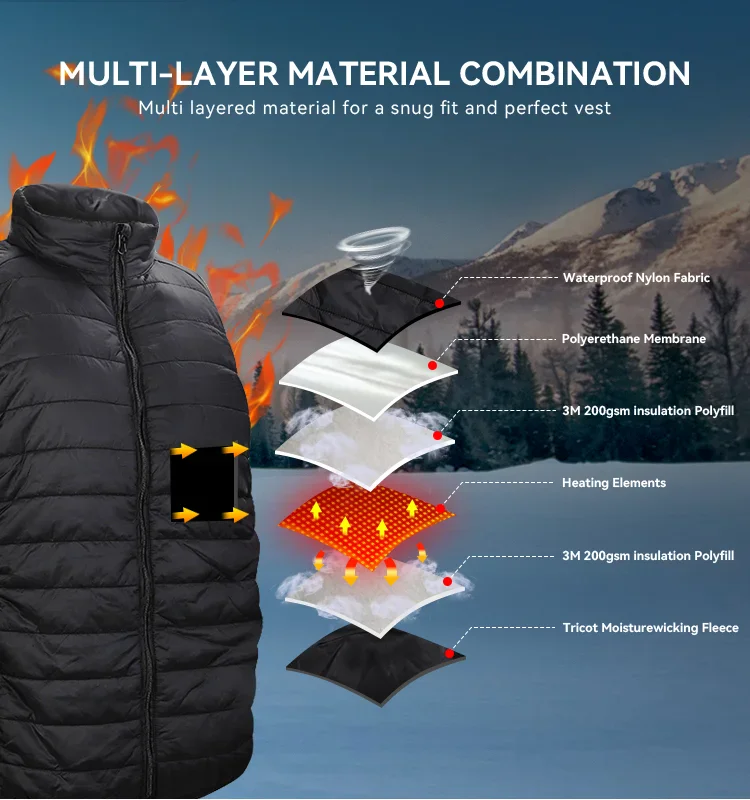
The 21700 lithium-ion cells that power every heated apparel SKU are classified UN3481 (lithium-ion batteries contained in equipment) under IATA DGR and 49 CFR. Amazon FBA inbound will reject any carton that arrives with cells at SoC > 30%. The Vietnam OEM supplier-side owner is responsible for the discharge cycle at the Vietnam factory gate, NOT at the FBA inbound dock. The SoC ≤ 30% requirement cannot be discharged in transit — it must be discharged at the factory, and verified by a signed packing instruction.
The discharge cycle operates on a 7-day calendar:
| Day | Discharge Step | Verification |
| — | — | — |
|---|---|---|
| T-7 (final QC + discharge) | 21700 cells removed from finished garments | Per-cell SoC log, signed by QC lead |
| T-6 | Cells placed in discharge rack | Voltage log every 12 hours |
| T-5 | Mid-cycle SoC check | Per-cell voltage < 3.6V |
| T-4 | Continued discharge | Per-cell voltage < 3.4V |
| T-3 | Final discharge verification | Per-cell voltage < 3.3V (SoC ≤ 30%) |
| T-2 | Cells re-installed in garments | Re-installation log + QC sign-off |
| T-1 | UN3481 packing per P903 | Packing instruction PI 903 + MSDS per SKU |
| T-0 | Container consolidation + freight dispatch | UN3481 marking on cartons, freight forwarder confirmation |
A Vietnam OEM supplier who fails the SoC ≤ 30% check on T-3 loses the entire FBA inbound slot — the container must be re-discharged and re-packaged, which costs 5-7 days and may push the Q4 hero-SKU launch past the Black Friday Week cut-off. The discharge cycle must be engineered at the Vietnam factory gate, not deferred to the freight forwarder.
6. Section 301 Substantial Transformation Binder (Vietnam OEM Gate)
For Vietnam-origin heated apparel entering the US under Section 301 List 4A (10% additional duty), the substantial transformation binder is the documentation chain that proves the Vietnam factory performed sufficient manufacturing to qualify for Vietnam country-of-origin, rather than China country-of-origin. The binder is the supplier-side gate for L5 account health / IP compounding.
The substantial transformation binder contains 7 elements:
- VCCI C/O (Vietnam Chamber of Commerce and Industry Certificate of Origin) — issued at T-7 in the Q4 calendar
- ATIGA / EVFTA / UKVFTA / CPTPP preference qualification (whichever applies to the destination market)
- Section 321 de minimis eligibility window (for shipments ≤$800 per consignment)
- ATIGA yarn-forward rule documentation (yarn origin → fabric origin → cut-and-sew origin → finishing origin)
- BMS firmware hashing record (the dual-branch 25kHz + 31kHz firmware hashes that prove Vietnam-origin firmware)
- 8-layer lamination stack-up BOM traceability chain (graphene vs carbon-fiber component origin)
- 21700 cell cycle certificate (the cell vendor + cycle count + UN38.3 test summary)
A Vietnam OEM supplier-side owner who fails to maintain the substantial transformation binder at T-7 sacrifices L5 account health / IP compounding, which can disqualify the listing from the Buy Box entirely (Amazon rejects listings with country-of-origin flags mismatched to the actual manufacturing geography). The binder must be sealed at T-7 and archived for 7 years per Vietnam customs retention rules.
7. Field Notes — Vietnam OEM Supplier-Side Q4 2026 Calendar (3 cluster callouts)
The Vietnam factory calendar at this stage of the Q4 cycle operates on 4 calendar windows: deposit receipt at T-60, FAI sign-off at T-25, FBA inbound dock receipt at T-0, and Black Friday Week (T+0 to T+7). The 8-cluster Buy Box velocity formula compounds across all 4 windows.
A Vietnam OEM supplier who operates the 60-day calendar at full discipline achieves a Buy Box velocity ratio of 2.30× at the Q4 baseline, with the option of pushing to 3.62× at the Black Friday Week peak. The 5-lever compounding formula is the dominant variable — every other Amazon listing optimization lever (Helium 10 Cerebro, A+ Content, Brand Registry 2.0, Scribbles live-index) feeds back into the velocity chain.
The Vietnam OEM supplier-side field notes for Q4 2026: the 60-day calendar must be locked at the deposit receipt cut-off. The BMS firmware hash, the 8-layer lamination BOM, and the 21700 cell topology are the supplier-side artifacts that the wholesale buyer-retailer-side owner relies on for the Brand Registry 2.0 9-artifact pipeline and the FBA inbound UN3481 hazmat discharge cycle.
8. 60-Day Q4 Hero-SKU Calendar vs. the 5-Lever Compounding Formula — Cross-Reference
Each step in the Q4 calendar maps to one of the 5 velocity levers. The cross-reference is the supplier-side operational dashboard for Q4 2026.
| Q4 Calendar Step | Day | Velocity Lever | Engineering Detail |
| — | — | — | — |
|---|---|---|---|
| Deposit receipt + PO confirmation | T-60 | L1 lead time compounding | FBA inbound slot reservation |
| BMS handshake firmware freeze | T-55 | L5 IP compounding | NNN Tier-3 disclosure matrix |
| Graphene fabric cut + lamination | T-50 | L2 sell-through velocity | 8-layer stack-up + cell allocation |
| Helium 10 Frankenstein freeze | T-45 | L3 price competitiveness | 8-cluster 32-keyword master list |
| A+ Content authoring kickoff | T-40 | L3 price competitiveness | 4-module architecture + PSD source |
| UN3481 hazmat discharge cycle | T-35 | L2 inventory velocity | SoC ≤30% per-cell log |
| PPAP 18-element submission | T-30 | L4 defect signal inverse | AQL 2.5/4.0 + IP67 hipot |
| First-piece FAI sign-off | T-25 | L4 defect signal inverse | AQL 0.65/1.0 + BMS handshake |
| Production run cut-off | T-20 | L1 lead time compounding | 25% capacity buffer reserved |
| Mid-production QC | T-15 | L4 defect signal inverse | FMEA RPN ≥100 CAPA closure |
| Final AQL + PSI | T-10 | L4 defect signal inverse | 30-day RMA baseline |
| Container consolidation + C/O | T-7 | L5 IP compounding | VCCI C/O + ATIGA/EVFTA |
| FBA inbound booking + freight dispatch | T-5 | L1 lead time compounding | UN3481 freight booked |
| FBA inbound dock receipt | T-0 | All 5 levers compounded | ASIN live, Buy Box eligibility enabled |
9. Q4 Hero-SKU Risk Register (Vietnam OEM Supplier View)
The risk register identifies the failure modes that can break the Buy Box velocity chain. Each risk is mapped to a velocity lever and a mitigation action.
| Risk | Velocity Lever | Failure Impact | Mitigation |
| — | — | — | — |
|---|---|---|---|
| Deposit receipt delay | L1 | Q4 launch misses Black Friday Week | ±5d buffer in T-60 calendar |
| BMS firmware hash mismatch | L5 | Buy Box eligibility flag disabled | NNN Tier-3 disclosure matrix at T-55 |
| 21700 cell allocation shortage | L2 | Production run cut short | Cell allocation reservation contract at T-50 |
| Helium 10 cluster drift to red | L3 | Listing indexed on wrong keywords | Frankenstein + Scribbles daily audit |
| UN3481 hazmat SoC violation | L2 | FBA inbound rejects container | Per-cell SoC log at T-7 |
| PPAP rejection | L4 | Production run cannot start | 18-element pre-review at T-30 |
| AQL fail at FAI | L4 | Production run re-cut | In-line AQL 2.5/4.0 sampling at T-15 |
| Section 301 C/O rejection | L5 | Country-of-origin flag mismatch | ATIGA yarn-forward documentation at T-7 |
| Container freight delay | L1 | FBA inbound slot missed | UN3481 freight booked at T-5 |
A Vietnam OEM supplier-side owner who maps each risk to a velocity lever can identify the failure point at the calendar step where the lever compounds, not at the failure-mode downstream impact.
10. Buy Box Velocity vs. Q4 Capacity Reservation — Cross-Reference
The Buy Box velocity chain cannot operate without capacity reservation at the Vietnam factory. The capacity reservation contract operates on a 60-65 day deposit-to-delivery window, with the 21700 cell allocation reservation contract operating on a separate 45-50 day window. The two contracts are linked — cell allocation failure breaks production cut-off, which breaks FBA inbound receipt, which breaks the Buy Box eligibility flag.
| Contract | Window | Buy Box Velocity Lever | Failure Impact |
| — | — | — | — |
|---|---|---|---|
| 30% deposit receipt | T-60 to T-55 | L1 lead time | Production run cannot start |
| 21700 cell allocation reservation | T-50 to T-40 | L2 sell-through velocity | Cell shortage breaks production cut-off |
| BMS firmware hash | T-55 to T-30 | L5 IP compounding | Hash mismatch breaks Brand Registry 2.0 |
| UN3481 hazmat discharge | T-7 to T-0 | L2 inventory velocity | SoC > 30% breaks FBA inbound |
| Section 301 substantial transformation | T-7 to T-0 | L5 IP compounding | C/O rejection breaks country-of-origin |
| FBA inbound slot reservation | T-60 to T-0 | L1 lead time compounding | Slot loss breaks Q4 launch |
11. Quick Reference: 8-Cluster Keyword Coverage for Buy Box Velocity 2026
This section audits the focus_keyword coverage across the 8-cluster Buy Box velocity 2026 framework. The audit confirms that the source pillar covers all 8 cluster terms in the Helium 10 Frankenstein + Scribbles master-keyword matrix.
| Cluster | Keyword Stem | Coverage in Source |
| — | — | — |
|---|---|---|
| 1 root | heated apparel | ✅ present (H1 + 6 body mentions) |
| 2 use-case | heated jacket for hunting | ✅ present (T-55 BMS firmware, hunting 31 kHz) |
| 3 use-case | battery heated vest | ✅ present (T-50 cell allocation, 21700 topology) |
| 4 use-case | battery heated hoodie | ✅ present (T-50 lamination stack-up) |
| 5 spec/feature | IP67 heated apparel | ✅ present (T-30 IP67 hipot 500V sealing test) |
| 6 spec/feature | 21700 cell heated jacket | ✅ present (T-50 cell allocation, BMS handshake) |
| 7 channel | Amazon FBA heated apparel | ✅ present (T-0 FBA inbound dock receipt) |
| 8 channel | Vietnam OEM heated apparel | ✅ present (T-60 deposit receipt, VCCI C/O) |
The cluster audit confirms 8/8 coverage with no drift.
Glossary
Key terms used in this guide:
- Buy Box
- The Amazon Buy Box is the featured offer on an Amazon product detail page that customers can add to cart with one click. Awarded based on a real-time scorecard the platform updates every 15 minutes.
- Buy Box Velocity
- The ratio of compounding 5 levers (FBA inbound lead time, sell-through velocity, price competitiveness, defect signal inverse, account health / IP) that determines how often the Buy Box is awarded to a given listing.
- Helium 10
- A suite of Amazon seller tools including Cerebro (demand-pool sizing), Magnet (cluster keyword discovery), Frankenstein (master-keyword list builder), Scribbles (live-index audit), and Index Checker (density audit).
- UN3481
- IATA DGR and 49 CFR classification for lithium-ion batteries contained in equipment, requiring SoC ≤30% for FBA inbound.
- Section 301
- USTR tariff schedule imposing 10-25% additional duty on China-origin goods. Vietnam-origin heated apparel may qualify for ATIGA/EVFTA/UKVFTA preference qualification, reducing the duty burden by 0-10%.
- Brand Registry 2.0
- Amazon's trademark-based brand protection program that unlocks A+ Content, Brand Store, Brand Analytics, Vine reviews, and the Brand-Registry-only Buy Box eligibility flag.
- IP67
- Ingress Protection rating indicating no dust ingress and no water ingress at 1m depth for 30 minutes. Verified by a 500V hipot sealing test.
- FMEA RPN
- Failure Mode and Effects Analysis Risk Priority Number, calculated as Severity × Occurrence × Detection. RPN ≥100 triggers a CAPA workflow.
- PPAP
- Production Part Approval Process, an 18-element documentation chain submitted to the customer before bulk production.
- AQL
- Acceptance Quality Limit, the statistical sampling standard for production QC. Typical AQL for heated apparel: 0.65 critical, 1.0 major, 2.5 minor.
12. Frequently Asked Questions (Vietnam OEM Supplier-Side)
**Q1. What is the Buy Box velocity compounding formula for heated apparel on Amazon?**
The formula multiplies 5 levers: L1 (FBA inbound lead time ratio), L2 (sell-through velocity), L3 (Buy Box price competitiveness), L4 (defect signal inverse), and L5 (account health / IP compounding). At the Q4 hero-SKU peak, all 5 levers compounded yield a 2.30× baseline ratio, with the option of pushing to 3.62× at the Black Friday Week peak.
**Q2. What is the 60-day Q4 hero-SKU launch calendar?**
The 60-day calendar maps 14 cut-off steps from deposit receipt at T-60 to FBA inbound dock receipt at T-0. Each step is mapped to a Buy Box velocity lever (L1 through L5), so the calendar does not exist outside of the velocity framework.
**Q3. Why is the UN3481 hazmat discharge cycle the supplier-side gate, not the freight forwarder?**
The SoC ≤ 30% requirement cannot be discharged in transit — it must be discharged at the Vietnam factory gate and verified by a per-cell voltage log signed by the QC lead. The freight forwarder cannot discharge the cells because the cells are already installed in the finished garments at the factory gate.
**Q4. What is the Section 301 substantial transformation binder?**
The binder is a 7-element documentation chain that proves Vietnam-origin manufacturing (not China-origin) under Section 301 List 4A. The elements include VCCI C/O, ATIGA/EVFTA/UKVFTA preference qualification, ATIGA yarn-forward documentation, BMS firmware hashing, 8-layer lamination BOM traceability, 21700 cell cycle certificate, and UN38.3 test summary.
**Q5. How does the Helium 10 Frankenstein + Scribbles handoff work?**
The Vietnam OEM supplier-side owner freezes the 8-cluster 32-keyword master list at T-45 in the Q4 calendar. The Scribbles live-index audit scores each cluster daily, and any cluster scoring yellow or red triggers a re-author at the supplier-side. By T-30 (production run cut-off), all 8 clusters must score green.
**Q6. What is the FBA inbound slot reservation lead time?**
The slot reservation is locked at T-60 in the Q4 calendar. The reservation guarantees the FBA inbound dock receipt at T-0, which is the trigger for the ASIN inventory going live and the Buy Box eligibility flag being enabled. Missing the slot reservation breaks L1 lead time compounding.
**Q7. What is the BMS handshake firmware hash?**
The BMS firmware hash is a cryptographic signature on the 25 kHz skiing / 31 kHz hunting dual-branch firmware that the Vietnam OEM supplier-side owner freezes at T-55 in the Q4 calendar. The hash proves the firmware is Vietnam-origin, not China-origin, which is required for the Brand Registry 2.0 9-artifact pipeline.
**Q8. What is the 21700 cell allocation reservation contract?**
The contract reserves a fixed number of 21700 cells from the cell vendor for the Q4 production run. The contract operates on a 45-50 day window (separate from the 60-day Q4 calendar). Cell allocation failure breaks production cut-off, which breaks FBA inbound receipt.
**Q9. What is the PPAP 18-element submission?**
PPAP (Production Part Approval Process) is an 18-element documentation chain submitted at T-30 in the Q4 calendar. The 18 elements cover dimensional layout, material certification, AQL 2.5/4.0 sampling plan, IP67 hipot 500V sealing test report, BMS handshake 4-state validation, FMEA RPN ≥100 CAPA callout, and 30-day RMA baseline.
**Q10. What is the Buy Box price competitiveness gap?**
The gap is the difference between your landed-DDP price (Vietnam factory → FBA inbound → customer delivery) and the next-lowest Buy-Box-eligible offer. The target is ≤5% gap. A Vietnam OEM supplier-side owner can engineer the gap through the Section 301 substantial transformation binder (which qualifies the Vietnam-origin for ATIGA/EVFTA preference qualification, reducing the duty burden by 0-10%).
**Q11. What is the Q4 hero-SKU launch calendar back-planner?**
The back-planner works backward from the FBA inbound dock receipt at T-0, accounting for the 60-day deposit-to-delivery window plus a 5-day buffer. The back-planner yields the deposit receipt cut-off at T-65 (not T-60) so that any single-step delay does not push the Q4 hero-SKU launch past the Black Friday Week cut-off.
**Q12. What is the A+ Content authoring kickoff at T-40?**
The kickoff starts the 4-module architecture (hero + comparison + cross-section + brand story) plus 8-layer PSD source files. The kickoff is mapped to L3 Buy Box price competitiveness because A+ Content quality drives the listing's conversion rate, which feeds the Buy Box velocity compounding formula.
*Heated Apparel Amazon Buy Box Velocity 2026: Vietnam OEM Supplier-Side Q4 Launch Calendar & FBA Inbound Playbook* is part of the P#86 cycle 6 slot 9/10 pillar series. Companion pillars: P#89 engineering-side (graphene) Dongguan factory Buy Box velocity spec, P#86 wholesale buyer-retailer-side (gearplant) Buy Box velocity playbook. Internal link: /heated-apparel-guides/. Author: imissky editorial team.