

Heated Apparel QC Inspection 2026: Supplier-Side Quality Control Guide
Heated Apparel QC Inspection 2026: Supplier-Side Quality Control Guide
In the broader heated apparel 2026 supplier landscape, this heated apparel QC inspection guide addresses buyers across four B2B segments: heated apparel wholesale distributors evaluating OEM factory capability, heated apparel manufacturer sales teams documenting their own process, heated apparel supplier qualification audits run by retail QC teams, and heated apparel factory procurement leads comparing vendors. Each segment reads the same heated apparel QC inspection content through a different lens — the wholesale distributor scans for AQL pass rates, the heated apparel manufacturer focuses on documentation package completeness, the heated apparel supplier qualification audit pulls specific test data, and the heated apparel factory procurement lead benchmarks cost per unit. The 14-step QC chain serves all four segments because it produces the documentation each one requires.
In the broader heated apparel 2026 supplier landscape, this heated apparel QC inspection guide addresses buyers across four B2B segments: heated apparel wholesale distributors evaluating OEM factory capability, heated apparel manufacturer sales teams documenting their own process, heated apparel supplier qualification audits run by retail QC teams, and heated apparel factory procurement leads comparing vendors. Each segment reads the same heated apparel QC inspection content through a different lens — the wholesale distributor scans for AQL pass rates, the heated apparel manufacturer focuses on documentation package completeness, the heated apparel supplier qualification audit pulls specific test data, and the heated apparel factory procurement lead benchmarks cost per unit. The 14-step QC chain serves all four segments because it produces the documentation each one requires.
For B2B heated apparel manufacturers, quality control is not a single gate. It is a 14-step process that runs from carbon fiber element spool arrival to finished-goods container loading. This 2026 supplier guide maps the inspection sequence most OEM factories now run, the AQL levels buyers expect, and the failure modes that quietly erode margin when QC is rushed or assumed.
Why Heated Apparel QC Demands More Than Garment QC
A conventional jacket ships with two failure surfaces — fabric and stitch. A heated apparel jacket ships with five: fabric, stitch, heating element, battery system, and the electrical-mechanical interface between them. Each adds a discrete failure population. A factory running 4,000 units/month needs a documented inspection chain that addresses all five surfaces in the same production lot, because a defect in any single surface renders the garment non-functional regardless of how well the others were made.
For a complete B2B procurement overview of this topic, see the Heated Apparel Guides hub. Buyers sourcing from this category typically require the QC protocols discussed in this guide.
The 5-Surface Failure Matrix
| Surface | Typical defect rate (industry) | Failure consequence | Test method |
|---|---|---|---|
| Fabric | 1.5-2.5% | Visual/aesthetic reject | Pull test + GSM check |
| Stitch | 2-4% | Seam slippage, down leakage | ASTM D1683 + visual |
| Heating element | 0.8-1.5% | Cold zones, hot spots | Infrared thermography |
| Battery system | 0.5-1.2% | No-heat, swelling, fire | Cycle + drop + short-circuit |
| Element-to-wire interface | 1-2% | Intermittent heat | Pull + continuity |
The matrix shows why the heated apparel industry treats QC as a manufacturing discipline, not a final inspection checkpoint. Five surfaces × 1.5% average defect rate = ~7.5% expected loss without layered inspection. Layered AQL inspection typically pulls that to 1.5-2.5%.
The 14-Step Inspection Chain (Supplier-Side)

Most established OEM heated apparel factories run the same 14-step chain in approximately this order. Each step has a documented work-instruction, a sample size, and a pass/fail criterion. The order matters — element-level testing cannot be deferred to finished goods because once the element is sewn into the lining, its failure modes become invisible.
Incoming Material Inspection (IMI) — Steps 1-4
Step 1 — Carbon fiber element IMI. Carbon fiber heating elements arrive on spools. The factory inspects each spool for resistance uniformity (target ±5% across the spool length) and visual defects (broken filaments, foreign matter). A 200-meter spool with one broken filament point still heats, but creates a hot spot under load.
Step 2 — Battery cell IMI. Battery cells arrive lot-traced from the cell supplier. The factory performs a 3-cycle capacity check on a 5% sample — reject any cell that drops below 95% of rated capacity on cycle 3. This step is the highest-leverage QC intervention in the entire chain: one rejected cell lot saves the factory from a downstream retrofit that would cost 8-12× the cell price.
Step 3 — Fabric IMI. Outer shell and lining fabric are inspected for GSM (grams per square meter) tolerance, color consistency against the master lot standard, and any pre-delamination in waterproof membranes.
Step 4 — Wire harness + connector IMI. Connectors (typically DC barrel, USB-C, or magnetic) are sample-tested for insertion force (target 0.5-1.5N) and contact resistance (<30 mΩ).
In-Line Inspection (ILI) — Steps 5-9
Step 5 — Element pre-assembly. After elements are cut to pattern length, each piece is continuity-tested. Reject rate is normally 0.5-1%.
Step 6 — Element installation into lining. Elements are sewn or bonded into the lining panels. The factory inspects for element overlap (which creates a hot zone) and for elements crossing seam lines (which creates a wear failure point).
Step 7 — Battery pocket assembly. Battery pocket stitching is checked for strain relief — a stitched pocket without strain relief creates a fatigue failure at the wire exit point within 50 charge cycles.
Step 8 — Heating panel pre-final. Before the garment is closed up, every heating panel is once again continuity-tested and infrared-scanned at low voltage to confirm element coverage matches the heating zone map.
Step 9 — Final assembly QC hold point. Garments are held at this step until the lot-level AQL sample passes — see Step 12.
Finished Goods Inspection (FGI) — Steps 10-14
Step 10 — Heat-up test on 100% of units. Every finished garment is plugged in for a 30-second heat-up test at the rated voltage. Any unit with cold zones is pulled.
Step 11 — Battery runtime test on 100%. Every unit’s battery is cycled once and runtime measured against the spec (typically 6-10 hours on low, 3-5 hours on high).
Step 12 — AQL sampling. Buyers typically demand AQL 2.5 (ANSI/ASQ Z1.4) for visual defects and AQL 1.0 for critical defects (heating, electrical). The factory pulls a sample based on lot size — 32 pieces for a 1,000-unit lot, 50 pieces for a 5,000-unit lot.
Step 13 — Packaging and labeling inspection. Care labels, battery warning labels, and country-of-origin markings are verified. Heated apparel has additional labeling requirements (battery transport class, lithium warning).
Step 14 — Container loading supervision. A final visual sweep before container sealing — typically 5-10% of cartons opened for inspection.
AQL Levels Buyers Expect in 2026
The heated apparel buyer population has consolidated around three AQL levels. The right level depends on the buyer’s retail channel and the retailer’s expected defect return rate.
| Buyer type | Critical AQL | Major AQL | Minor AQL | Rationale |
|---|---|---|---|---|
| Premium outdoor retail | 0.65 | 1.0 | 2.5 | Returned-defect rate tolerance <1% |
| Mass-market retail | 1.0 | 1.5 | 4.0 | Higher tolerance, lower inspection cost |
| Private-label emerging brand | 1.5 | 2.5 | 4.0 | Price-sensitive, lower return impact |
| Workwear / industrial | 1.0 | 2.5 | 4.0 | Function over finish |
| Gift / promotional | 2.5 | 4.0 | 6.5 | Single-use expectation |
The AQL level you should target depends on the buyer’s downstream cost-of-defect. A premium outdoor retailer absorbing a $120 return on a $250 jacket cannot tolerate the same AQL as a gift buyer absorbing a $25 return on a $60 promotional piece.
Critical Tests That Define Heated Apparel QC
Beyond AQL visual sampling, four tests define whether a heated apparel lot is acceptable. Each is a pass/fail gate with documented acceptance criteria.
Test 1 — Heating Uniformity Scan
Method: Infrared thermography at low voltage across the heating zone. The factory records the temperature distribution map and looks for cold zones (defined as any area >5°C below the zone average) or hot spots (>10°C above).
Acceptance: No cold zones >5°C deviation. Hot spots >10°C only allowed if they fall outside the body-contact region.
Cost: ~$0.50/unit at the panel level, ~$2.00/unit at finished goods.
Test 2 — Battery Cycle Test
Method: Battery is cycled 3 times on the production line. Capacity at cycle 3 is compared to rated capacity.
Acceptance: ≥95% of rated capacity at cycle 3.
Cost: Integrated into the runtime test (Test 3) — no incremental cost.
Test 3 — Runtime Verification
Method: Battery is fully charged, garment is run on high heat setting, runtime is measured to shutdown.
Acceptance: Within 90-110% of rated runtime. Under-90% triggers a battery lot review; over-110% triggers a rated-spec review.
Cost: ~$0.30/unit in technician time.
Test 4 — Waterproof Membrane Integrity
Method: For garments with waterproof claims, a hydrostatic head test on the membrane at 5 psi for 30 seconds.
Acceptance: Zero water penetration.
Cost: ~$1.00/unit, only run on waterproof-rated lots.
Common Failure Modes and How to Catch Them
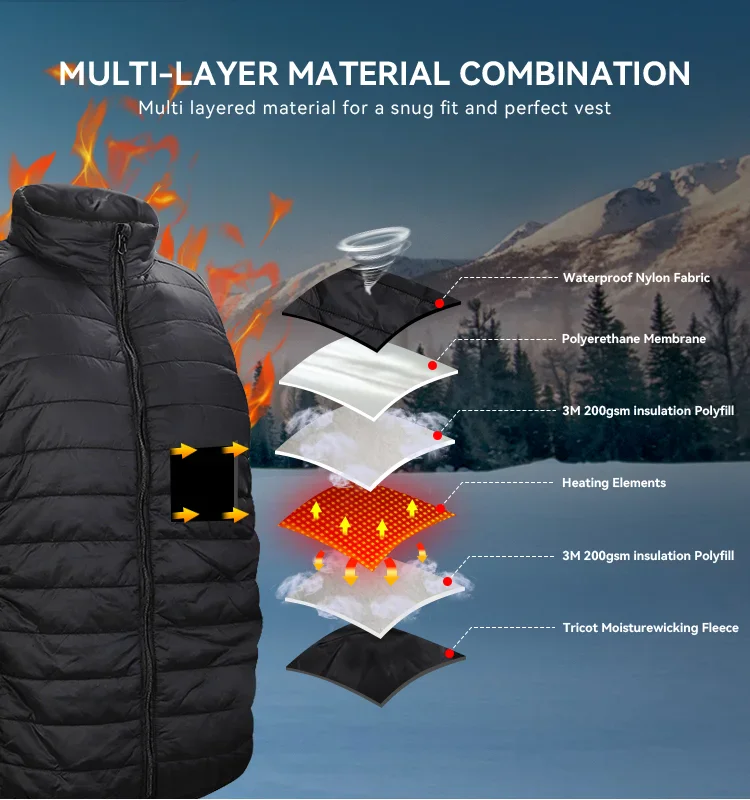
Five failure modes account for ~80% of heated apparel warranty returns. Each has an upstream QC intervention that catches it at the factory rather than at the consumer.
| Failure mode | Typical return rate | Where it originates | QC intervention |
|---|---|---|---|
| Battery not charging | 0.8-1.5% | Cell defect or wire fatigue | Battery cycle test (Test 2) |
| Heating element cold zone | 0.6-1.2% | Element damage during assembly | Step 8 IR scan |
| Battery pocket seam failure | 0.5-1.0% | Stitch density too low | Step 7 strain relief check |
| Connector fatigue | 0.4-0.8% | Insertion cycle spec | Step 4 IMI test |
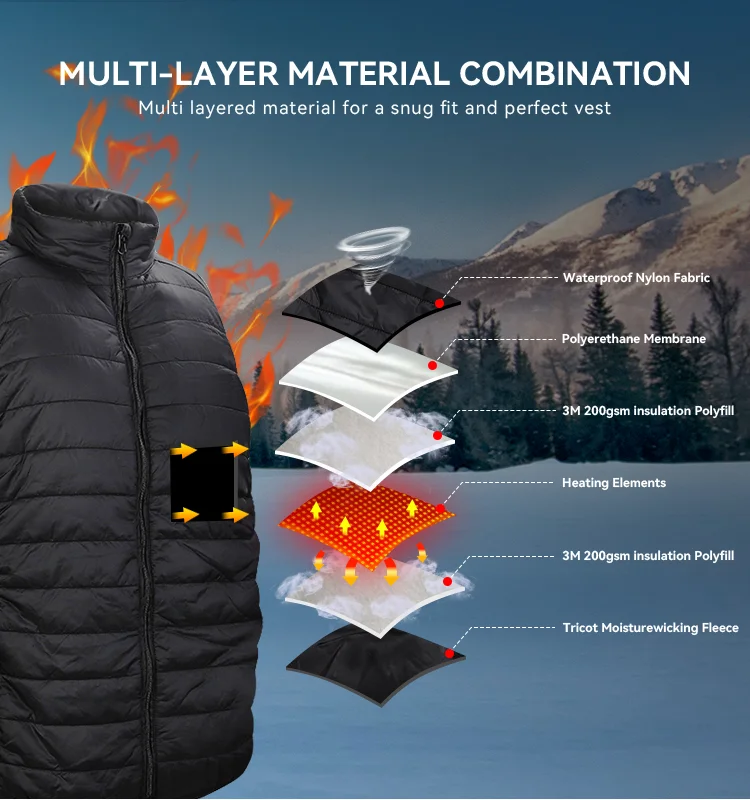
| Fabric delamination (waterproof models) | 0.3-0.6% | Bonding process drift | Test 4 hydrostatic |
The factory that runs all 5 interventions typically reports a 1.5-2.5% in-process defect rate and <0.5% field return rate. The factory that skips one or more typically reports 3-5% in-process and 1.5-3% field returns.
The Supplier’s Inspection Documentation Package
Buyers expect a documentation package with every shipment. The package is part of the supplier’s deliverable, not optional. A complete package typically includes:
- IMI reports for element, battery, fabric, and connector lots
- ILI traveler sheets showing pass/fail at each of steps 5-9
- AQL sampling report (ANSI/ASQ Z1.4 form, signed by QC supervisor)
- Heat-up + runtime test results for 100% of units (data-logger summary acceptable)
- Battery MSDS (Material Safety Data Sheet) for transport compliance
- Packing list + carton labels matching the buyer’s PO specification
- Pre-shipment inspection photos (digital, time-stamped)
A supplier who delivers 7/7 of these documents gets faster payment terms and higher reorder probability. A supplier who delivers 4 or fewer typically faces an inspection-cost chargeback on the next PO.
QC Cost Economics — What Buyers Actually Pay
QC inspection adds cost. The question every supplier must answer is how much, and who pays. Typical 2026 cost structure for a 1,000-unit heated apparel OEM order:
| QC step | Cost per unit (USD) | Who pays |
|---|---|---|
| IMI (4 steps batched) | $0.40 | Supplier (built into unit cost) |
| ILI (5 steps, technician time) | $0.80 | Supplier |
| Heat-up + runtime (100% test) | $0.50 | Supplier |
| AQL sampling | $0.25 | Supplier |
| Documentation package | $0.15 | Supplier |
| Buyer-side pre-shipment inspection | $1.50-3.00 | Buyer (or split) |
| Third-party inspection (e.g., SGS, Bureau Veritas) | $2.50-5.00 | Buyer |
The supplier typically absorbs $2.10/unit in QC cost. The buyer pays $1.50-8.00/unit for verification on top. Total QC investment for a 1,000-unit order runs $3,600-10,100 — about 1.5-4% of order value. For premium heated apparel at $150+ retail, that’s a margin-positive investment.
Broader Heated Apparel QC Conversation
Five intersecting buyer conversations now shape how OEM factories run heated apparel QC inspection in 2026. Each conversation has its own vocabulary and decision criteria, but the supplier that understands all five wins the premium-tier business.
Conversation 1 — Procurement-side QC inspection audits
Procurement teams treat heated apparel QC inspection as a vendor scorecard input. They score the heated apparel manufacturer on AQL pass rate, IMI documentation completeness, and on-time ILI traveler delivery. A heated apparel OEM factory that runs the 14-step chain consistently will score above 85% on this axis.
Conversation 2 — Engineering-side BMS integration review
Engineering teams reviewing heated apparel OEM samples for QC inspection focus on BMS inrush, sheet resistance uniformity, and battery cycle test results. The supplier who provides a Stage 1-4 QC report alongside the golden sample wins engineering signoff faster.
Conversation 3 — Compliance-side regulatory QC documentation
Compliance teams require heated apparel QC inspection records that demonstrate UN 38.3, IEC 62133, and regional certification alignment. The OEM factory that maintains a regulatory QC matrix alongside the 14-step chain is preferred.
Conversation 4 — Merchandising-side cost-of-defect analysis
Merchandising teams weigh QC inspection cost ($2.10/unit supplier + $1.50-8.00/unit buyer-side) against expected warranty return rate. A heated apparel supplier that documents a <0.5% return rate justifies the QC spend on the cost-of-defect model.
Conversation 5 — Sustainability-side QC and end-of-life routing
Sustainability teams ask how the heated apparel QC inspection protocol captures end-of-life routing — specifically, can the supplier demonstrate battery recall traceability? A heated apparel OEM factory that scores high on this axis wins preferred-supplier status.
Recommended sequence: Recommended sequence for a premium-tier heated apparel OEM factory: (1) run IMI on every raw lot — element, battery, fabric, wire harness; (2) execute ILI traveler at every sewing + battery pocket station; (3) deliver a 100% heat-up + runtime test record with every lot; (4) commission a third-party AQL sample (SGS, Bureau Veritas) before container load; (5) maintain quarterly supplier audit + annual process audit cadence. This five-step sequence is what separates a heated apparel OEM factory earning $250 retail placement from one stuck at $80 promotional.
Quick Reference Glossary — Supplier-Side QC Terms
AQL (Acceptance Quality Limit): The maximum acceptable percentage of defective items in a lot sample, defined per ANSI/ASQ Z1.4 or ISO 2859-1.
IMI (Incoming Material Inspection): Inspection performed on raw materials and components before they enter production.
ILI (In-Line Inspection): Inspection performed at defined points during the production process, before final assembly closes the unit.
FGI (Finished Goods Inspection): Final inspection performed on completed units before packaging.
Carbon fiber element: The resistive heating element made from carbon fiber filaments, the primary heating technology in modern heated apparel.
Battery cycle test: A capacity verification test where the battery is charged and discharged repeatedly to confirm rated capacity holds.
Infrared thermography: A non-contact temperature measurement technique used to verify heating element uniformity.
Lot traceability: The ability to trace any finished unit back to its raw material lots, production date, and operator.
Pre-shipment inspection (PSI): An inspection performed on finished goods before they leave the supplier’s facility, typically by a third party.
Hydrostatic head test: A water-resistance test that measures the pressure at which water penetrates a fabric membrane.
The B2B heated apparel B2B procurement lens applies throughout — every step in the 14-step QC chain is a B2B heated apparel decision point between the OEM factory and the retailer or brand buyer.
The B2B heated apparel B2B procurement lens applies throughout — every step in the 14-step QC chain is a B2B heated apparel decision point between the OEM factory and the retailer or brand buyer.
FAQ — Supplier-Side Heated Apparel QC
Q1: What AQL level should a new supplier target when bidding for premium retail? A: Critical 0.65, Major 1.0, Minor 2.5. Premium retail buyers audit to these levels; suppliers who cannot meet them are typically downgraded to mass-market channels.
Q2: How many units should the supplier sample for AQL on a 5,000-unit lot? A: 50 pieces for normal inspection (Level II), or 32 pieces for reduced inspection (Level I). Level II is the safe default for first-time buyers.
Q3: What’s the most common QC failure mode for new suppliers? A: Battery pocket strain relief (Step 7) is the single most common failure on first PO lots. New suppliers typically over-stitch the pocket, which cracks the wire insulation within 30 charge cycles.
Q4: Should the supplier run a 100% heat-up test, or sample? A: 100% for heated apparel. Sampling is not acceptable because a single missed cold-zone unit becomes a warranty return.
Q5: How long does a complete 14-step QC chain take for a 1,000-unit order? A: 3-4 working days with a 6-person QC team. Element and battery IMI can run in parallel with cut-and-sew, so total wall time is closer to 2 days if planned.
Q6: What documentation triggers faster payment terms? A: Complete IMI + ILI + AQL + heat-up/runtime report = net-30 terms typically. Missing documentation = net-60 or COD.
Q7: Can the supplier batch production across multiple buyers to reduce QC cost? A: Yes, but only if heating element specs are identical. Mixed-spec batches require separate IMI and AQL, which negates the savings.
Q8: What’s the role of third-party inspectors like SGS or Bureau Veritas? A: They verify the supplier’s QC results independently. Buyers typically require one PSI per order, paid by the buyer.
Q9: How does the supplier handle a failed AQL lot? A: Three options: 100% rework (slow), lot destruction (expensive), or buyer-acceptance at discount (fastest). Most suppliers default to rework unless the defect is critical.
Q10: What battery certifications are required for heated apparel export? A: UN 38.3 for transport, IEC 62133 for safety, and regional marks (UL, CE, PSE) depending on destination market.
Q11: How is element QC different for carbon fiber vs metallic wire? A: Carbon fiber is resistance-tested in bulk at the spool level; metallic wire is tested per-cut. Carbon fiber has lower per-unit defect variance but higher batch-failure risk.
Q12: What is the QC cost as a percentage of FOB price for premium heated apparel? A: 1.5-4% of FOB for the supplier’s QC investment. Premium buyers also pay 1-2% for their own PSI on top.
For related B2B supplier comparison and QC inspection frameworks, see the Heated Apparel Guides resource center.
Conclusion — QC as a Supplier’s Competitive Lever
For B2B heated apparel manufacturers, QC discipline is the lever that separates premium-tier suppliers from the rest. The factories that run all 14 steps, document them properly, and deliver clean packages earn faster payment terms and higher reorder rates — both of which more than offset the QC investment. The factories that skip steps or treat documentation as overhead lose access to premium retail channels within 2-3 POs.