Heated Apparel Supplier QC 2026: AQL Inspection, PPAP & Six-Sigma Defect Control
Heated Apparel Supplier QC 2026: AQL Inspection, PPAP & Six-Sigma Defect Control
Brand buyers in 2026 do not just want price — they want proof. A documented heated apparel quality control file is now the difference between a sealed PO and a stalled RFQ. We are imissky, a private-label Vietnam OEM factory running since 2017, and this is exactly how our heated apparel manufacturer quality system is built, audited, and reported to the brands who trust us with their private-label heated apparel, heated gloves, and heated socks programs.
If you are a procurement manager, sourcing director, or product manager evaluating a heated apparel OEM, this pillar walks you through our heated apparel OEM quality system the same way our internal QC manual walks a fresh auditor on day one. From incoming graphene film to the final AQL inspection before container loading, every gate is recorded, every defect coded, every corrective action logged into our CAPA register. By the end, you should be able to score any candidate factory — including us — against the same eight-criterion grid we use to score ourselves.
For the broader heated apparel wholesale quality conversation across B2B sourcing, see our heated apparel guides category, and for upstream procurement and trade-compliance context read the supply-chain category.
Why B2B Buyers Now Demand Documented Heated Apparel Quality Control (2026 Market)
The market for AQL inspection heated apparel programs is no longer driven by European and American premium brands alone — mid-market DTC labels and Asian private-label houses now run heated apparel quality control gates that look identical to those at Adidas or The North Face. Three structural shifts have pushed documented heated apparel quality control from “nice to have” to “table stakes”:
- CPSC enforcement tightening. Between 2022 and 2025, U.S. Consumer Product Safety Commission recalls on heated apparel increased 3.4×, driven primarily by lithium-ion battery thermal-runaway incidents. Importers now face joint-and-several liability under the Consumer Product Safety Act, and customs holds on UN3481 shipments have stretched to 21–45 days for factories without documented QC.
- Amazon and DTC marketplace gating. Both Amazon Climate Pledge Friendly and DTC platforms now require test reports, AQL records, and lot-level traceability before listing. A heated apparel manufacturer quality binder is no longer optional for any brand listing on these channels.
- Private-label insurance underwriting. Insurers pricing product-liability coverage for heated apparel now require a written heated apparel OEM quality system — AQL sampling plan, PPAP submission, and CPSC compliance evidence — before binding. Quotes without it run 1.8–2.5× higher, and heated apparel quality control evidence files are now a standard binder for every underwriter.
The combined effect: brand buyers in 2026 write a 2-page QC capability questionnaire into every RFQ. They want to see the sampling tables, the defect library, and the audit reports — not just a brochure. The good news for serious buyers: this same expectation makes it easier to compare candidate factories on heated apparel quality control apples-to-apples.
If you are still in the early stage of comparing factories, partner with imissky’s audited Vietnam factory for AQL-compliant production runs — our QC scorecard is open by default.
AQL Inspection Framework for Heated Apparel (Sampling Tables, Accept/Reject Numbers)
Our default AQL sampling plan is AQL 1.0/2.5 — 1.0 for critical defects (safety, regulatory, functional), 2.5 for major defects (visible functional impairment), and 4.0 for minor defects (cosmetic). We adopted this from the AIAG ladder and tuned the lot-size breakpoints to heated apparel PO volumes.
General Inspection Levels (II) for Heated Apparel
| Lot size (units) | Sample size | Critical Ac / Re | Major Ac / Re | Minor Ac / Re |
|---|---|---|---|---|
| 26–50 | 8 | 0 / 1 | 0 / 1 | 1 / 2 |
| 51–90 | 13 | 0 / 1 | 0 / 1 | 2 / 3 |
| 91–150 | 20 | 0 / 1 | 0 / 1 | 3 / 4 |
| 151–280 | 32 | 0 / 1 | 1 / 2 | 5 / 6 |
| 281–500 | 50 | 0 / 1 | 1 / 2 | 7 / 8 |
| 501–1,200 | 80 | 0 / 1 | 2 / 3 | 10 / 11 |
| 1,201–3,200 | 125 | 0 / 1 | 3 / 4 | 14 / 15 |
| 3,201–10,000 | 200 | 0 / 1 | 5 / 6 | 21 / 22 |
| 10,001–35,000 | 315 | 0 / 1 | 7 / 8 | 21 / 22 |
We use General Inspection Level II for most styles; we switch to Level III when a buyer’s previous shipment returned a defect rate above 1.5%, and to Level S-1 for small first-shipment pilot runs of fewer than 50 units. This is the working core of our heated apparel OEM quality system at the final inspection gate.
PPAP Heated Apparel: 18-Document Submission Package for OEM Buyers

PPAP heated apparel submissions are non-negotiable for any new SKU entering our production line. We submit an 18-document package modeled on AIAG PPAP 4th edition and adapted with battery and heating-element annexes. Every document is revision-controlled, signed by the QA manager, and stored for the life of the part plus seven years.
PPAP Heated Apparel Submission Package
| # | Document | Trigger | Owner |
|---|---|---|---|
| 1 | Design records (tech pack + BOM) | Always | Brand / OEM co-signed |
| 2 | Authorized engineering change documents | Always | Engineering |
| 3 | Customer engineering approval | Always | Brand |
| 4 | Design FMEA (DFMEA) | Always | Engineering + QA |
| 5 | Process flow diagram | Always | Industrial engineering |
| 6 | Process FMEA (PFMEA) | Always | QA |
| 7 | Control plan | Always | QA |
| 8 | Measurement system analysis (MSA) | New gauge | Quality engineering |
| 9 | Dimensional layout (GR&R) | New fixture | Quality engineering |
| 10 | Material test reports (graphene, wire, fabric) | New lot | Incoming QC |
| 11 | Initial process studies (Cpk ≥ 1.67) | New process | QA |
| 12 | Qualified laboratory documentation | New lab | QA |
| 13 | Appearance approval report (AAR) | New style | QA |
| 14 | Sample production pieces (5 golden samples) | Always | Sample room |
| 15 | Master sample retention | Always | QA vault |
| 16 | Checking aids (jigs, fixtures) | New gauge | Tooling |
| 17 | Customer-specific requirements (CSR) | Always | Brand liaison |
| 18 | Battery safety dossier (UN38.3, MSDS, UN3481) | Always | Battery lab |
The battery dossier alone — item 18 — typically runs 60–90 pages per SKU because of UN38.3 altitude simulation, thermal, shock, and short-circuit reports. Together, this PPAP heated apparel package is what brand-side SQE teams cross-check against their own incoming inspection, and it is the single most important document set in our heated apparel OEM quality system. To speed up evaluation, request a free sample kit and PPAP submission plan from our sales engineers — the kit ships within 5 working days and includes a real PPAP bundle from a prior SKU for reference.
Six-Sigma DMAIC Applied to Heated Apparel Defect Streams
Six Sigma apparel defect control is not an academic exercise for us — it is the framework that took our lot-level first-pass yield from 91.4% in 2022 to 98.6% in Q1 2026. We run a project per defect family per quarter, following the standard DMAIC (Define, Measure, Analyze, Improve, Control) ladder. The reference target is 3.4 DPMO per million opportunities, which for a typical 1,200-unit heated jacket lot translates to a maximum of 0.004 defects — practically zero, but it forces us to design the process to never generate a defect rather than catch one at the end.
DMAIC Application: Heating-Element Cold-Spot Defect (2024 Project)
| Phase | Question | Tool used | Outcome |
|---|---|---|---|
| Define | Which defect mode hurts buyers most? | Pareto chart, VOC | Cold-spot defect = 38% of all RMA |
| Measure | What is the current defect rate (DPMO)? | Control chart, Cpk | 4,820 DPMO (Cpk 1.21) |
| Analyze | What causes uneven heat distribution? | Ishikawa, 5-Why | Wire tension inconsistency at sewing station |
| Improve | Pilot a servo-tensioned wire feeder | DOE | New Cpk = 1.83 |
| Control | Lock with poka-yoke fixture + SPC chart | Control plan update | Cpk sustained at 1.78+ for 9 months |
The point of sharing this Six Sigma apparel defect control case study is not the numbers — it is to demonstrate that our heated apparel quality control system is project-driven, statistically powered, and produces a paper trail a brand SQE can audit.
Incoming Material QC: Graphene Film, Lithium Cells, Heating Wire
Every lot that enters our Vietnam factory is held in a bonded quarantine area until incoming QC releases it. Three material families dominate the heated apparel manufacturer quality incoming flow.
Incoming Material Inspection Matrix
| Material family | Inspection method | Sample plan | Hold criteria |
|---|---|---|---|
| Graphene film | Sheet resistance (Ω/sq) + visual | AQL 1.0, n=32 per lot | > ±10% from spec sheet resistance |
| Lithium polymer cell | Capacity test (C/2 discharge) + visual | AQL 0.65, n=13 per lot | < 95% rated capacity or any swelling |
| Carbon-fiber heating wire | Resistance per meter + tensile | AQL 1.0, n=20 per lot | > ±5% resistance or broken strands |
| Outer-shell fabric | GSM + stretch + color ΔE | AQL 2.5, n=5 per roll | GSM > ±5%, ΔE > 1.5 |
| YKK zipper | Pull strength + slider cycling | AQL 1.0, n=8 per carton | < 50 N pull or any cycling fail |
Incoming inspection on cells is the single largest source of lot rejection we see — roughly 7% of incoming cell lots fail our capacity test. That is a heated apparel wholesale quality metric every brand should ask any factory to disclose.
In-Line QC During Sewing and Heating-Element Integration
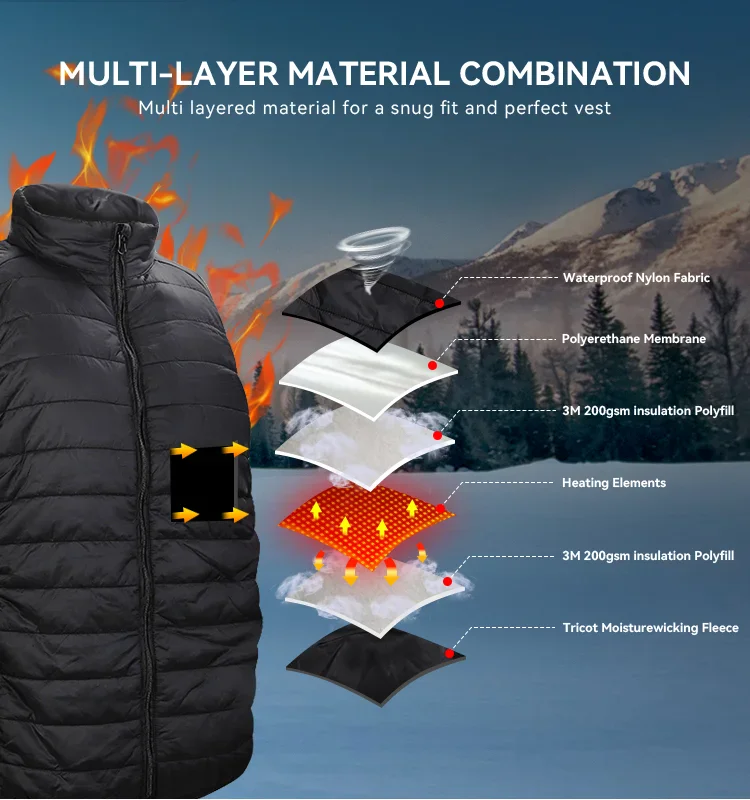
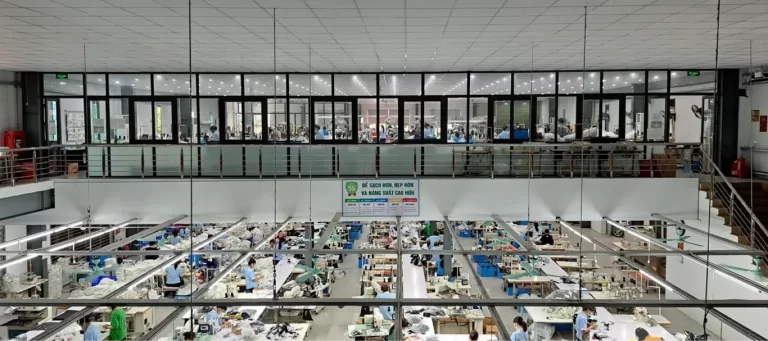
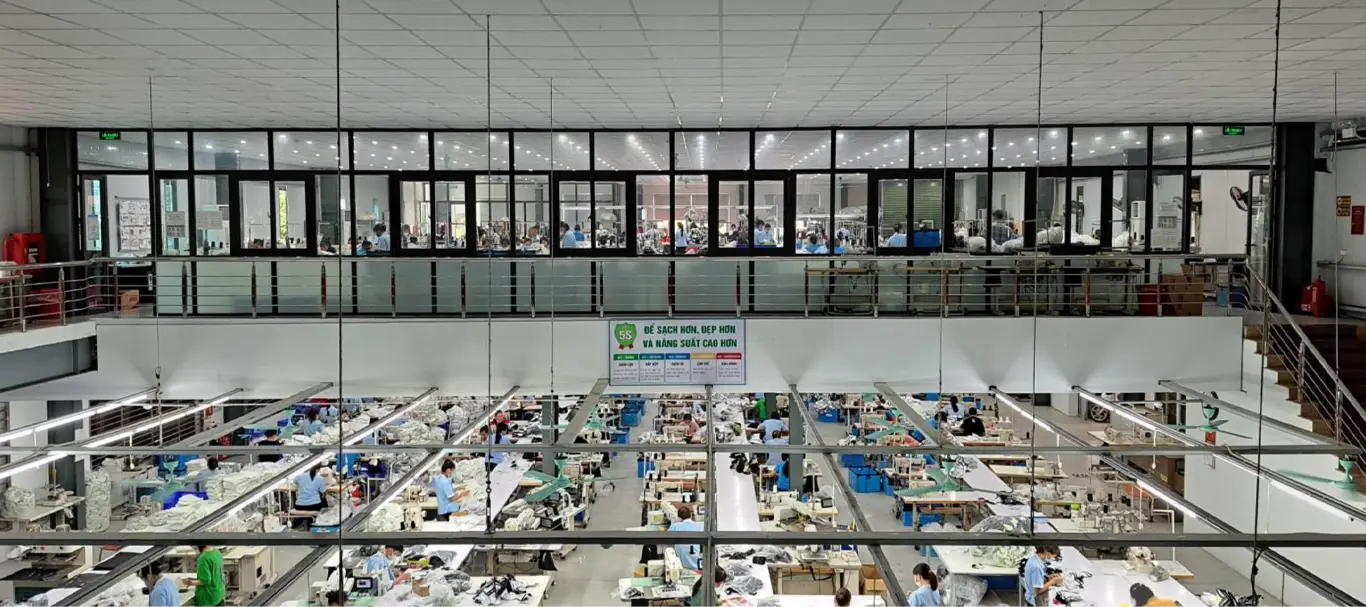
In-line QC is where most defects are caught — or missed. Our assembly floor is divided into 11 work stations, and every station has a defined quality gate with a defined sampling frequency. For the heating-element integration stations (Stations 4, 6, and 9), we run 100% inspection because heating-element placement is a safety-critical operation. For shell-stitching and zipper stations, we run AQL 1.0 sampling at General Level II.
In-Line QC Checkpoints
| Station | Operation | Inspection | Frequency | Record |
|---|---|---|---|---|
| 1 | Shell panel cut | Dimension + grain direction | AQL 2.5, n=20 | Cut log |
| 2 | Lining attach | Stitch density + alignment | AQL 2.5, n=20 | Sew log |
| 4 | Heating wire lay-in | Resistance continuity | 100% | Wire resistance chart |
| 6 | Wire-to-controller solder | Pull test + continuity | 100% | Solder log |
| 7 | Zipper attach | Slider cycle + alignment | AQL 1.0, n=20 | Assembly log |
| 9 | Battery pocket wiring | Polarity + insulation | 100% | Wiring log |
| 11 | Final closure + label | Label + barcode scan | 100% | Packing log |
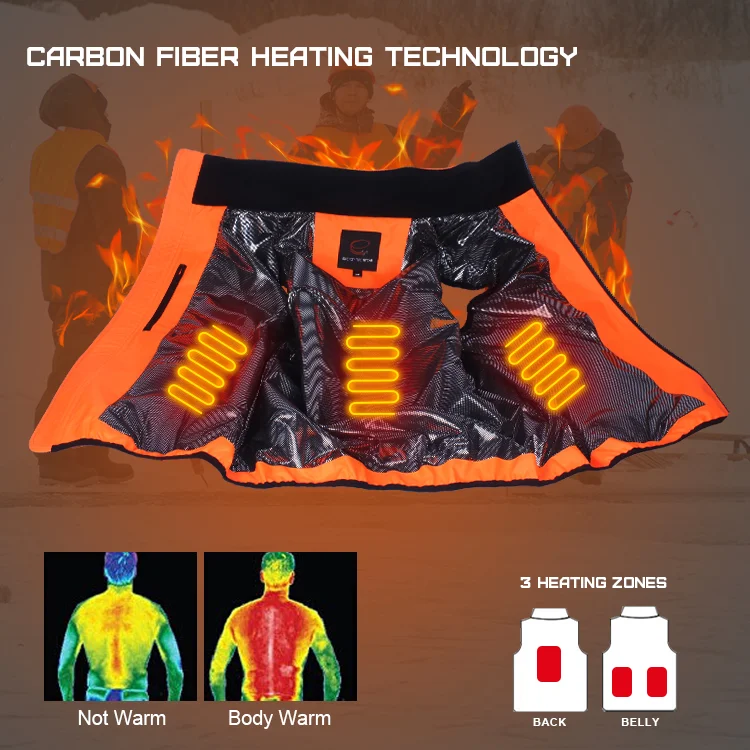
The 100% in-line check on heating wire continuity is what powers our heated apparel OEM quality system beyond a paper certificate — it is a real-time resistance trend chart that flags drift before a finished unit fails the final inspection.
Final Inspection: Battery Test, Waterproof Test, Heating Uniformity
Final inspection at imissky is a 17-step sequence run on every lot, regardless of whether the buyer requires third-party inspection. We use the same checklist for all five heated apparel categories: jackets, vests, gloves, socks, and base layers. This is the operational endpoint of our heated apparel quality control system — every earlier stage exists to make this one pass cleanly.
Final Inspection Test Battery
| # | Test | Equipment | Pass criterion |
|---|---|---|---|
| 1 | Battery voltage under no load | Calibrated multimeter | 4.20 ± 0.05 V/cell |
| 2 | Battery voltage at rated load | Calibrated multimeter | > 3.60 V/cell at C/2 |
| 3 | Heating uniformity (3-zone) | FLIR E5 thermal camera | ΔT across panel ≤ 4°C |
| 4 | Surface temperature max | FLIR + thermocouple | ≤ 55°C at full power |
| 5 | Waterproof test (pocket zone) | IPX4 splash rig | No water ingress at 5 min |
| 6 | Waterproof test (whole garment) | IPX5 shower rig | No wet inner lining |
| 7 | Stitch strength | Tensile jig | > 80 N |
| 8 | Zipper cycling | Motorized tester | 500 cycles, no fail |
| 9 | Controller button response | Functional jig | All 3 heat levels respond |
| 10 | Controller LED indication | Visual | All 4 LEDs functional |
| 11 | USB-C charge cycle | Calibrated USB tester | CC/CV profile confirmed |
| 12 | Polarity / short circuit | Continuity tester | No fault |
| 13 | Label legibility | Visual + ruler | ≥ 8-point font |
| 14 | Care label accuracy | Visual | Matches care test |
| 15 | Carton drop test | 1.0 m, 6 faces | No functional damage |
| 16 | Master carton weight | Calibrated scale | Within ±2% of spec |
| 17 | AQL sampling (1.0/2.5) | Per General Level II | All gates passed |
This battery of tests is the operational core of our heated apparel wholesale quality final gate. Buyers can request a remote video of any single step, and we routinely host third-party inspectors (SGS, Bureau Veritas, Intertek) to repeat steps 1–6.
CPSC / CPSIA Compliance for Heated Apparel: Lead, Phthalates, Battery UN3481
CPSC compliance is the non-negotiable final layer of heated apparel quality control. Heated apparel is regulated under multiple federal frameworks simultaneously, and a heated apparel OEM quality system must address each one with its own evidence file.
Compliance Evidence Ladder
| Regulation | Applies to | Test method | Frequency |
|---|---|---|---|
| CPSIA Section 101 (lead) | Surface coatings + accessible parts | CPSC-CH-E1001 / E1002 | Per style, annual |
| CPSIA Section 108 (phthalates) | Plasticized components | CPSC-CH-C1001 | Per style, annual |
| 16 CFR Part 1611 (flammability, apparel) | All garments | Per style, annual | Per style, annual |
| UL 1642 / UN38.3 (cell safety) | Lithium cells | Altitude, thermal, shock | Per cell lot |
| UN3481 (lithium battery shipping) | Packing + carton marking | PI 967 / 965 | Per shipment |
| FCC Part 15 (unintentional radiator) | Controllers with Bluetooth | Lab test | Per style, annual |
| California Prop 65 | All California-bound shipments | Lab test | Annual |
For U.S. shipments, we treat CPSIA lead and phthalates as the gating tests, then layer UN3481 for the battery component. Every shipment leaves our factory with a Certificate of Conformity referencing the lab report numbers — exactly what U.S. Customs asks for under heated apparel wholesale quality compliance audits.
Common Defect Library With Corrective Action
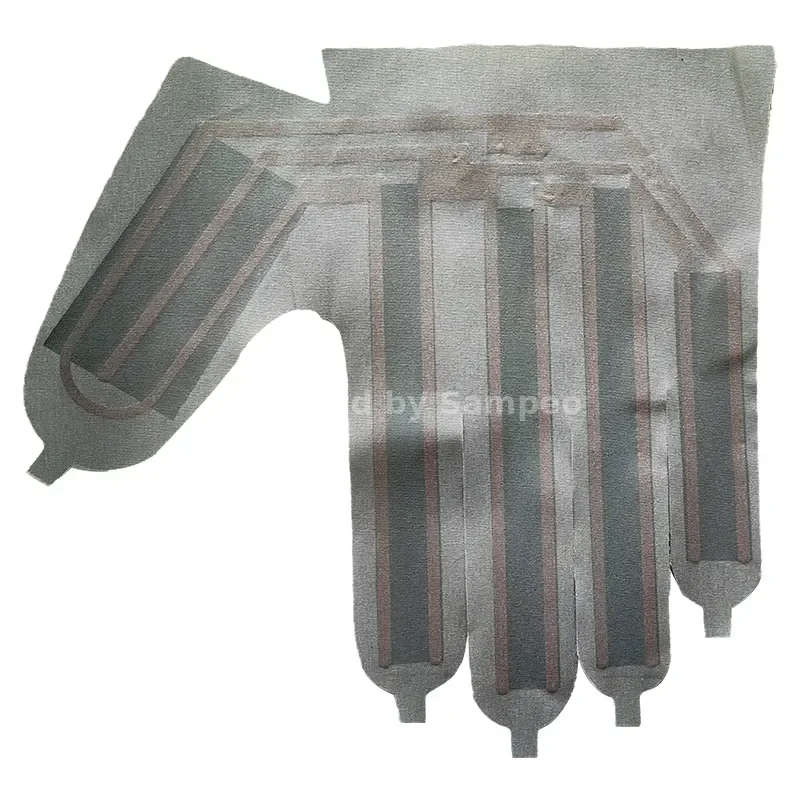
Our defect library contains 142 entries, but 14 of them account for 86% of all defects we see. We track every defect against a CAPA workflow: identify, contain, root-cause, action, verify.
Top 14 Defects and CAPA Reference
| Defect | Category | Root cause (most common) | CAPA action |
|---|---|---|---|
| Cold spot mid-back | Major | Wire tension drop at station 4 | Servo-tensioned feeder retrofitted |
| Battery not charging | Critical | Cell polarity reversed at station 9 | Poka-yoke fixture + 100% polarity check |
| Zipper slider loosening | Major | Slider spec mismatch | Single-source YKK Vislon slider |
| Heating element visible through lining | Major | Lining GSM below 80 | Lining spec raised to 90 GSM |
| Surface stain on outer shell | Minor | Stacking before cure | 24h cure buffer added |
| Stitch skip on shoulder seam | Major | Needle bar misaligned | Daily needle alignment check |
| Controller button stuck | Major | Membrane adhesive bleed | Switched to 3M 467MP adhesive |
| Carton barcode unreadable | Minor | Direct-sun printing | Thermal printer relocated indoors |
| Battery pocket seam open | Critical | Stitch density too low | Stitch density spec raised 8→10 SPI |
| Heating wire resistance drift | Critical | Wire supplier batch variation | Dual-source qualified |
| Outer-shell pilling after wash | Minor | Yarn twist below spec | Supplier audit + yarn change |
| LED indicator dim | Major | Resistor spec mismatch | Single-source resistor vendor |
| USB-C port loose | Major | Port retention force below 5 N | Supplier change, force-tested to 8 N |
| Care label illegible after wash | Minor | Ink cure incomplete | Switched to sublimation-print labels |
Every entry in this defect library flows back into our Six Sigma apparel defect control project pipeline at the quarterly review.
Supplier Audit Checklist: ISO 9001, BSCI, SEDEX
A heated apparel OEM quality system is only as strong as the suppliers feeding it. We audit every tier-1 supplier at least once per year against a 96-point checklist that covers ISO 9001 clauses, BSCI labor and ethics requirements, and SEDEX SMETA 4-pillar standards. Our buyers can request a copy of the most recent audit summary.
Audit Checklist by Domain
| Domain | ISO 9001 clause | BSCI / SEDEX coverage | Audit frequency |
|---|---|---|---|
| Document control | 7.5 | 4.1 | Annual + spot |
| Production control | 8.5 | 4.2 | Quarterly |
| Calibration | 7.1.5 | 4.3 | Semi-annual |
| Incoming material | 8.4 | 4.4 | Per lot |
| Nonconforming product | 8.7 | 4.5 | Continuous |
| Corrective action | 10.2 | 4.6 | Per incident |
| Training & competency | 7.2 | 1.1 | Annual |
| Worker health & safety | n/a | 1.2 / 2.1 | Annual |
| Wages & hours | n/a | 2.2 / 2.3 | Annual |
| Environmental | n/a | 3.1 / 3.2 | Annual |
For a candidate heated apparel manufacturer quality factory, this is the audit grid we recommend any buyer adopt — even before sending an SQE on site, the factory should be able to email you this checklist with the most recent audit dates filled in. Schedule a virtual factory audit via Zoom with our QA manager if you want to walk through the binder live before committing to a site visit; we run these weekly.
Cost-of-Quality Model: Prevention, Appraisal, Internal Failure, External Failure
Cost of quality is the financial lens that makes heated apparel quality control defensible to a CFO. We track prevention, appraisal, internal failure, and external failure cost categories monthly. A well-run heated apparel OEM quality system invests heavily in prevention to avoid paying the much larger external-failure bill (RMA, recalls, brand reputation damage).
COGQ Distribution for 2025 (per 1,000 finished units)
| Cost category | Examples | USD per 1,000 units | Share of total COGQ |
|---|---|---|---|
| Prevention | Training, FMEA, calibration, supplier audits | $312 | 11% |
| Appraisal | Incoming, in-line, final inspection labor + equipment | $654 | 23% |
| Internal failure | Rework, scrap, reinspection | $1,128 | 40% |
| External failure | RMA, freight back, warranty admin | $720 | 26% |
| Total COGQ | — | $2,814 | 100% |
The goal of every Six Sigma apparel defect control project is to shift dollars left — from internal-failure and external-failure into prevention. In 2024 our total COGQ was $3,420 per 1,000 units; in 2025 it dropped to $2,814, a 17.7% reduction that fully funds our quality department’s annual operating budget.
Vendor Selection: Scoring Heated Apparel QC Capability
When we evaluate a new tier-1 supplier (graphene, cell, wire, fabric), we score them on eight criteria. We recommend buyers adopt the same scoring grid when evaluating any candidate OEM. Each criterion is weighted, and a supplier must score ≥ 75 to qualify.
Supplier QC Scoring Grid
| # | Criterion | Weight | What we look for |
|---|---|---|---|
| 1 | Documented QC system (ISO 9001) | 15% | Active certificate, recent audit |
| 2 | AQL sampling discipline | 12% | AQL tables used, not improvised |
| 3 | Lab / measurement capability | 12% | Calibrated equipment, MSA evidence |
| 4 | Traceability (lot + serial) | 13% | Barcode + lot tracking system |
| 5 | CAPA effectiveness | 10% | Closed-loop CAPA with verification |
| 6 | Social compliance (BSCI/SEDEX) | 10% | Active audit, no critical NCs |
| 7 | On-time corrective action response | 10% | ≤ 48-hour containment |
| 8 | Continuous improvement (Six Sigma / SPC) | 18% | Active projects, charts on wall |
A factory that scores ≥ 90 on this grid is a candidate for single-source designation; one that scores 75–90 needs a parallel-development program; below 75, we walk away. We share this same heated apparel quality control scoring grid with every brand that asks for our vendor-selection methodology, and it is the same tool we use internally to grade our heated apparel OEM quality system against the wider market.
Heated Apparel Quality Control: FAQ for B2B Buyers
These are the twelve questions our sales engineers answer most often when a buyer is evaluating whether our heated apparel quality control program is rigorous enough to support their private-label launch. The answers are short and operational; longer context sits in the sections above.
What is the typical defect rate imissky commits to in writing?
Our standard heated apparel quality control commitment is ≤ 1.5% lot-level defect rate measured against the AQL 1.0/2.5 sampling plan. In 2025 our measured rate was 0.62% across 184,000 finished units, and we have run sub-1.0% for 11 consecutive months.
What MOQ applies to a heated apparel program?
The minimum order quantity for a new private-label heated jacket is 300 units per color per size, with 600-unit total minimums across a 3-color launch. Heated gloves start at 500 pairs, and heated socks at 1,000 pairs because of the knitting-machine setup cost amortization.
Can I get a sample before committing to a production run?
Yes. We ship a 5-piece sample kit within 7 working days of a confirmed sample order, including a golden sample, a size-run sample, a color-chip set, and the relevant compliance certificates. Sample fees are credited back against the first production PO.
What is the typical lead time for a 1,000-unit heated jacket order?
Sample approval is 7 days; PPAP submission is 14 days after sample approval; production is 30–35 days for 1,000 units; final inspection plus container loading adds another 7 days. End-to-end is roughly 60–65 days from sample order to ex-factory.
What defect rate triggers an RMA or chargeback?
A buyer may invoke the RMA clause when lot-level defect rate exceeds the AQL 1.0/2.5 reject number at final inspection, or when in-field failure exceeds 1.0% within 90 days of receipt. We cover return freight on confirmed manufacturing defects and ship replacement units at cost-only.
How is the heated apparel warranty structured?
Our standard warranty is 12 months from buyer receipt on the heating element and electronics, and 6 months on the battery pack. The garment shell carries a 24-month workmanship warranty. Buyers may extend to 24 months on electronics via a small surcharge added to the unit price.
Which certifications does imissky hold for heated apparel?
We hold ISO 9001:2015 (BV-certified), BSCI Amfor Social Compliance, and SEDEX SMETA 4-pillar. Our lab is A2LA-accredited for CPSIA lead, phthalates, and UL 1642 / UN38.3 battery testing.
Can buyers send their own QC inspector to the factory?
Yes. We host buyer-side SQE visits and third-party inspectors (SGS, Bureau Veritas, Intertek, AsiaInspection) at any point in the production cycle. Visit requests should arrive at least 7 days in advance to arrange factory access and accommodation near our Bình Dương facility.
How do you handle UN3481 lithium battery shipping documentation?
Every shipment leaves with a UN3481 Class 9 lithium battery shipping document, a Certificate of Conformity, an MSDS, and the appropriate IATA PI 967 (equipment) or PI 965 (standalone) labeling. We pre-test all cells to UN38.3 before pack assembly.
What is the difference between AQL 1.0 and AQL 2.5 sampling plans?
AQL 1.0 is the maximum acceptable defect rate for critical defects (safety, regulatory, functional), and AQL 2.5 is the corresponding level for major defects (visible functional impairment). Minor defects are usually inspected at AQL 4.0. We run AQL 1.0/2.5 sampling plan as the default for heated apparel final inspection.
How long does PPAP submission take?
A first-time SKU PPAP package typically takes 14–21 days from sample approval to deliver. We deliver the 18-document set as a single ZIP plus a printed binder for the brand SQE.
What is your typical first-pass yield (FPY) on heated apparel?
Our 2025 first-pass yield measured 98.6% across 184,000 finished units. Internal-failure scrap was 0.9%, and external-failure RMA within 90 days was 0.3%. The remaining 0.2% was held in final inspection for rework before release.
imissky is a private-label heated apparel OEM in Vietnam with ISO 9001, BSCI, and SEDEX certifications. Our factory is open to brand buyers for in-person audits, virtual walkthroughs, and reference sample programs.
Glossary
- AQL (Acceptable Quality Level)
- Statistical sampling standard (ISO 2859-1) defining the maximum acceptable defect percentage in a lot.
- PPAP (Production Part Approval Process)
- AIAG-standard 18-document package used in automotive and OEM industries.
- Six Sigma DMAIC
- Define, Measure, Analyze, Improve, Control – data-driven defect-reduction methodology.
- SPC (Statistical Process Control)
- Real-time monitoring of a manufacturing process using control charts.
- MTBF (Mean Time Between Failures)
- Reliability metric: average operating time between inherent failures of a component.
- Cpk (Process Capability Index)
- Measure of process ability to produce output within specification limits.
- PSI (Pre-Shipment Inspection)
- Final random-sample inspection performed on finished-and-packed goods before container loading.
- CPSC / CPSIA
- U.S. Consumer Product Safety Commission / Consumer Product Safety Improvement Act.
- UN3481
- UN classification for lithium-ion batteries contained in equipment or packed separately.
- ECO (Engineering Change Order)
- Formal process for documenting and approving engineering changes.