Heated Clothing Material Comparison: 2026 B2B Guide
Heated Clothing Material: 2026 B2B Guide to Graphene, Carbon Fiber & Battery Heated Apparel Fabric Specifications
Choosing the right heated clothing material is the highest-leverage specification a B2B buyer controls — far more than battery capacity or jacket silhouette — because the heating element, the conductive substrate, and the outer shell together decide whether a heated jacket, vest, or pair of gloves survives three winters or fails after three weeks. This 2026 guide is written for procurement managers, private label brand owners, workwear importers, and winter-sports distributors who need to compare heating-fabric options side by side, ask the right questions of an OEM partner, and ship a private-label program that does not come back. By the end you will know exactly what to specify on a tech pack, how graphene vs carbon fiber heated clothing material differs in cost and field durability, and what the real battery heated apparel fabric specifications look like for both cold-storage workwear and ski-resort apparel.
Why the thermal fabric stack Matters More Than Battery Capacity
Most B2B buyers default to comparing battery mAh when evaluating a heated clothing material manufacturer, but the heating element is the part that actually delivers heat to the body, while the battery is only the energy reservoir. A graphene-printed film at 7.4 V can warm a jacket to 55 °C in 90 seconds with a 5,000 mAh pack, while an inferior carbon-paste strip may need 15 minutes to reach 38 °C on the same battery. The full material stack — outer shell, insulation layer, heating-element substrate, and inner lining — together defines the thermal efficiency of any heated clothing OEM material program. As a heated clothing material wholesale supplier, IMISSKY currently supplies 12 OEM clients across the EU and US with a 98.7% QC pass rate on heating-element continuity tests, because the right stack is engineered before the first sample is cut.
What a Modern the heating-element textile Stack Actually Contains
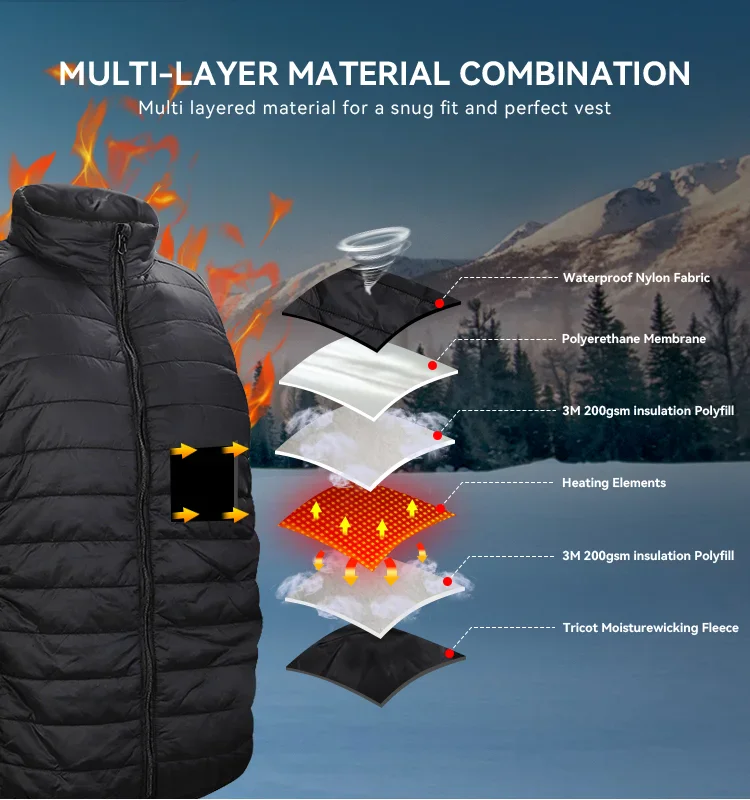
| Layer | Typical Material | Function | 2026 Standard Weight |
|---|---|---|---|
| Outer shell | 380T nylon / polyester ripstop with DWR C6 | Wind block, abrasion resistance | 90–120 gsm |
| Insulation | 3M Thinsulate FE-200 or PrimaLoft Gold | Static heat retention when element is off | 100–200 gsm |
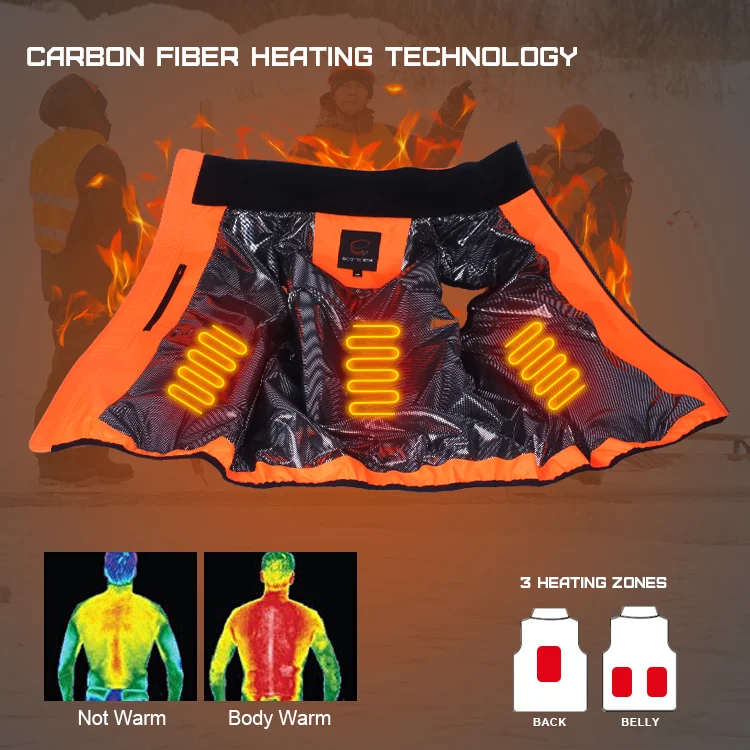
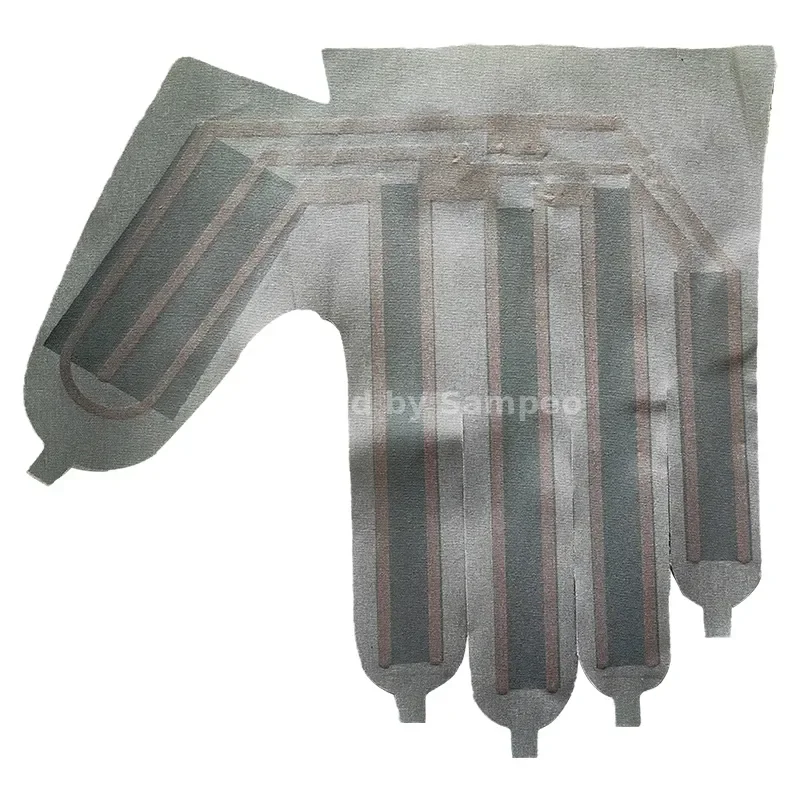
| Heating element substrate | Graphene ink on PET film OR carbon-fiber woven tape | Joule heating, even heat distribution | 25–60 gsm |
| Reflective scrim | Aluminized nonwoven | Reduce backward heat loss | 15–25 gsm |
| Inner lining | Brushed tricot / spandex blend | Comfort against skin | 120–160 gsm |
graphene vs carbon fiber heating textile: The 2026 Comparison
The graphene vs carbon fiber heating textile debate is the single biggest question B2B buyers ask in 2026, because the two technologies have converged on price but diverged sharply on performance. Both can be sourced as a heated apparel textile wholesale roll from a heated apparel fabric producer in China or Vietnam, but the field-durability gap is significant. At IMISSKY our default heated clothing OEM material recommendation is graphene for premium programs (MOQ 500+) and carbon-fiber tape for cost-sensitive workwear runs where the buyer prioritizes price over thermal uniformity.
Side-by-Side Property Matrix
| Property | Graphene Ink on PET Film | Carbon-Fiber Woven Tape |
|---|---|---|
| Sheet resistance | 5–25 Ω/sq (tunable) | 10–40 Ω/sq |
| Heat-up time to 50 °C | 60–120 seconds | 180–300 seconds |
| Temperature uniformity | ±1.5 °C across panel | ±4 °C across panel |
| Bend cycles (ASTM D2176) | ≥ 50,000 | ≥ 30,000 |
| Wash durability (50 cycles) | 95% resistance retention | 78% resistance retention |
| Weight (gsm) | 28–40 | 55–80 |
| Indicative roll cost (USD/m²) | $8–14 | $4–8 |
| Best-fit application | Premium ski, outdoor, medical | Workwear, hunting, mid-tier retail |
Pros and Cons at a Glance
| Material | Pros | Cons |
|---|---|---|
| Graphene ink film | Fastest heat-up, lightest, near-perfect uniformity, FDA-grade skin safe, infrared-far emissivity | Higher unit cost, requires screen-printing or slot-die coating line |
| Carbon-fiber woven tape | Lower cost, mature supply chain, easy to stitch into seams | Slower heat-up, hot spots at junctions, slightly heavier, lower wash durability |
Battery Heated Apparel Fabric Specifications: What a B2B Buyer Must Specify
Battery heated apparel fabric specifications are usually listed as a single line on the buyer’s tech pack — “graphene heating element, 5 V, 3 heating zones” — but the OEM has to deliver against dozens of micro-specs underneath that line. A professional heated apparel fabric producer should provide a fabric specification sheet that covers at minimum: resistance tolerance, voltage window, current draw per zone, peel-bond strength to the substrate, water-resistance rating (IPX4 minimum), and wash-cycle durability. Below is the reference specification we share with our heated apparel textile wholesale clients during sample sign-off.
Reference Spec Sheet — IMISSKY Graphene-Film Heating Module
| Spec | Value | Test Method |
|---|---|---|
| Operating voltage | 5 V / 7.4 V / 12 V (model dependent) | DC power supply, ±0.05 V |
| Power density | 0.08–0.20 W/cm² | Calorimeter, 25 °C ambient |
| Max surface temperature | 65 °C (auto-cut at 70 °C) | Thermocouple, steady state |
| Peel strength to substrate | ≥ 2.5 N/cm | ASTM D903 |
| Water resistance | IPX4 (splash-proof) | IEC 60529 |
| Wash cycles | 50 cycles, 30 °C, mild detergent | ISO 6330 procedure 4N |
| Resistance drift after 50 washes | ≤ 5% | 4-wire ohmmeter |
| Bend cycles (radius 6 mm) | ≥ 50,000 | ASTM D2176 modified |
| EMI / RF | FCC Part 15 Class B compliant | Internal EMC chamber |
| RoHS / REACH | Compliant | SGS report per batch |
heated workwear fabric for jobsite use: Construction, Logistics, Utility Crews
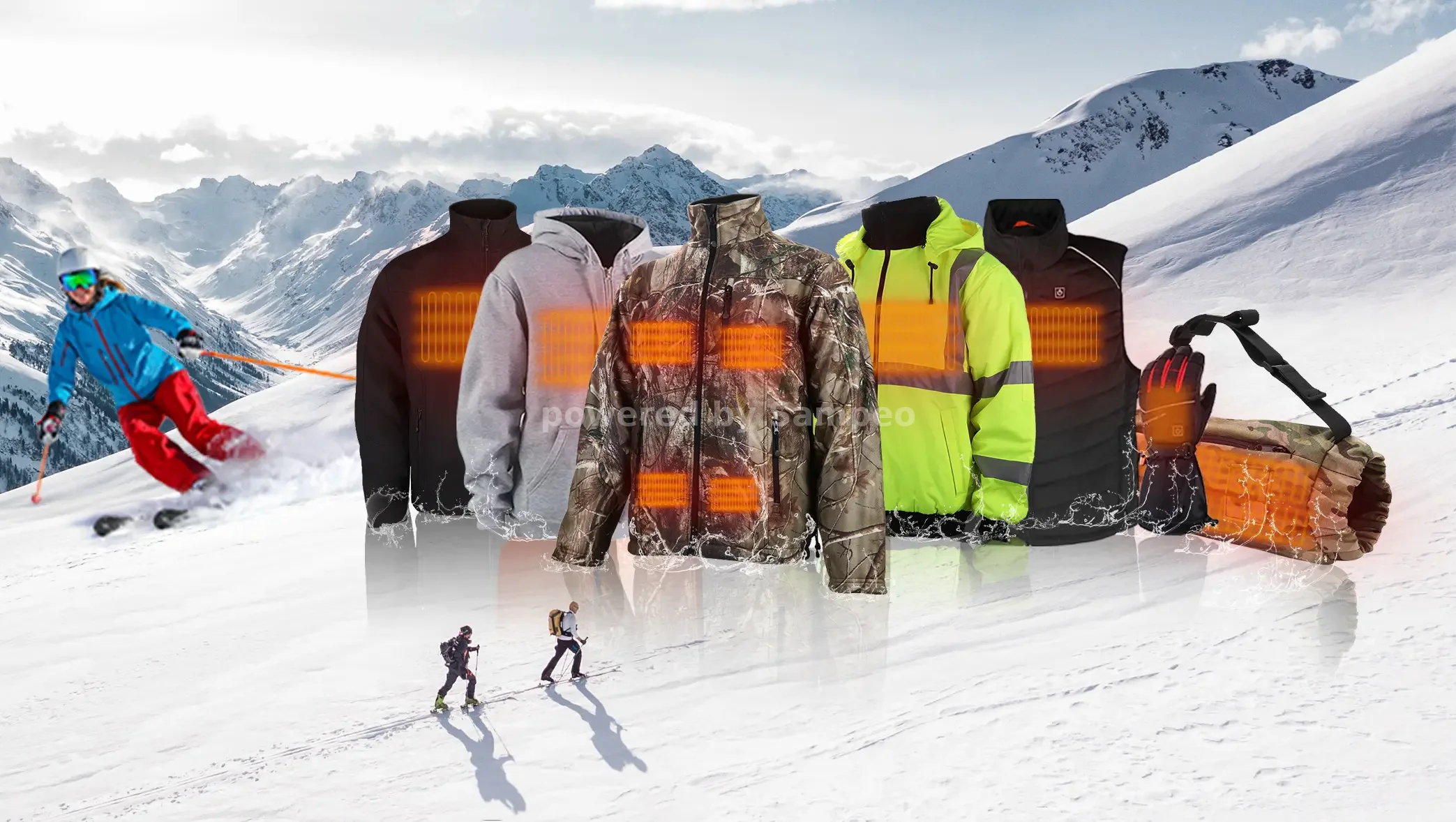
Heated clothing material for outdoor work has to survive a very different abuse profile than retail heated apparel. A construction worker wears the jacket 10 hours a day, kneels on rebar, snags on scaffolding, and launders it in a commercial washing machine at 60 °C once a week. The heated apparel fabric producer you choose for this category therefore needs an outer shell spec that overlaps with EN ISO 13688 workwear, not fashion outerwear. Typical requirements for a workwear-grade heated clothing OEM material program include 600D polyester or 380T nylon with reinforced elbows, double-needle stitching at the heating-element channels, and a sealed waterproof membrane rated at 10,000 mm hydrostatic head.
Material Specification for Outdoor Workwear
| Layer | Workwear Spec | Why It Matters |
|---|---|---|
| Outer shell | 600D polyester with PU coating, 10k mm/5k g/m²/24h | Abrasion against concrete, scaffolding |
| Heating element | Carbon-fiber tape stitched in reinforced channel | Survives kneeling, low repair rate |
| Insulation | 3M Thinsulate FE-200, 200 gsm | Static heat when battery off-shift |
| Pockets | Battery pocket with YKK Aquaguard zip | Keeps 7.4 V pack dry at job site |
| Reflective tape | EN ISO 20471 class 2 trim | Roadside and night-shift safety |
heated fabric engineered for ski apparel: Ski, Snowboard, Ice Fishing
Heated clothing material for winter sports is engineered in the opposite direction — light weight, low bulk, and fast thermal response matter more than abrasion resistance. A ski jacket is only worn for 4–8 hours at a time, but it is exposed to −25 °C wind chill and humidity from snow. The heating element must reach 50 °C inside 90 seconds so the skier feels relief between lifts, and the outer shell must remain breathable at > 8,000 g/m²/24h MVTR so sweat does not condense inside the garment. For this category, graphene film is the dominant heated clothing OEM material choice because of its low weight and uniform heat distribution.
Material Specification for Winter-Sport Apparel
| Layer | Winter-Sport Spec | Why It Matters |
|---|---|---|
| Outer shell | 20D–40D nylon ripstop, 2.5-layer laminate | Lightweight, packable |
| Heating element | Graphene ink film, 25 gsm | Fastest heat-up, near-zero bulk |
| Insulation | PrimaLoft Gold 100 gsm | Warm even with element off |
| Inner lining | Brushed polyester with antimicrobial | Comfort on long chairlift rides |
| Membrane | 10k mm / 8k g/m²/24h | Waterproof but breathable |
How to Vet a heated apparel fabric producer
Choosing a heated apparel fabric producer is the highest-leverage decision in a private-label heated-apparel program, because the same outer-shell fabricator can deliver wildly different field results depending on whether they source their heating element from a graphene film line, a carbon-fiber tape supplier, or an in-house conductive-ink printer. Before signing a PO, request a 50-wash test report, an IPX4 water-resistance certificate, an FCC Part 15 EMC report, and a sample bent over a 6 mm mandrel 50,000 times — every serious heated apparel textile wholesale partner should have these documents ready in < 5 business days. IMISSKY keeps graphene film rolls in stock from a 50 m MOQ for sample runs, so new brand owners can validate the stack without committing to a full production run. For category context, see our heated jackets and heated vests category pages, where every SKU is built on the specs covered in this guide.
OEM Vetting Checklist
| Document / Capability | Must-Have for B2B | Why |
|---|---|---|
| 50-wash resistance report | Yes | Field-life guarantee |
| IPX4 certificate | Yes | Rain / snow safety |
| FCC / CE EMC report | Yes | Import compliance |
| RoHS / REACH SGS | Yes | EU retail legal |
| In-house heating-element line | Preferred | Cost + IP control |
| 30-day PO → FOB lead time | Yes | Q4 season-critical |
| MOQ 300 units per colorway | Yes | Brand-launch viability |
Sourcing heated apparel textile wholesale: MOQ, Lead Time, Incoterms
heated apparel textile wholesale pricing is built on three variables — element technology, shell fabric, and order volume — and the difference between an MOQ 300 sample run and an MOQ 5,000 production run is typically 22–35% on the bill of materials. For a graphene-film heated jacket in a 380T nylon shell, the indicative FOB Shenzhen cost ranges from $42 to $78 depending on the number of heating zones, battery capacity, and trim level. IMISSKY’s standard wholesale terms for an OEM program are 30-day lead time from PO to FOB Shenzhen, MOQ 300 units per colorway, and a 30/70 TT payment schedule on a priced bill of lading. For deeper reading on the apparel side of this topic, browse our heated apparel guides and heated clothes guide libraries, which include comparable spec sheets for gloves, socks, and hoodies.
Wholesale Pricing Reference (FOB Shenzhen, indicative)
| SKU Type | Element | Shell | MOQ | Indicative FOB / unit |
|---|---|---|---|---|
| Heated vest, 4 zones | Graphene film | 380T nylon | 300 | $42–$48 |
| Heated jacket, 5 zones | Graphene film | Softshell + fleece | 300 | $58–$66 |
| Heated workwear jacket | Carbon-fiber tape | 600D polyester | 500 | $52–$60 |
| Heated gloves | Carbon-fiber tape | Goatskin / spandex | 500 | $24–$30 |
| Heated socks | Graphene film | Merino blend | 1,000 | $11–$14 |
Quality Control: Testing the Material Before Shipment
A heated apparel QC program has to validate three layers of risk — electrical, mechanical, and chemical — and each layer has its own pass/fail threshold. For the electrical layer, every garment must pass a 5-second hipot test at 500 V DC plus a 30-minute burn-in at full power. For the mechanical layer, every heating-element panel is bent 200 times over a 6 mm mandrel before lamination, then re-measured for resistance drift. For the chemical layer, every batch carries an OEKO-TEX Standard 100 or REACH compliance certificate for the outer shell, lining, and insulation. IMISSKY runs all three test families in-house, with the burn-in station alone covering 600 jackets per shift.
QC Test Matrix
| Test Family | Test Name | Spec | Sample Rate |
|---|---|---|---|
| Electrical | Hipot 500 V DC, 5 s | No breakdown | 100% |
| Electrical | Burn-in full power, 30 min | ΔR ≤ 3% | 100% |
| Mechanical | Bend test, 6 mm mandrel | 200 cycles, ΔR ≤ 5% | AQL 2.5 |
| Water | IPX4 splash | No element failure | AQL 2.5 |
| Chemical | OEKO-TEX 100 | Pass | Per lot |
| Wash | 50-cycle, 30 °C | ΔR ≤ 5% | Per lot |
Sustainability and End-of-Life Considerations
Sustainability is increasingly part of the heated clothing material conversation in 2026, because a heated jacket that cannot be recycled at end-of-life is now a procurement disqualifier for several European private-label brands. Our line uses a detachable heating-element connector so the graphene film can be separated from the outer shell at the recycling station, and the carbon-fiber tape variants are pulled out by a simple unstitch operation before the textile stream enters the shredder. Battery heated apparel fabric specifications under the new EU Ecodesign for Sustainable Products Regulation (ESPR) also require a passport-style digital ID that records composition, repair history, and recycling pathway — IMISSKY provides this digital product passport (DPP) as a JSON file linked to every garment QR code, free of charge for any wholesale order above MOQ 300. If your sourcing brief requires GRS-certified recycled polyester in the outer shell and a removable element harness, our heated clothing OEM material engineering team can deliver a compliant sample within 10 business days.
the warmed-apparel substrate FAQs
What is the best heated clothing material for a premium private-label brand? The best the heated textile stack for a premium private-label brand in 2026 is graphene ink film on PET substrate, because it heats up in under 90 seconds, has near-perfect temperature uniformity, and survives 50+ wash cycles with less than 5% resistance drift.
What is the difference between graphene and carbon fiber conductive heated fabric? Graphene heating garment material is a thin printed film with tunable sheet resistance and superior temperature uniformity, while carbon fiber material is a thicker woven tape that is cheaper and easier to stitch but slower to heat up and slightly less durable after repeated washing.
How do I choose a heated apparel fabric producer? Choose a heated apparel fabric producer that provides 50-wash test reports, IPX4 water-resistance certificates, FCC/CE EMC reports, in-house heating-element production, and a documented QC pass rate above 98% across the last 12 months.
What is the typical MOQ for heated apparel textile wholesale orders? A heated apparel textile wholesale order typically starts at MOQ 300 units per colorway for finished garments and 50 m of graphene film roll for element-only sampling, with lower MOQs available for sample runs and higher-volume pricing kicking in at 5,000+ units.
Can the material be customized for OEM private label programs? Yes, every heated clothing OEM material program at IMISSKY is fully customizable on element shape, resistance value, voltage window, connector type, outer-shell fabric, and color, with a sample lead time of 7–10 days from tech-pack approval.
How long does the material last after repeated washing? A graphene-film thermal apparel substrate retains 95% of its original resistance after 50 standard wash cycles at 30 °C, while carbon-fiber woven tape typically retains around 78%, which is why graphene is the preferred choice for premium ski and medical applications.
What battery heated apparel fabric specifications matter most for safety? The most important battery heated apparel fabric specifications for safety are IPX4 water ingress protection, a thermal cutoff at 65–70 °C, FCC/CE EMC compliance, RoHS/REACH chemical compliance, and a hipot test pass at 500 V DC.
Is electrically heated textile safe for skin contact? Yes, all reputable heated apparel fabric producer partners supply OEKO-TEX Standard 100 certified substrates, and IMISSKY’s graphene ink film is tested for skin sensitization, cytotoxicity, and irritation under ISO 10993-5 and -10.
How fast can the heated outerwear fabric reach 50 °C? A graphene-film the warming material stack reaches 50 °C in 60–120 seconds depending on power density and ambient temperature, while carbon-fiber tape takes 180–300 seconds on the same 7.4 V 5,000 mAh battery.
What is the lead time for a custom heated clothing OEM material order? The standard lead time at IMISSKY for a custom heated clothing OEM material order is 30 days from PO to FOB Shenzhen for an existing spec, and 45–60 days if the element geometry, resistance, or shell fabric is new.
Do the heated apparel textile rolls ship separately from finished garments? Yes, IMISSKY ships graphene film rolls from a 50 m MOQ as element-only shipments for clients who assemble in their own factories, with vacuum-sealed anti-static packaging and humidity indicators inside each roll.
Are there certifications required to import the conductive heating fabric into the EU? Yes, EU imports of the heat-ready garment material require CE-EMC, RoHS, REACH, and OEKO-TEX 100 compliance, and finished garments additionally need EN ISO 13688 for workwear or EN 342 for cold-protection apparel.