
Heated Apparel for Senior Citizens: 2026 B2B Sourcing Guide
Heated Apparel for Senior Citizens: The 2026 B2B Sourcing & OEM Guide for Retailers, Pharmacies & Care Brands
One in six people worldwide will be aged 60+ by 2030. For B2B buyers — pharmacy chains, mobility retailers, Medicare-DME partners, senior-care uniform brands, and winter-gear catalogs — the senior segment is a structural growth lane. Generic heated-apparel catalogs miss what seniors need: heated apparel for senior citizens must be safe, simple, and comfortable — not just warm. This 2026 PILLAR guide walks importers, private-label brands, and OEM buyers through the design, compliance, voltage, MOQ, and packaging decisions that turn a regular heated jacket into a product a 70-year-old can put on without a manual.
Whether you are sourcing heated clothing for elderly shoppers through a pharmacy chain, a senior heated jacket manufacturer for a Medicare-aligned catalog, a senior heated vest OEM partner for fall-prevention uniforms, or stocking heated gloves for arthritis sufferers and heated socks for elderly circulation support, this guide gives you the technical checklist, the regulatory map, and the supplier-vetting questions to de-risk the program.

1. Why Heated Apparel for Senior Citizens Is a Separate Product Category (Not Just a Smaller Jacket)
The fastest mistake a B2B buyer makes is to re-tag a hunting or construction heated jacket as senior. The use case is fundamentally different: a construction worker at -10 °C needs raw heating power and a rugged shell; a senior walking from the car to the pharmacy needs low-voltage heated apparel (3.7 V / 5 V), oversized zippers, oversized buttons, and a controller operable with arthritic hands. The BMS tuning and ergonomic spec are all different.
Three structural reasons push heated apparel for senior citizens into its own SKU family:
- Voltage tolerance: Senior users — and their family caregivers — are wary of anything that feels “industrial.” A 12 V motorcycle jacket reads as unsafe in a living-room setting. Low-voltage heated apparel (3.7 V / 5 V) maps to USB-C power-bank form factors, which is exactly the visual language seniors already trust from phones and tablets.
- Cognitive load: Three heat levels with labeled icons (low / mid / high) outperform seven-step digital controllers. A senior heated jacket manufacturer that ships an OLED touch-screen controller is shipping the wrong product.
- Thermoregulation drift: Seniors have reduced vasoconstriction response and thinner subcutaneous fat. A 50 °C heating element that is “comfortable” for a 30-year-old can cause contact-dermatitis on a 75-year-old. This is why easy-to-use heated apparel with simple controller is not a marketing line — it is a burn-prevention requirement.
2. Safety Standards & Low-Voltage Architecture (Why 12 V Is Wrong for Seniors)
For B2B buyers, the voltage question is the single most important spec on the data sheet. Low-voltage heated apparel (3.7 V / 5 V) systems — the same lithium-ion cell topology used in phones — cap surface temperature at 42-48 °C even on the highest setting, run cool enough to pass UL 9540 / EN 60204 textile safety review, and pair with a USB-C input so caregivers can hot-swap a power bank without unplugging a wall charger.
In contrast, 12 V motorcycle and snowmobile heated gear uses RC-grade LiFePO4 packs, hits 55-65 °C at the element, and requires a hard-shell controller with a fused loom. For a senior, that combination is a burn risk in a wheelchair, a fall risk on a tangle of cords, and a regulatory red flag for any retailer selling into Medicare-aligned reimbursement channels. The minimum safe voltage for senior heated apparel is 3.7 V, with 5 V (USB-C PD) being the B2B sweet spot.
The following table compares the two architectures across the dimensions a B2B buyer must underwrite:
| Dimension | 3.7 V / 5 V Senior System | 12 V Motorcycle / Workwear System |
|---|---|---|
| Surface temperature (max) | 42–48 °C | 55–65 °C |
| Cell topology | 18650 Li-ion, USB-C PD | LiFePO4, hard-shell pack |
| Battery swap | Universal power bank | Dedicated branded pack |
| Controller | 3-step button, LED ring | Multi-zone digital / OLED |
| Burn risk (skin contact) | Low (low-voltage heated apparel benchmark) | Moderate–high |
| Pharmacy / Medicare-friendly | Yes | No |
| Best-fit buyer segment | Senior heated jacket manufacturer, senior heated vest OEM, pharmacy retail, DME catalogs | Motorcycle aftermarket, snowmobile, industrial workwear |
A practical B2B heuristic: if the product is sold to a caregiver, a pharmacy buyer, or a senior-care uniform program, the spec sheet must read 3.7 V or 5 V — never 12 V.
3. Heated Clothing for Elderly: Anatomy of a Senior-Optimized SKU
When a B2B buyer audits a heated clothing for elderly SKU — jacket, vest, gloves, or socks — seven dimensions separate senior-grade from generic. The table below shows what “good” looks like on the BOM.
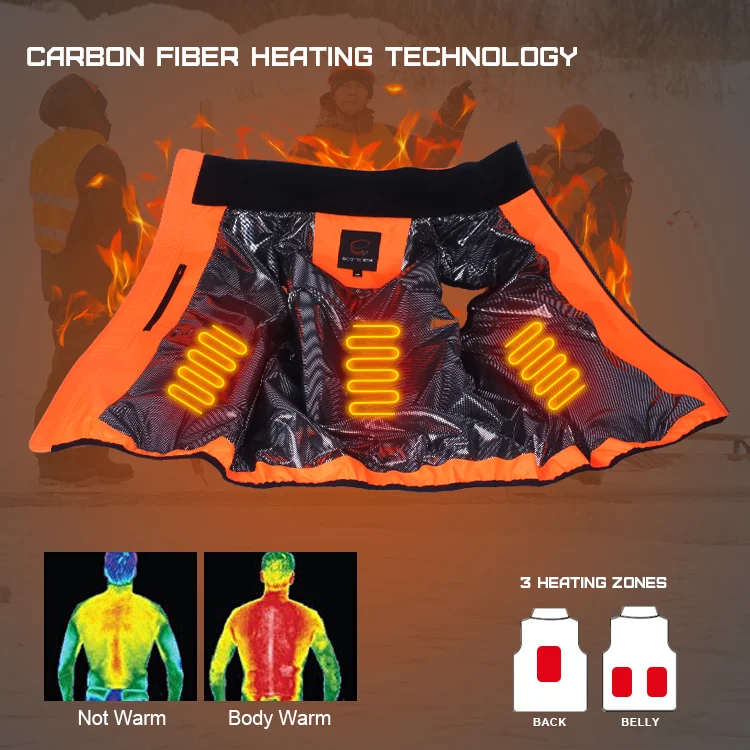
3.1 Seven-point senior-grade BOM specification
The seven dimensions below separate a senior-grade product from a generic heated SKU. Each is a B2B audit gate — a senior heated jacket manufacturer must show documentation for every line.
| Dimension | Senior-Grade Spec | Why It Matters |
|---|---|---|
| Heating elements | Carbon-fiber / graphene-foil, 4+ symmetric zones across upper back, kidney, collar, chest | Senior thermoregulation is asymmetric; single-zone = hot spot |
| Outer shell & lining | Soft-shell polyester, brushed tricot lining, 5,000 mm waterproof / 3,000 g/m²/24h breathability, machine-washable | Caregivers need laundry-friendly garments |
| Zippers, snaps, cuffs | YKK #8 chunky zippers, oversized pull-tabs, magnetic chest snaps, elasticated cuffs with thumb-loops | Reduces dressing failure; one-handed donning |
| Controller | Single silicone button (≥ 18 mm), 3 levels with LED color, 2-sec press-and-hold on/off | Easy-to-use heated apparel with simple controller is the procurement rule, not a tagline |
| Battery & BMS | 5 V / 10,000 mAh USB-C PD, UN 38.3 + IEC 62133 certified, 3-6 hr runtime | Caregiver can swap a phone power bank; no proprietary pack |
| Weight (jacket size L) | ≤ 900 g jacket / ≤ 450 g vest / ≤ 220 g gloves / ≤ 110 g socks | Lightweight = keeps the layer on indoors where heating matters |
| Care labeling | 12-point minimum, high-contrast pictograms, NFC tag linking to caregiver how-to video | Pharmacy-channel differentiator; vision-impaired friendly |
4. The B2B Buyer’s Product Mix: What to Stock for a Senior-Heated Program
A senior-heated program is rarely a single SKU. Pharmacists, mobility-store owners, and Medicare-DME buyers typically run a four-SKU family: jacket, vest, gloves, socks. Each addresses a different micro-need, and the cross-sell lifts basket size by 35-60 % versus a single-SKU aisle. Below is the typical B2B assortment matrix.
| SKU | Primary Senior Pain Point | Voltage | Best-Fit OEM Type | Typical Retail Price (USD) |
|---|---|---|---|---|
| Heated Jacket (4-zone) | Cold-weather walking, errands | 5 V USB-C PD | Senior heated jacket manufacturer | $119 – $179 |
| Heated Vest (4-zone, lightweight) | Indoor layering, fall-prevention uniforms | 5 V USB-C PD | Senior heated vest OEM | $79 – $129 |
| Heated Gloves (arthritis line) | Raynaud’s, osteoarthritis hand pain | 3.7 V rechargeable | Heated glove OEM (medical-aligned) | $59 – $99 |
| Heated Socks (circulation line) | Peripheral circulation, diabetic feet | 3.7 V rechargeable | Heated sock OEM (DME-aligned) | $39 – $69 |
The four-SKU family maps to four senior pain points: full-body cold, indoor layering, hand arthritis / Raynaud’s, and circulation. A senior heated jacket manufacturer that also builds the vest, gloves, and socks on a shared 5 V architecture saves the B2B buyer 8-12 weeks of duplicated sampling and gets the program to shelf in one season.
5. Heated Gloves for Arthritis Sufferers: The Hidden Demand
Arthritis affects more than 50 million U.S. adults, and the senior cohort (65+) carries the majority of the burden. Heated gloves for arthritis sufferers are not a winter-only product — they are a year-round DME-adjacent SKU. Continuous low-level heat (38-42 °C) has clinically documented effects on joint stiffness, and B2B buyers who position gloves as a “pain-management accessory” rather than a “winter glove” unlock a Q2 and Q3 sales window that pure winter SKUs miss.
The procurement spec for an arthritis-line glove is a 3.7 V rechargeable battery (replaceable, not sealed), heating elements across the full dorsal hand including the thumb web and finger PIP joints, a Lycra cuff with hook-and-loop tab for single-handed donning, touchscreen-compatible fingertips, and an optional graphene element for deeper penetration.
6. Heated Socks for Elderly Circulation: Diabetic-Adjacent & DME-Friendly
Heated socks for elderly circulation are the highest-margin SKU in the senior assortment because they overlap with diabetic-footcare and peripheral-vascular-disease retail channels. B2B buyers can place the same SKU in three distinct aisles: senior heated apparel, DME / pharmacy, and outdoor / hunting — provided the product is built on a low-voltage heated apparel (3.7 V / 5 V) platform and is documented as a “circulation-support” rather than a “medical device.”
Build spec for a senior-grade heated sock: 3.7 V / 3,000 mAh battery clipped at the cuff (not the ankle — ankle clips interfere with footwear), carbon-fiber element wrapping forefoot / toes / heel, merino-wool blend (40 % merino + 60 % acrylic), universal S/M/L sizing via adjustable cuff strap, and standard orthopedic-footwear compatibility with no elevated heel.
7. Sourcing & OEM Selection: How to Vet a Senior-Heated-Apparel Manufacturer
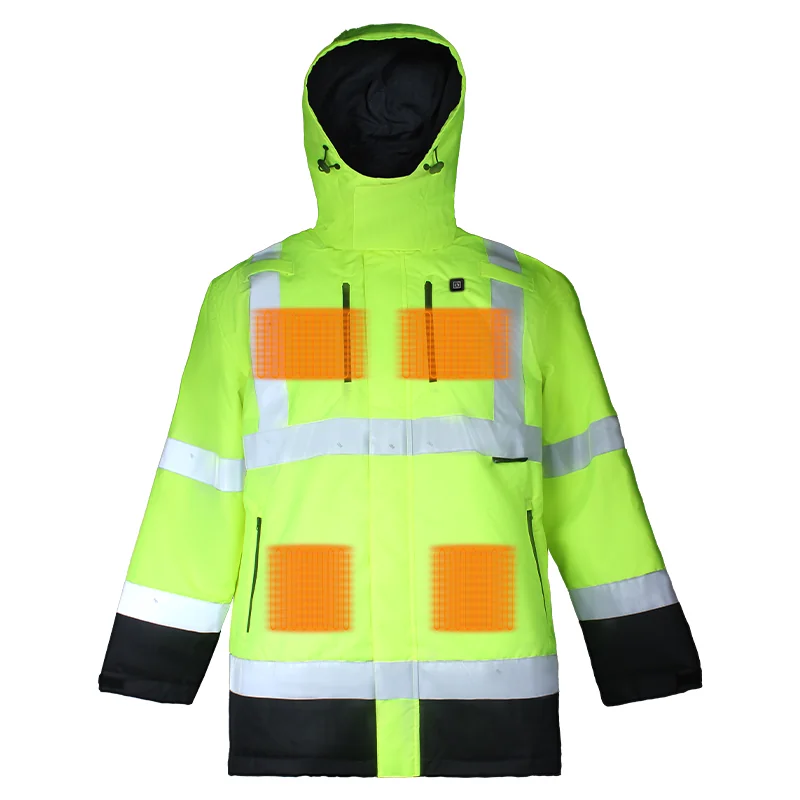
When evaluating a senior heated jacket manufacturer or a senior heated vest OEM, the B2B buyer should run a seven-step supplier audit before issuing the PO. The audit is designed to fail fast — most generic heated-apparel factories will not clear all seven gates, and that is the point.
| Audit Gate | What to Verify | Pass / Fail Trigger |
|---|---|---|
| 1. Voltage architecture | 3.7 V / 5 V only — no 12 V SKU in the senior line | 12 V catalog page = fail |
| 2. BMS certification | UN 38.3, IEC 62133, MSDS on file | Missing MSDS = fail |
| 3. Element layout | 4+ symmetric zones; redundant left/right | Single center-back = fail |
| 4. Controller ergonomics | Oversized single button, 3 levels, LED | OLED touchscreen = fail |
| 5. Wash-test cycles | ≥ 50 wash cycles with element intact | < 30 cycles = fail |
| 6. Sample lead time | ≤ 10 days for an OEM sample | > 21 days = red flag |
| 7. Reference clients in senior / pharmacy channel | ≥ 2 named buyers in DME or pharmacy retail | No senior reference = risky |
A practical B2B rule of thumb for the senior category specifically: average sample-to-PO cycle is 9 days for a senior heated vest OEM with a 5 V platform and an existing senior-grade BOM. If a factory quotes 4-6 weeks for a senior sample, the BOM is being built from scratch and the senior line is not yet mature — that is a risk to weigh against the price advantage.
For MOQ and incoterm details, see the Heated Apparel MOQ Guide in the Heated Apparel Guides library.
8. Compliance, Labeling & Reimbursement Considerations
Senior heated apparel sits in a regulatory grey zone — generally not a Class I medical device in the U.S. or EU, but DME-adjacent. The B2B buyer should plan for:
- FDA: “General wellness” claim is permitted if no disease-specific language is used. Avoid “treats Raynaud’s” — instead, use “supports circulation in cold environments.”
- EU CE / UKCA: Low-Voltage Directive (LVD) 2014/35/EU + EMC 2014/30/EU + REACH for textile chemistry. A senior heated jacket manufacturer exporting to the EU must provide a DoC (Declaration of Conformity).
- UL / CSA: UL 9540 and CAN/CSA C22.2 are the de facto marks for pharmacy-channel listings in North America.
- Care labeling: FTC 16 CFR 423 (U.S.) and EU 1007/2011 govern fiber-content. Add a “Caregiver Quick Guide” pictogram for senior lines.
- Packaging: Specify 14-point print minimum on the carton and a “Try It” perforated tear-strip so the senior can open the package without scissors.
| Region | Key Marks | Claim Boundaries |
|---|---|---|
| USA | UL 9540, FCC Part 15, FTC fiber label | “Supports warmth” — not “treats” |
| EU | CE (LVD + EMC + REACH), UKCA | “Wellness” positioning only |
| Canada | CSA C22.2, ISED RSS-Gen | Bilingual EN/FR care label |
| UK | UKCA + BS EN 60204 | Same as EU, post-Brexit mark set |
| Australia | RCM, AS/NZS 60335 | “Personal warming device” wording |
9. Pricing, MOQ & Margin Architecture for the Senior Channel
Senior channels — pharmacy, mobility retail, Medicare-DME catalogs — operate on different margin architecture than outdoor or fashion. Buyers expect 45-55 % wholesale-to-retail markup, longer payment terms (Net 60 or Net 90), and a one-season exclusivity on a private-label colorway. The OEM must be able to absorb these terms without margin collapse.
The table below is a reference margin model that senior heated jacket manufacturer partners and senior heated vest OEM partners typically run for a 5 V platform with shared 10,000 mAh power-bank BOM.
| Channel | FOB Price Range (USD) | Retail Price Range (USD) | Typical Wholesale Margin | Payment Terms |
|---|---|---|---|---|
| Pharmacy chain (CVS / Walgreens / Rite Aid tier) | $32 – $48 | $79 – $129 | 50-55 % | Net 60 |
| Senior-care uniform program | $28 – $42 | N/A (B2B uniform) | N/A (program price) | Net 30 |
| Medicare-DME catalog | $36 – $54 | $89 – $149 | 50-55 % | Net 90 |
| Mobility / e-commerce direct | $34 – $50 | $99 – $159 | 55-60 % | Net 30 |
| Outdoor crossover (ski / hunting crossover SKU) | $38 – $56 | $119 – $179 | 50-55 % | Net 30 |
The single biggest margin lever is battery cost. A senior heated jacket manufacturer shipping a 5 V / 10,000 mAh shared BOM across jacket + vest + gloves drops per-unit battery cost by 18-25 % versus four dedicated cell packs — the difference between a margin-thin and a margin-healthy senior line.
10. B2B Action Plan: How to Launch a Senior-Heated-Apparel Program in 90 Days
| Phase | Week | Action | Owner |
|---|---|---|---|
| 1. Sourcing | Week 1-2 | Shortlist 3 senior heated jacket manufacturer candidates, request samples | Buyer |
| 2. Sampling | Week 3-4 | Receive 3 jacket + 3 vest samples, run 7-point audit | Buyer + QA |
| 3. Validation | Week 5-6 | User-test with 10+ senior panel, collect wash-cycle data | Buyer + Care partner |
| 4. Negotiation | Week 7-8 | Lock BOM, MOQ, payment terms, packaging spec | Buyer + OEM |
| 5. PO & production | Week 9-12 | Issue PO, 35-day production window, pre-shipment inspection | OEM + Buyer QA |
For a turnkey path, see the Heated Apparel Guides library for MOQ and incoterm references. To request a senior-grade private-label catalog and sample kit, email [email protected] or use the contact form with the subject “Senior Heated Apparel OEM/ODM.”
Frequently Asked Questions (FAQ)
Q1: What voltage is safest for heated apparel for senior citizens?
A: The safest voltage for heated apparel for senior citizens is 3.7 V (single Li-ion cell) or 5 V (USB-C PD power bank). Anything 12 V or higher is not recommended for senior users because of burn risk and battery-handling complexity.
Q2: Can heated gloves actually help arthritis pain in elderly users?
A: Yes. Heated gloves for arthritis sufferers deliver continuous 38-42 °C warmth across the dorsal hand and finger joints, which clinical studies show reduces joint stiffness and improves hand mobility in cold environments. They are sold as a “wellness” accessory, not a medical device.
Q3: How long does a senior heated vest battery last on the medium setting?
A: A typical 5 V / 10,000 mAh battery on a senior heated vest OEM product runs 4-5 hours on medium, 2.5-3 hours on high, and 8-10 hours on low. Hot-swap with any USB-C PD power bank extends runtime indefinitely.
Q4: Are heated socks safe for diabetic seniors?
A: Heated socks for elderly circulation are positioned as circulation-support, not as a medical device. For diabetic users, specify a low-surface-temperature model (≤ 42 °C), avoid direct skin contact over open wounds, and consult the user’s physician if peripheral neuropathy is present.
Q5: What is the typical MOQ for a senior heated jacket manufacturer?
A: For a private-label senior heated jacket with custom color and logo, MOQ typically starts at 300-500 units per colorway per size. Stock-color programs can drop to 100 units. See the Heated Apparel MOQ Guide for the full breakdown.
Q6: What certifications should a senior heated vest OEM have?
A: Look for UN 38.3 (battery transport), IEC 62133 (battery safety), CE-EMC, CE-LVD, REACH (textile chemistry), and a DoC for the target market. North American pharmacy channels also ask for UL 9540 and FCC Part 15.
Q7: How do you clean a senior-grade heated jacket?
A: Remove the battery, close all zippers, machine-wash cold on a delicate cycle in a mesh laundry bag, hang dry. Do not tumble dry, iron, or bleach. The carbon-fiber elements are designed for ≥ 50 wash cycles.
Q8: Can senior heated apparel use a regular USB-C phone power bank?
A: Yes — that is the architectural advantage of low-voltage heated apparel (3.7 V / 5 V). A senior or caregiver can swap any 5 V / 10,000 mAh USB-C PD power bank, including the one they already carry for a phone or tablet.
Q9: What is the best controller design for seniors with arthritis?
A: Easy-to-use heated apparel with simple controller means one oversized silicone button (≥ 18 mm), three heat levels (high / medium / low) with LED color coding, and a 2-second press-and-hold to power on. Avoid touchscreens, app-controlled heating, and multi-zone pairing.
Q10: How does a senior heated apparel program differ from a hunting or construction heated apparel program?
A: A senior program uses lower voltage (3.7 V / 5 V vs 12 V), simpler controllers (3 levels vs 7+), softer outer shells (soft-shell polyester vs hard-shell nylon), and a different go-to-market channel (pharmacy / mobility / DME vs outdoor retail). The BOM, the QA gates, and the marketing language are all distinct.
Q11: Are reflective elements important on senior heated vests?
A: Yes. Reflective trim on the cuffs, hem, and chest panels of a senior heated vest OEM product is a fall-prevention and visibility feature for evening walks. It is a low-cost B2B differentiator that pharmacy buyers actively request.
Q12: What is the typical lead time from sample to bulk shipment?
A: For a senior heated jacket manufacturer with a mature senior-grade BOM, sample lead time is 7-10 days and bulk production is 30-45 days after PO. Total sample-to-shelf for a four-SKU family is typically 75-95 days.