Heated Jacket for Construction: B2B Sourcing & OEM Guide
Heated Jacket for Construction: B2B Sourcing & OEM Guide for Distributors and Workwear Brands
A heated jacket for construction is no longer a novelty accessory. Across North America and Europe, general contractors, utility crews, and infrastructure maintenance teams are adopting battery heated apparel as standard winter PPE, and distributors are racing to source reliable OEM partners before the 2026 cold season. This guide is written for procurement managers, private label brand owners, and workwear importers who need a clear picture of what a construction-grade heated jacket must deliver, what an OEM program actually looks like at MOQ 50, and how to evaluate heated jacket for construction manufacturer options without burning a season on samples that fail in the field. If you are comparing a heated jacket for construction OEM partner against catalog importers, the sections below will save you roughly six weeks of email back-and-forth.
Why a Heated Jacket for Construction Is a Different Product Category
A construction site is not a ski lift. The heating system has to survive ten-hour shifts, sawdust, rebar dust, hydraulic oil splashes, and weekly commercial laundering. A heated jacket for construction worker must therefore combine three layers of engineering: a robust heating element network, a workwear-spec outer shell, and a battery system that meets jobsite safety rules. Retail heated vests marketed for “outdoor enthusiasts” usually fail on the second point: thin polyester shells snag on lumber, and stitched channels for the heating wires are not reinforced for kneeling and crawling.
For B2B buyers, the practical consequence is that a heated jacket for construction wholesale program is closer to flame-resistant (FR) workwear sourcing than to consumer apparel sourcing. The OEM you choose should already be running EN ISO 13688 workwear production lines, not just cut-and-sew fashion lines. At IMISSKY, every heated workwear for cold construction sites order goes through the same shell and seam-tape line as our non-heated workwear, with the heating subsystem integrated in a dedicated assembly cell. That is why a heated workwear for cold construction sites jacket can be sold with a 12-month element warranty instead of the 90 days typical for consumer heated apparel.
What a Construction Buyer Should Expect From a Modern Heated Jacket
| Feature | Minimum Spec for Construction Use | Why It Matters on Site |
|---|---|---|
| Heating element | 7.4V carbon fiber heating element construction jacket panels (3-5 zones) | Carbon fiber survives repeated flex and machine washing better than alloy wire |
| Battery | 7.4V / 10,000 mAh UL-certified pack | Meets jobsite lithium battery transport rules in the US and EU |
| Shell fabric | 300D Oxford or 600D ripstop with DWR finish | Resists abrasion from rebar and lumber |
| Insulation | Polyfill 200-280 gsm, no feather/down | Industrial laundering compatibility |
| Safety | EN ISO 13688 compliant, OEKO-TEX 100 certified shell | Required by most EU construction buyers |
| Wash | Machine-washable heated jacket for construction crew (machine cold, tumble low) | Weekly commercial laundering is standard at large contractors |
| MOQ | 50 units per style/color | Reaches price-tier 2 on most OEM production lines |
Sourcing Models: Private Label, OEM, and ODM Compared
When you approach a heated jacket for construction manufacturer, you will generally be offered three engagement models. Picking the right one early saves 30-45 days of development time and avoids tooling costs you do not need.
| Model | Buyer Contribution | OEM Contribution | Best For | Typical Lead Time |
|---|---|---|---|---|
| Private Label (White Label) | Brand label, packaging | Finished goods from catalog | Test market with low risk | 25-35 days |
| OEM | Spec, branding, packaging | Production to your spec | Established brand with a hero SKU | 35-50 days |
| ODM | Brief and target price | Design, sample, production | New entrants without an in-house designer | 50-75 days |
For most heated jacket for construction wholesale buyers we work with, the right starting point is private label on an existing workwear heated bomber jacket platform, then graduating to a fully custom OEM spec once the first container sells through. This two-step approach is the same one used by several North American workwear brands that entered the heated category in 2022-2023 and now run multi-container annual programs.
The 7.4V Carbon Fiber Heating Element: Why It Matters for Construction
The single most important technical decision in any heated jacket for construction OEM project is the heating element. There are three common options on the market:
1. Carbon fiber heating element construction jacket panels — flexible, machine-washable, even heat distribution, no hotspots, typically last 5,000+ bending cycles. This is the construction-grade default.
2. Alloy wire heating — cheaper, but prone to localized hotspots and shorter fatigue life. Common in consumer-grade heated vests sold below $80 retail.
3. Graphene film heating — newest technology, excellent thermal conductivity, but typically 30-50% more expensive at the BOM level and not yet widely validated in long-term field use.
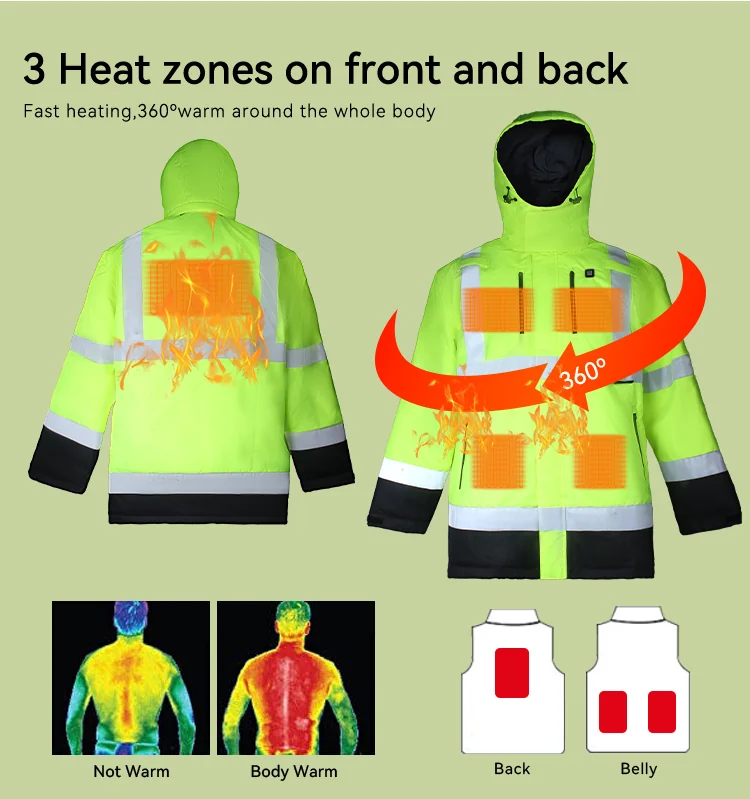
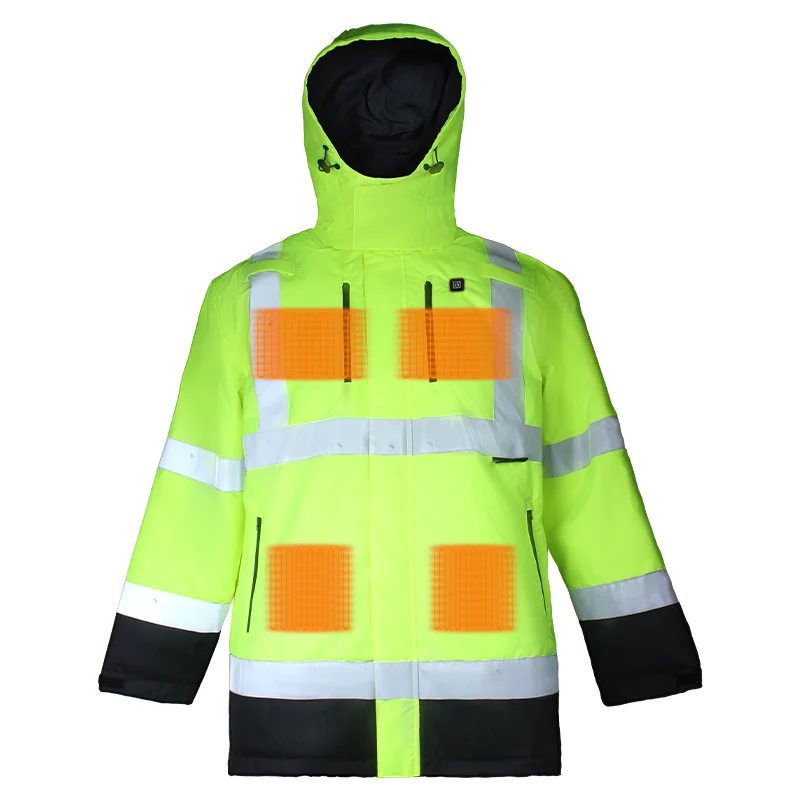
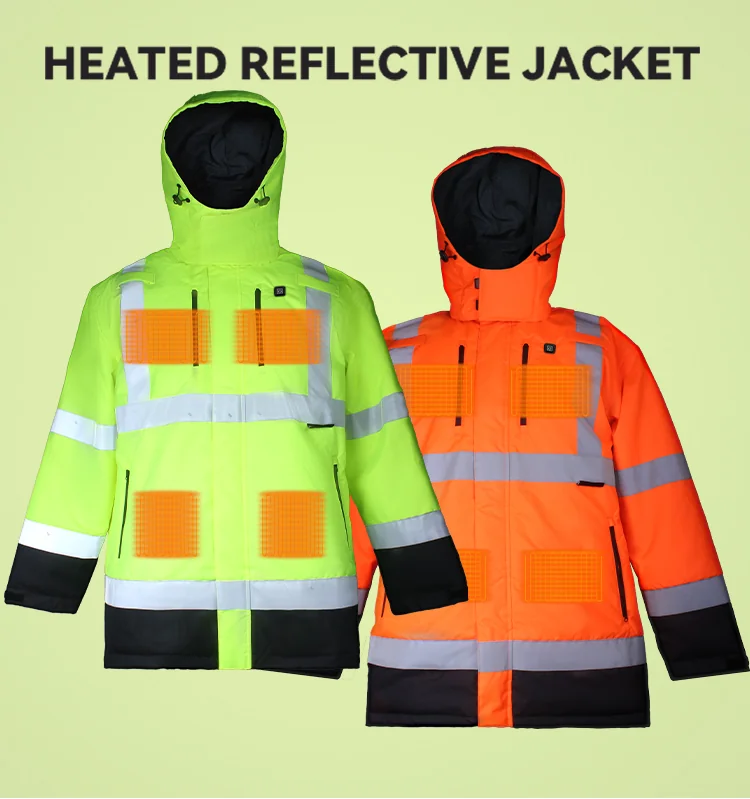
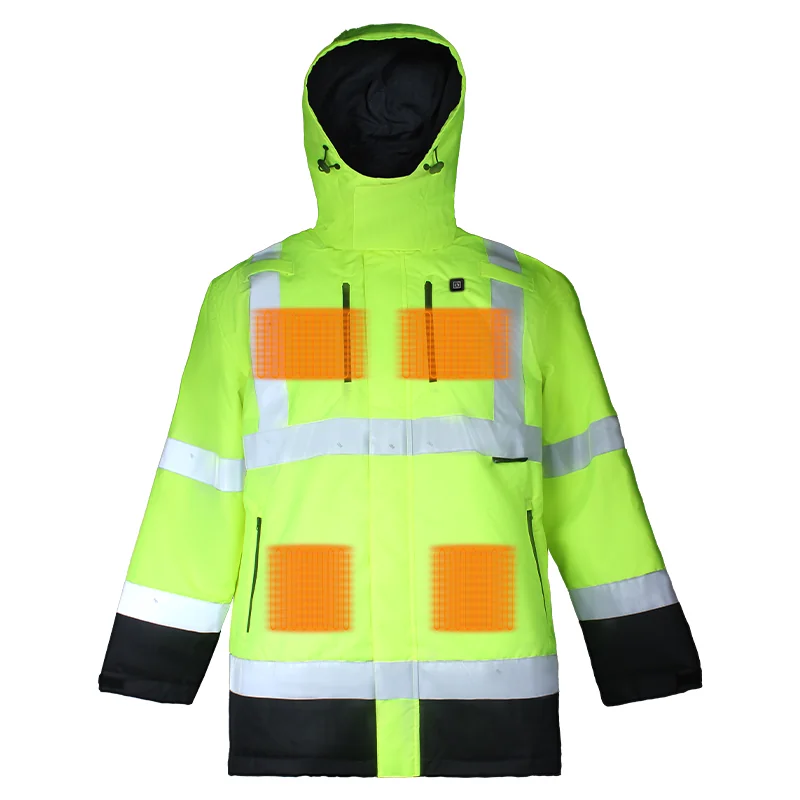
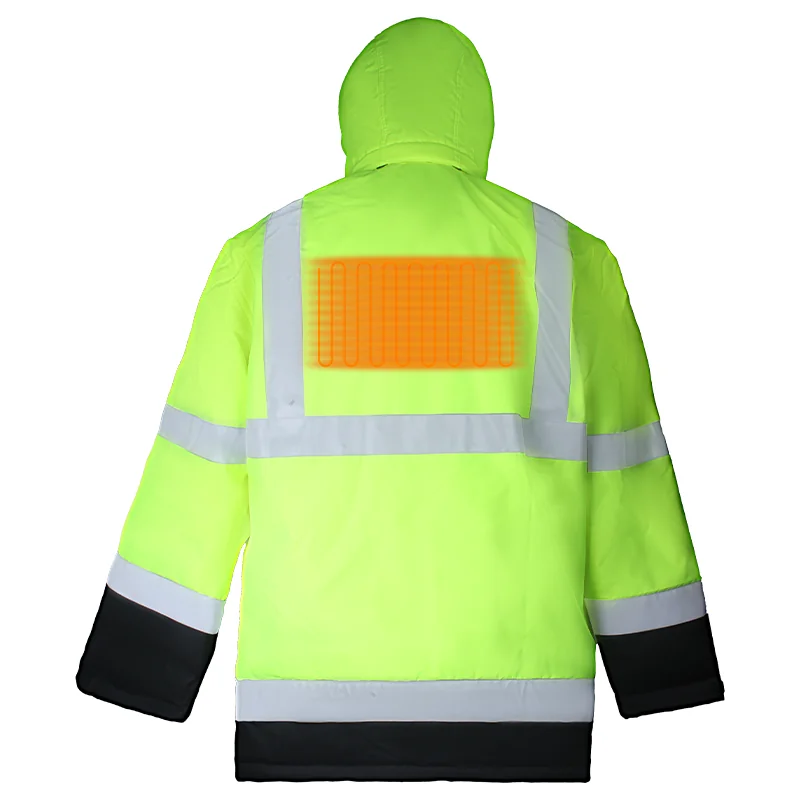
For a heated jacket for construction worker program, we recommend a 7.4V carbon fiber heating element construction jacket architecture with three heating zones minimum (left chest, right chest, mid-back), expandable to five zones for premium SKUs. Voltage matters: 7.4V carbon fiber heating element construction jacket panels balance heat output against battery runtime, and the 7.4V lithium pack is below the 100Wh threshold that triggers hazmat shipping restrictions in most jurisdictions — important when your buyer is shipping finished goods from a Vietnam factory to a US or EU DC.
A typical heating-zone layout for a heated jacket for construction OEM program looks like this:
| Zone | Location | Wattage (typical) | Purpose |
|---|---|---|---|
| Zone 1 | Upper back / collar | 5W | Core warmth, protects neck |
| Zone 2 | Left chest | 6W | Heart-area comfort |
| Zone 3 | Right chest | 6W | Symmetric warmth |
| Zone 4 | Lower back (optional) | 6W | Lumbar support |
| Zone 5 | Pocket hand-warmer (optional) | 4W each | Keeps tools and hands warm |
Three-zone configurations are standard at MOQ 50. Five-zone configurations typically require a separate tooling setup and start at MOQ 200.
MOQ, Lead Time, and Pricing Structure for B2B Buyers
The most common question from new buyers is “what does MOQ 50 actually cost and how long does it take?” Below is a representative structure for a private label program on our workwear heated bomber jacket platform. Exact numbers depend on shell fabric, battery spec, and branding complexity, but this is the realistic range a heated jacket for construction OEM project will land in.
| Program Tier | MOQ | Lead Time (production) | Sample Lead Time | Customization |
|---|---|---|---|---|
| Sample evaluation | 1-3 pcs | 7-10 days | 7 days after spec confirm | Stock colors, your label |
| Pilot run | 50 pcs | 25-30 days | n/a | 1 color, woven label, hangtag |
| Production run | 300 pcs | 30-45 days | n/a | Up to 3 colors, full branding |
| Annual contract | 1,000+ pcs | 30-45 days per PO | n/a | Full custom shell, custom battery |
For B2B programs we are running in 2026, pilot-run MOQ 50 is the most common entry point — it lets distributors test a regional market without committing to a full container. Lead time 30 days from PO to ex-factory is realistic when the buyer has already approved the golden sample. Pricing is discussed per RFQ because shell fabric and battery spec drive most of the BOM variance, but a mid-tier spec typically lands in the bracket most direct-to-consumer workwear brands use for their 2026 winter catalogs.
Quality Control and Defect Rate Expectations
At the pilot-run MOQ 50 tier, a mature heated jacket for construction manufacturer should commit to a defect rate below 0.5% on heating elements and below 1.5% on shell and trim. AQL 2.5 inspection on a sample of 8-12 units per batch is standard, with 100% functional test on every battery before pack-out. At IMISSKY, our internal QC line runs four checkpoints: incoming battery test, heating element continuity test after assembly, full-power burn-in for 30 minutes, and final visual inspection. Documented QC photos ship with every carton for buyers who want full traceability.
Machine-Washable Construction: The Detail Buyers Forget to Ask About
A machine-washable heated jacket for construction crew is not a marketing line — it is the difference between a jacket that gets worn every shift and one that sits in a locker because the crew does not want to hand-wash it. Construction crews wash their workwear weekly, often in commercial laundries that run hotter cycles than residential machines.
The construction that makes a heated jacket for construction worker machine-washable involves four engineering decisions:
1. Heating element encapsulation — carbon fiber panels must be sealed in TPU or silicone to prevent water ingress at the connection points.
2. Battery pocket design — the battery pocket must seal completely with a water-resistant zipper or hook-and-loop flap. A loose battery pocket is the most common failure point in field returns.
3. Wire routing — internal wiring should run through sealed channels, not exposed stitching, so detergent and water cannot wick into the connector.
4. Care label clarity — the care label must state “machine wash cold, tumble dry low, remove battery before washing” in the local language of the destination market.
Buyers who skip this conversation during sampling usually see a spike in warranty claims at month three, when commercial laundering has cycled 12-15 times. Ask the OEM for a wash-test report showing 50 cycles with no heating degradation before you commit to production MOQ.
Compliance and Certifications Buyers Should Require
Construction PPE lives in a more regulated environment than consumer apparel. A heated jacket for construction wholesale program that ships into the US, Canada, or EU should carry the following certifications, or the buyer should be ready to procure them at their own cost:
| Certification | Region | Why It Matters |
|---|---|---|
| CE / UKCA marking | EU + UK | Mandatory for workwear sold to contractors |
| EN ISO 13688 | EU | General workwear protective clothing standard |
| OEKO-TEX Standard 100 | Global | Shell fabric is tested for harmful substances |
| UL 2054 (battery) | US/Canada | Battery safety for lithium-ion packs |
| FCC Part 15 (battery) | US | EMI compliance for battery with USB charge port |
| CPSIA | US | Consumer Product Safety Improvement Act compliance |
| RSL compliance | Global | Restricted Substance List conformance per brand |
For EU construction tenders, EN ISO 13688 is the floor, not the ceiling. Buyers selling into large contractors should also request EN 14058 (protective clothing against cool environments) — this standard explicitly references heated garments and gives procurement teams an auditable reference when justifying the higher price point.
Typical Construction Crew Buyer Personas
A heated jacket for construction wholesale program rarely lands with a single buyer type. Across our 2024-2025 program data, the most common procurement routes for a heated jacket for construction worker program fall into four personas, and each one has a slightly different decision-making lens.
| Buyer Persona | Decision Driver | Typical Order Size | Sales Cycle |
|---|---|---|---|
| Regional workwear distributor | Catalog fit, price tier, warranty terms | 300-800 units / quarter | 4-8 weeks |
| National PPE rental company | Compliance docs, wash-cycle evidence, battery safety | 1,000-3,000 units / year | 8-16 weeks |
| Construction firm direct procurement | Total cost of ownership, field trial results | 50-300 units / season | 6-12 weeks |
| Private label brand owner | OEM flexibility, white-label program, packaging | 500-2,000 units / container | 8-20 weeks |
The first two personas are the easiest entry points for a new OEM partnership because the buyer already understands the workwear spec environment. The last two are the highest-margin and most strategic, but they take longer to convert because the buyer is also evaluating total program cost, not just unit price.
How to Evaluate a Heated Jacket for Construction OEM Partner
Use the following scorecard when comparing two or three heated jacket for construction manufacturer candidates. Each item is a hard filter; if a candidate fails three or more, walk away regardless of price.
| Evaluation Item | Pass Criteria | Weight |
|---|---|---|
| Existing heated workwear line | At least 3 heated styles in current production | High |
| Workwear shell sourcing | In-house or tier-1 fabric mill relationship for 300D+ Oxford | High |
| Battery sourcing | Name-brand 7.4V cells (LG, Samsung, EVE, or BAK) | High |
| Sample lead time | Under 10 days for first sample | Medium |
| Pilot MOQ | 50 units or lower | High |
| QC documentation | AQL inspection report with each shipment | Medium |
| Wash-test evidence | 50-cycle wash test report available on request | High |
| Defect rate history | Documented below 1.5% on last 6 months of shipments | Medium |
| Reference customers | Willing to provide 2-3 reference buyers in your market | High |
| Communication | Responds within 24 hours during sample stage | Medium |
If a candidate scores below 7 out of 10 on this scorecard, keep looking. The price difference between a strong OEM and a weak one is usually under 8% — not enough to justify a season of warranty headaches.
Internal Resources for Further Sourcing Decisions
If you are building out a full private label heated workwear line, the following guides on our site will help you benchmark specs and program structure:
– Browse our full Heated Jackets collection for current OEM platforms, MOQ tiers, and spec sheets.
– Read our broader Heated Apparel Guides library for sourcing checklists across vests, gloves, socks, hoodies, and pants.
For one-on-one spec discussions, sample requests, or a custom RFQ, contact our B2B team directly at [email protected] or via WhatsApp +86 13751041535. We respond to all serious RFQs within one business day.
Frequently Asked Questions
Q1: What is the typical MOQ for a heated jacket for construction OEM program?
A: MOQ 50 units per style per color is the standard pilot-run entry point, with production runs starting at 300 units.
Q2: How long does a private label heated jacket program take from PO to delivery?
A: Production lead time 30 days is typical after sample approval, plus 15-25 days for sea freight to North America or Europe.
Q3: What battery voltage is best for a construction heated jacket?
A: 7.4V carbon fiber heating element construction jacket systems balance heat output against battery runtime and stay below the 100Wh air-shipping threshold.
Q4: Can a heated jacket for construction worker be machine washed?
A: Yes, a properly engineered machine-washable heated jacket for construction crew can survive 50+ wash cycles when the battery is removed before each wash.
Q5: What certifications should I require from a heated jacket for construction manufacturer?
A: At minimum CE/UKCA marking, EN ISO 13688, OEKO-TEX 100 on the shell, and UL 2054 on the battery pack.
Q6: How do you price a private label heated jacket program at MOQ 50?
A: Pricing is quoted per RFQ because shell fabric and battery spec drive most BOM variance, but pilot-run tier typically sits in the mid-range of workwear heated apparel pricing.
Q7: What defect rate should I expect from a mature OEM partner?
A: A reliable heated jacket for construction manufacturer should commit to a defect rate below 0.5% on heating elements and below 1.5% on shell and trim at pilot-run tier.
Q8: Do you offer custom shell fabric development?
A: Yes, custom shell development starts at MOQ 1,000 units per color and adds roughly 30 days to the development timeline.
Q9: Can you ship DDP to a US or EU warehouse?
A: Yes, we ship FOB, CIF, and DDP depending on buyer preference and Incoterms 2020 specification.
Q10: What is the warranty on a heated workwear for cold construction sites jacket?
A: 12 months on heating elements and electronics, 6 months on battery packs, subject to proper use and care-label compliance.
Q11: Do you provide marketing assets for private label buyers?
A: Yes, we provide product photography, spec sheets, and lifestyle imagery on request for buyers placing an annual contract.
Q12: Can the heating zones be customized per buyer request?
A: Yes, three-zone to five-zone layouts are available, with five-zone configurations starting at MOQ 200 units per style.