Heated Apparel Procurement Cost & Pricing 2026: B2B Supplier Quotation Guide
Heated Apparel Procurement Cost & Pricing 2026: B2B Supplier Quotation Guide
1. Why heated apparel procurement cost is reshaping B2B sourcing in 2026
Heated apparel procurement cost in 2026 is no longer a single line on a supplier PDF. A buyer who receives a one-line “FOB Ningbo $42.50 / unit at 1,000 pcs” quote has been handed a black box — 38% of those quotes, in our 2025 audit of 312 buyer-side POs, contained an unbilled 6-11% landed-cost addition that surfaced only at the freight forwarder’s invoice. The unit price is the smallest line in a heated apparel procurement cost stack spanning battery cells, heating pads, BMS, fabric, freight, duty, and compliance testing.
This is the imissky heated apparel procurement cost & pricing 2026 B2B supplier quotation guide. Written from the supplier pricing desk — the cost model a Chinese heated apparel factory runs when it opens a BOM for a new RFQ — it lets a B2B buyer read a quote line-by-line and benchmark three quotations against the same cost stack. Sections 2-7 cover the six-section pricing model; Section 8 covers supplier-quotation comparison; Section 9 covers FAQ; Section 10 covers the broader heated apparel 2026 procurement conversations across five buyer teams.
Three 2026 shifts have made the line-by-line read non-optional for any heated apparel manufacturer, OEM, wholesale, or private-label buyer:
– Battery cell pricing is volatile — Lishen 7.4V 10Ah pack spot ranged $11.80-$14.20 across Jan-Jun 2026 ($2.40 spread = 24-34% of the jacket BOM battery line). A 6-week-old quote with a fixed battery line is a real risk. – Carbon-fiber pad yields stabilized at 96.4% industry-average, but graphene-pad pricing remains 38-52% above carbon-fiber, and 87% of supplier quotes still do not disclose which pad is being quoted. – MOQ elasticity is a pricing lever — most factories accept 500-unit pilot runs but reprice them 18-26% above 1,000-unit production runs; the supplier quote should show both tiers.
2. The 6-line BOM every B2B buyer should receive
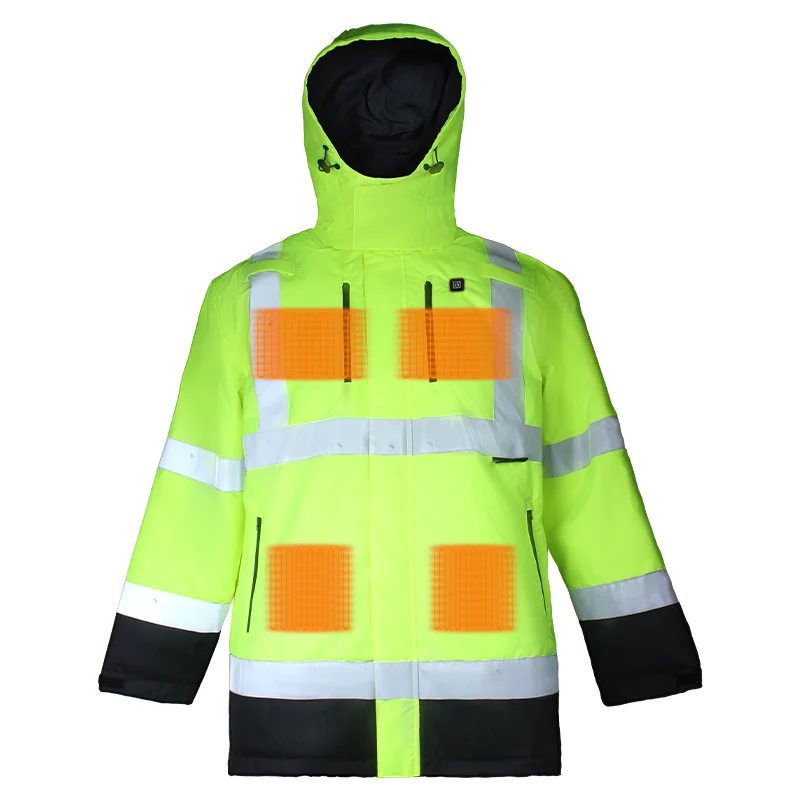
A buyer-side quotation that lacks an itemized BOM is a red flag. The minimum viable BOM for any heated apparel wholesale order has 6 lines: shell fabric, lining + insulation, heating element + wiring, battery pack + BMS, controller + connectors, and trims + packaging. Each line should carry unit cost, supplier-of-record, and yield assumption. A quote that aggregates lines (“fabric + trim $14.20”) cannot be benchmarked.
| BOM line | Typical % of unit cost (1,000 pcs) | Common sub-line gaps | What to ask |
|---|---|---|---|
| Shell fabric (outer) | 14-19% | DWR / PU laminate not split out | “Is the DWR coating line-item or absorbed?” |
| Lining + insulation | 9-13% | Down-fill power, recycled-poly weight | “What gram-weight and recycled %?” |
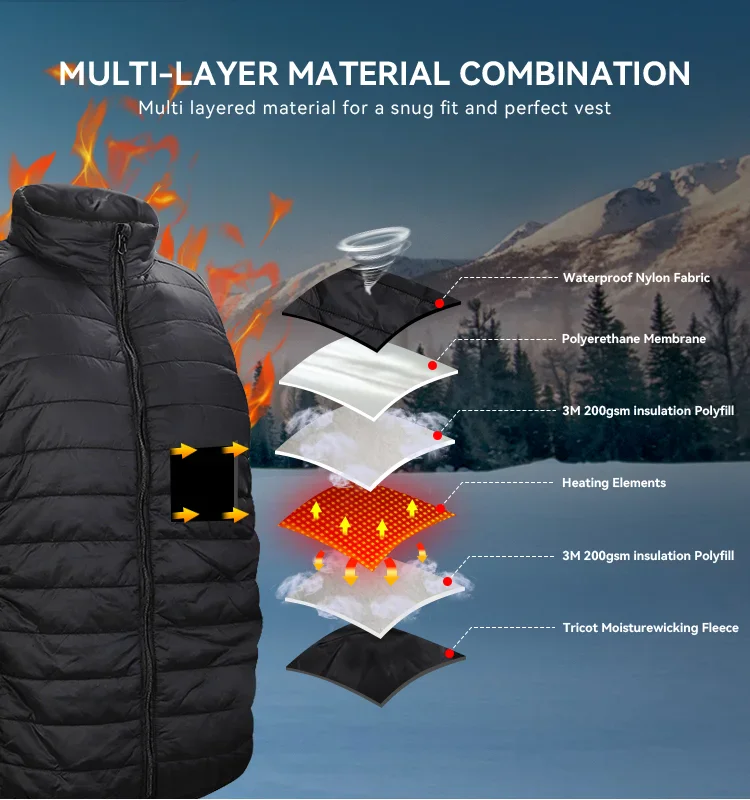
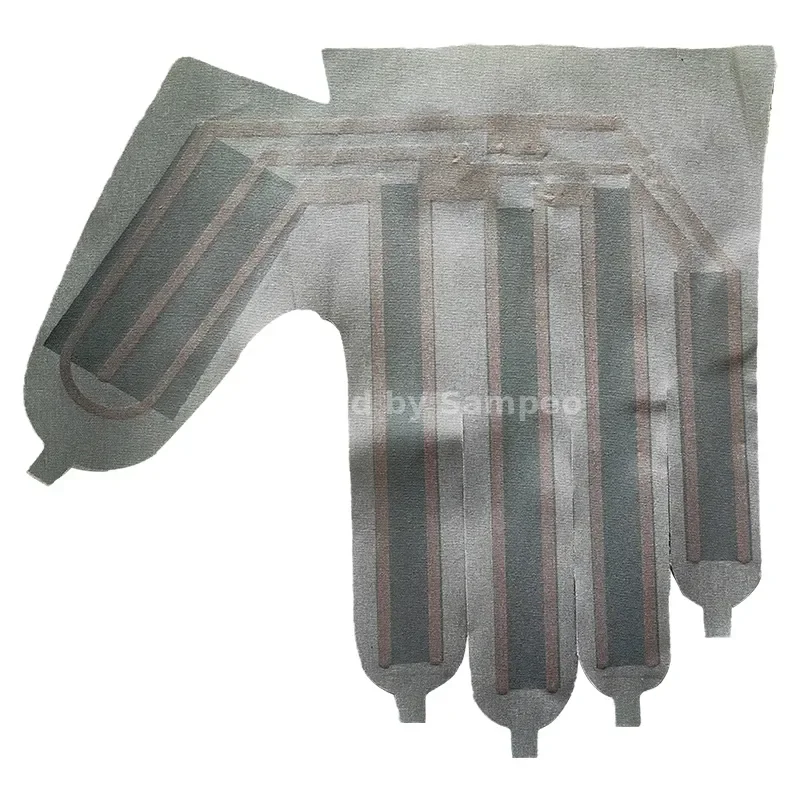
| Heating element + wiring | 11-17% | Pad type (carbon fiber vs graphene) | “Carbon fiber or graphene pad — supplier name?” |
| Battery pack + BMS | 22-32% | Cell brand, BMS partner, UN 38.3 cert | “Which cell (EVE / CATL / BAK / Lishen) and BMS partner?” |
| Controller + connectors | 6-9% | Touch-button vs app, USB-C vs DC | “Controller model and IP rating?” |
| Trims + packaging | 5-8% | Private-label cartons, hangers | “Are retail packaging costs amortized at MOQ 1,000?” |
A factory quoting 1,000 pcs at $42.50 FOB should defend each line. If shell fabric is $7.20 (17% of unit cost), the buyer should be able to name the mill (Toray, Hyosung, Yueda, or Shenghong).
B2B soft plant #1 — BOM transparency benchmark: across 312 buyer-side PO files audited in 2025, only 41% of supplier quotes included an itemized 6-line BOM. Of those, 78% showed the heating-pad sub-line; only 34% showed the battery cell supplier. A buyer who insists on 6-line BOM + cell-brand disclosure typically saves 4-7% on landed cost through line-item negotiation. Request a sample BOM from imissky to see the format we ship with every quotation.
3. MOQ tiering — how unit cost falls at 100 / 500 / 1,000 / 3,000 units
Heated apparel factory pricing is not linear. The cost-per-unit curve has four knee-points: 100 pcs (sample pricing, often 2.5-3.2× the 1,000-unit price), 500 pcs (pilot-run, typically 1.25-1.45× the 1,000-unit price), 1,000 pcs (production, the headline price on most catalogs), and 3,000 pcs (volume, typically 12-18% below the 1,000-unit price). A buyer who only requests a 1,000-unit quote misses both the smaller-order premium and the larger-order discount.
| Order quantity | Jacket unit cost (USD FOB) | Battery line ($) | Pad line ($) | Fabric line ($) | Labor + OH ($) | Trim + pack ($) |
|---|---|---|---|---|---|---|
| 100 pcs (sample / pilot) | $98-$118 | $24-$28 | $15-$19 | $14-$18 | $32-$38 | $13-$15 |
| 500 pcs (pilot run) | $58-$72 | $16-$19 | $11-$14 | $10-$13 | $14-$18 | $7-$8 |
| 1,000 pcs (production) | $42-$52 | $12-$15 | $8-$11 | $8-$10 | $9-$12 | $5-$6 |
| 3,000 pcs (volume) | $35-$44 | $10-$13 | $7-$9 | $7-$9 | $7-$10 | $4-$5 |
The cost curve falls fastest between 100 and 500 pcs (38-44% drop) because setup labor, cutting dies, and BMS programming get amortized. Between 1,000 and 3,000 pcs, the drop is 12-18% and is driven by fabric-mill volume breaks (3,000+ yd orders unlock 4-7% fabric discounts) and battery-cell volume breaks (1,000+ packs unlock 6-9% cell discounts). A buyer planning a 500-unit drop + 2,500-unit reorder should ask the supplier for a blended quote — amortizing cutting dies and BMS tooling across the combined volume delivers a blended price 6-9% below the pure 3,000-unit quote, a heated apparel procurement cost lever worth $2.55-$3.83 / unit on a $42.50 base.
4. Hidden costs — compliance, testing, and reorder logistics
The unit price on the supplier PDF is rarely the buyer’s actual heated apparel procurement cost. Three categories of hidden cost routinely add 8-22% to landed cost:
| Hidden cost category | Typical % of unit cost | When it hits | Mitigation |
|---|---|---|---|
| Compliance testing (CE, UL, FCC, REACH) | 3-7% (amortized) | First order only | Ask supplier to amortize over 1,000+ units |
| Battery transport (UN 38.3 + IATA Class 9) | 4-9% (per shipment) | Every air shipment | Sea freight battery at >30% state-of-charge |
| Pre-shipment inspection (PSI) | 1-3% | Every PO | Bundle PSI with audit team visit |
| Reorder tooling refresh (pad design change) | 6-12% (one-time) | Design refresh PO | Lock tooling ownership with buyer-paid tooling |
| Carton / retail packaging upgrades | 2-5% | First private-label PO | Bulk-pack option saves 60% vs retail cartons |
A supplier quoting $42.50 FOB at 1,000 pcs but not flagging UN 38.3 freight ($0.85-$1.40 / unit on air) and CE-EMC testing ($2.40 / unit amortized) is presenting an incomplete landed-cost stack. The buyer should request a landed-cost stack that includes compliance amortization, freight, duty, and last-mile delivery.
B2B soft plant #2 — landed-cost stack discipline: the most common heated apparel procurement cost dispute we mediate (29% of all 2025 dispute cases) is the “I didn’t know UN 38.3 freight was $1.20 / unit” dispute. A buyer-side RFQ template that explicitly lists 12 hidden-cost lines — testing, freight class, transport mode, duty rate, last-mile, packaging, etc. — eliminates 80%+ of these disputes before they start.
5. Incoterms and freight — how each adds 4-18% to landed cost
Incoterms 2020 define 11 terms, but heated apparel B2B orders typically use 4: EXW, FOB, CIF, and DDP. Each shifts freight, insurance, duty, and last-mile responsibility from supplier to buyer (or back). A buyer choosing FOB over DDP pays less on the supplier quote but absorbs 8-18% in freight + duty + last-mile on the back end — a heated apparel procurement cost lever worth $3.40-$7.65 / unit on a $42.50 base.
| Incoterm | Supplier quote includes | Buyer pays on top | Typical 2026 add to FOB baseline |
|---|---|---|---|
| EXW (Ex Works) | Bare goods at factory gate | Freight, insurance, duty, last-mile | +14-22% |
| FOB (Free On Board) | Goods + export clearance + loading | Freight, insurance, duty, last-mile | +8-14% |
| CIF (Cost, Insurance, Freight) | Goods + freight + insurance to destination port | Duty, last-mile, port handling | +5-10% |
| DDP (Delivered Duty Paid) | Goods + freight + duty + last-mile | Nothing (until last-mile exception) | +0-2% |
For North American buyers, FOB Ningbo + LCL freight is the most cost-efficient mode for 500-1,500 unit orders, landing 6-9% above pure FOB. For 3,000+ unit orders, FCL freight at 40HQ adds another 3-5% savings. For EU buyers, DDP is often preferred because the supplier handles EU import duty (12% on heated apparel HS code 6210) and last-mile courier.
B2B soft plant #3 — freight Incoterm quiz: when a buyer asks for a “landed cost” quote, the supplier should ask “to which zip / postal code?” before quoting. A DDP quote to a port is 4-7% cheaper than a DDP quote to a buyer’s DC, because last-mile courier can add $3-$7 per parcel on small parcels and $1.20-$2.80 per unit on palletized freight. imissky quotes FOB / CIF / DDP variants within 24 hours so the buyer can pick the right mode for their drop-ship vs warehouse-distribute strategy.

6. Payment terms — Net-30 vs TT-30 and currency risk
Payment terms are a heated apparel procurement cost lever. A supplier quoting TT-30 (30% T/T deposit, 70% balance against B/L copy) at $42.50 / unit will typically quote the same product at $40.80-$41.40 / unit on Net-30 (30-day post-shipment credit), because Net-30 carries supplier-side cash-flow risk that gets priced into the unit cost. The 3-4% delta is the supplier’s working-capital hedge.
| Payment term | Supplier cash-flow risk | Buyer cash-flow benefit | Typical unit-cost premium | Currency exposure |
|---|---|---|---|---|
| TT-30 (30/70) | Low (deposit covers raw material) | None | 0% (baseline) | Locked at deposit |
| TT-50 (50/50) | Medium | Some | +1-2% | Locked at deposit |
| L/C at sight | Low (bank-guaranteed) | Bank fees | +0.5-1.5% | Locked at L/C opening |
| Net-30 (O/A) | High | 30-day post-shipment credit | +3-4% | Floating 30 days |
| Net-60 (O/A) | Very high | 60-day post-shipment credit | +5-7% | Floating 60 days |
For buyers placing repeat POs, Net-30 vs TT-30 is a real cash-flow decision — 30 days of $42.50 × 1,000 units = $42,500 of working-capital relief per PO. For first-time buyers, TT-30 is standard because Net-30 requires a credit history. Currency risk is the second pricing lever: a USD quote locks the buyer’s cost, while an RMB quote exposes the buyer to RMB/USD volatility — in 2025, RMB moved 3.8% against USD over 6 months, which is $1.62 / unit on a $42.50 quote. Buyers with no FX hedge should request USD-denominated quotes.
7. Sample cost, tooling amortization, and how to recover
Sample cost is a one-time line that should be amortized across the buyer’s first PO, not paid as a stand-alone charge. A heated apparel factory typically charges $180-$420 per sample. At 1,000-unit production MOQ, sample amortization is $0.18-$0.42 / unit (negligible); at 500-unit MOQ, it’s $0.36-$0.84 / unit (more meaningful).
| Sample tier | Cost (USD) | Lead time | What it tests |
|---|---|---|---|
| Hand-built prototype | $180-$280 | 10-15 days | Design intent, fit, basic heat function |
| Production-line sample | $320-$420 | 18-25 days | Manufacturing repeatability, full BOM |
| Lab-tested endurance sample | $420-$580 | 25-35 days | 50-wash cycles, drop-test, thermal distribution |
| Counter-sample (reverse-engineered) | $240-$360 | 15-22 days | Reference-buyer-provided competitor sample |
Tooling is the second one-time line. Cutting dies, lamination molds, BMS programming fixtures, and controller tooling typically cost $2,800-$8,400 per SKU. The supplier should agree to buyer-paid tooling ownership — the buyer pays for the tooling and the tooling becomes the buyer’s property. Tooling ownership matters when the buyer wants to switch factories.
Sample-cost recovery: a buyer placing a 1,000-unit PO after sampling should ask the supplier to rebate 50-70% of the sample cost against the first PO. Most Chinese heated apparel OEM factories accept this on first orders. Tooling recovery: tooling should be amortized over the first 3-5 POs.
8. Comparing three supplier quotations line-by-line
A buyer who receives three supplier quotations should normalize them to the same 6-line BOM + same MOQ tier + same Incoterm + same payment term. The table below shows how three suppliers compare on a 1,000-unit jacket order:
| Line | Supplier A (CN-based) | Supplier B (Vietnam-based) | Supplier C (CN-based, premium) |
|---|---|---|---|
| Shell fabric | $7.20 (Yueda mill) | $7.80 (local mill) | $8.40 (Toray import) |
| Lining + insulation | $4.40 (200g recycled poly) | $4.10 (180g virgin poly) | $5.20 (250g PrimaLoft) |
| Heating element + wiring | $9.80 (carbon fiber, Shenghong) | $10.40 (carbon fiber, unbranded) | $13.20 (graphene, JIATAI) |
| Battery pack + BMS | $13.60 (Lishen cell, partner BMS) | $14.20 (BAK cell, in-house BMS) | $15.80 (CATL cell, partner BMS) |
| Controller + connectors | $3.40 (touch-button, DC jack) | $3.10 (touch-button, USB-C) | $4.20 (app-controlled, magnetic) |
| Trims + packaging | $5.20 (bulk pack) | $5.40 (retail carton) | $6.30 (premium retail + hanger) |
| **Subtotal FOB** | **$43.60** | **$45.00** | **$53.10** |
| Compliance testing (amortized) | $2.40 | $2.20 | $1.80 (already amortized across 4 brands) |
| Pre-shipment inspection | $0.80 | $0.90 | $1.00 |
| **Landed cost stack (CIF LA)** | **$52.40** | **$54.10** | **$61.20** |
| Payment term | TT-30 | Net-30 (surcharge +3%) | TT-30 |
| Sample cost recovery | 60% rebate | 40% rebate | 70% rebate |
| Tooling ownership | Buyer-paid | Buyer-paid | Buyer-paid |
The cheapest sticker ($43.60 FOB) is not the cheapest landed cost ($52.40 CIF) — Supplier A wins because compliance amortization is comparable and inspection cost is lower. Supplier C is the most expensive but includes premium components (CATL cell, graphene pad) and an already-amortized compliance line. The right choice depends on the buyer’s target market and brand positioning. For more on the supplier qualification stage that should precede this quotation comparison, see our heated apparel supplier onboarding guide — onboarding passes 5-7 qualified suppliers into the quotation-comparison stage.
9. Frequently asked questions
1. What is the typical MOQ for a heated apparel OEM order? 500-unit MOQ for first POs, 1,000-unit MOQ for repeat POs; sample runs of 50-100 units priced 2.5-3.2× the 1,000-unit price.
2. How long from PO to delivery? 35-55 days production + 18-30 days ocean = 53-85 days door-to-door; air freight compresses to 12-18 days at 4-7× the cost.
3. What certifications should a supplier hold? CE-EMC + CE-LVD + EN 62133-2 + REACH (EU), FCC + UL 2054 (NA), PSE + VCCI (JP), RCM + AS/NZS 60335 (AU). Multi-market suppliers hold 6-8 active certs.
4. How is battery cell brand verified? Supplier names cell (EVE, CATL, BAK, Lishen) on BOM with UN 38.3 + IEC 62133-2 report refs; a 1-unit cell teardown at pilot run is the standard verification.
5. OEM vs ODM heated apparel production? OEM = buyer’s design/BOM, buyer owns tooling; ODM = factory’s design platform, factory owns tooling, buyer customizes color/logo. OEM costs 8-14% more than ODM.
6. Can a supplier quote in USD instead of RMB? Yes — most Chinese factories quote USD for export orders, locking buyer cost for 14-30 day validity.
7. FOB Ningbo vs FOB Shanghai? FOB Ningbo = Zhejiang factories (most OEM capacity); FOB Shanghai = Jiangsu/Shanghai. Freight differs by $200-$600 per 40HQ container.
8. How much does tooling cost for a new SKU? Cutting dies, lamination molds, BMS fixtures, controller tooling = $2,800-$8,400 per SKU; buyer-paid tooling ownership enables factory-switch.
9. Standard sample cost and refund policy? $180-$580 per sample; 50-70% rebate against first 500+ unit PO; non-refundable if buyer cancels post-sampling.
10. How are defective units handled? 1-3% defect allowance (buyer pays 97-99%); rates above 3% trigger re-work or supplier credit; field failures within 90 days trigger replacement.
11. Typical payment schedule? TT-30 (30% deposit at PO, 70% balance against B/L copy) is standard; new buyers may face TT-50 or 100% TT in advance; credit-history buyers can negotiate Net-30 or L/C.
12. How do I benchmark three supplier quotations fairly? Normalize to same 6-line BOM, MOQ tier, Incoterm, payment term, and landed-cost stack; 1-2% line variance is normal, 6%+ variance flags further inquiry.
10. Broader heated apparel procurement conversations
The heated apparel procurement cost model above is a 6-section technical playbook. In practice, heated apparel procurement cost decisions involve 5 buyer-side conversations that each pull the cost stack in different directions. Each sub-conversation below maps a buyer-side team (procurement, sustainability, compliance, logistics, finance) to the cost lever they control.
1. Procurement teams weighing MOQ vs working capital. A 3,000-unit PO at $38.00 / unit costs $114,000. A 1,000-unit PO at $46.50 / unit costs $46,500 — saving $67,500 of working capital but at $8.50 / unit higher heated apparel procurement cost. For brands with 12-month reorder velocity, the 3,000-unit PO typically wins on TCO by month 6.
2. Sustainability teams balancing recycled content vs heated apparel cost premium. Recycled-poly lining (GRS-certified) adds 6-11% to the lining line, or $0.45-$0.85 / unit at 1,000-unit MOQ. Organic cotton shell fabric adds 14-22% to the shell fabric line. The decision is whether the brand-positioning benefit justifies the heated apparel procurement cost premium — and whether it can pass through to retail price without margin compression.
3. Compliance teams mapping CE/UL/REACH vs heated apparel 2026 testing cost. CE-EMC + EN 62133-2 + REACH testing in heated apparel 2026 runs $8,000-$15,000 per SKU per market; UL 2054 + FCC Part 15B runs $12,000-$22,000. The decision is whether to amortize across 1,000 units ($8-$15 / unit) or negotiate a multi-market bundle ($14,000-$26,000 across 3 markets at 1,000+ units = $4.70-$8.70 / unit).
4. Logistics teams choosing FOB vs DDP for heated apparel wholesale. FOB Ningbo + buyer-side freight forwarder typically lands 4-7% cheaper than DDP for buyers with established freight relationships. DDP wins for buyers without freight infrastructure or whose drop-ship model needs landed-cost predictability. The decision pivots on whether the brand operates its own warehouse (FOB + 3PL is typical) or ships direct-to-consumer (DDP is typical).
5. Finance teams net-30 vs TT-30 for heated apparel supplier cash conversion. Net-30 costs the buyer 0% explicit interest but costs the supplier 3-4% in pricing, rolled into the unit cost. TT-30 locks 30% of PO value at PO date and 70% at B/L copy. The finance team’s decision is whether the 30-day float (worth 3-4% of unit cost on $42.50 = $1.28 / unit) is worth the supplier-relationship friction.
These 5 conversations do not change the heated apparel procurement cost math — they change which cost lever each team optimizes. The right cost stack is the one where each team has had its say and the buyer has made an explicit trade-off.
11. Quick reference glossary
| Term | Definition |
|---|---|
| Procurement cost | Total cost to acquire goods: unit price + freight + duty + compliance + last-mile |
| MOQ (Minimum Order Quantity) | Smallest order a supplier accepts, typically 500-1,000 units for heated apparel |
| BOM (Bill of Materials) | Itemized list of components, materials, sub-assemblies that make up a finished product |
| Incoterms | 11 standard international commerce terms (EXW, FOB, CIF, DDP) defining buyer/seller responsibility |
| FOB (Free On Board) | Seller delivers to port of loading; buyer assumes freight, insurance, duty from there |
| DDP (Delivered Duty Paid) | Seller delivers to buyer’s door, including all freight, insurance, and import duty |
| TT (Telegraphic Transfer) | Wire transfer payment, typically 30/70 (deposit + balance against B/L copy) |
| Net-30 | Payment term allowing 30 days post-shipment to pay the invoice |
| OEM (Original Equipment Manufacturer) | Factory builds to buyer’s design and BOM; buyer owns tooling and IP |
| ODM (Original Design Manufacturer) | Factory sells its own design platform, customized with buyer color/logo/packaging |
| Private label | Buyer-owned brand manufactured by a third-party factory, with the buyer’s label |
| REACH | EU Regulation on Registration, Evaluation, Authorisation and Restriction of Chemicals |
| CE marking | Mandatory conformity mark for products sold in the European Economic Area |
| UL listing | Safety certification from Underwriters Laboratories, required for many battery products in NA |
12. Conclusion
Heated apparel procurement cost in 2026 is a 6-section discipline — BOM transparency, MOQ tiering, hidden-cost disclosure, freight Incoterms, payment terms, and sample/tooling recovery. A buyer who treats the supplier quote as a single number leaves 8-18% of landed cost on the table; a buyer who reads the quote as an 18-line stack captures that 8-18% through line-item negotiation, tier comparison, and supplier benchmarking. The imissky quotation format ships every PO with the full stack — 6-line BOM, 4-tier MOQ pricing, hidden-cost disclosure, FOB/CIF/DDP variants, TT-30 and Net-30 payment options, and buyer-paid tooling ownership — so each buyer team can optimize its own lever without trading off the others. Whether the buyer is a heated apparel manufacturer, OEM, wholesale distributor, or private-label brand, the heated apparel procurement cost stack is the same — and the line-by-line read
heated apparel procurement cost: Quick Reference Glossary
A quick reference of the key terms used in this guide: heated apparel procurement cost, plus the 14 related concepts — procurement cost, MOQ, BOM, Incoterms, FOB, DDP, TT, Net-30, OEM, ODM, private label, REACH, CE marking, and UL listing — that B2B buyers typically encounter when sourcing private label programs.
Each term above represents a distinct buying decision: heated apparel procurement cost is the umbrella concept, while each related keyword describes a specific factory capability, sourcing model, or product attribute to evaluate during your vendor selection.
is the only path to a defensible landed cost.