Battery Heated Clothing Private Label: B2B Guide 2026
When a retailer, outdoor brand, or workwear distributor searches for a winter thermal product line to add under their own label, the conversation almost always lands on one term: battery heated clothing private label. The phrase captures three buying decisions in seven words — the heating technology (battery-powered, not plug-in or chemical), the product category (heated clothing, including jackets, vests, gloves, and base layers), and the commercial model (private label, where the buyer owns the brand and the manufacturer handles production). This guide is written for the procurement, sourcing, and product development teams on that side of the table.
Over the last decade the global heated apparel market has shifted from a niche specialty category dominated by a handful of North American brands into a structured B2B manufacturing segment. Battery heated clothing private label programs are now the standard route through which retailers, workwear suppliers, hunting brands, and corporate-gift distributors build their own heated apparel line — without the capex of a factory, a heating-element R&D team, or a battery certification lab. The remaining question is no longer whether to source privately labeled heated clothing, but which manufacturer is the right fit and what technical, certification, and supply-chain questions a buyer should answer before signing a purchase order.
IMISSKY Industrial has been manufacturing battery heated clothing for private label programs since 2014, with engineering teams in China and a production facility in Vietnam. This guide consolidates the questions our B2B buyers ask most often, the technical standards our products are built to meet, and the commercial mechanics of a typical private label engagement — from MOQ and sample lead time to CE, FCC, UN38.3, and ISO 9001 documentation. The intent is to give a sourcing manager enough context to shortlist manufacturers, evaluate samples confidently, and avoid the most common pitfalls of a first-time private label heated apparel order.
What “Battery Heated Clothing Private Label” Actually Means
The phrase battery heated clothing private label covers a specific commercial model. It is not the same as OEM, ODM, white-label, or branded resale. Understanding the difference matters when negotiating with a manufacturer, because each model carries a different set of obligations around design ownership, tooling, branding, and minimum order quantities.
Private Label vs. OEM vs. ODM vs. White Label
In a private label program, the buyer chooses from a manufacturer’s existing, proven product platform — heating element layout, battery pack spec, fabric shell, sizing grade — and applies the buyer’s own brand name, logo, packaging, hang tags, and care labels. The product design belongs to the manufacturer; the brand identity belongs to the buyer. This is the fastest and lowest-risk model, with MOQs typically starting around 300 to 500 units per SKU for an established platform.
In an OEM (Original Equipment Manufacturer) agreement, the buyer provides the full product specification — heating zone map, battery capacity, fabric composition, seam construction, even circuit diagrams — and the manufacturer builds to that spec. MOQs are higher (often 1,000 to 3,000 units per SKU) and tooling costs may apply, but the buyer gets a truly differentiated product.
ODM (Original Design Manufacturer) sits between the two. The manufacturer offers a complete design — including drawings, tech packs, and a working sample — that the buyer can re-brand, lightly modify, or take to market as-is. White label is the simplest model: a generic, unbranded SKU that any number of resellers can buy and re-sell under their own label, often with no customization beyond a printed logo on a care label or polybag.
Core Product Categories in a Heated Apparel Private Label Line

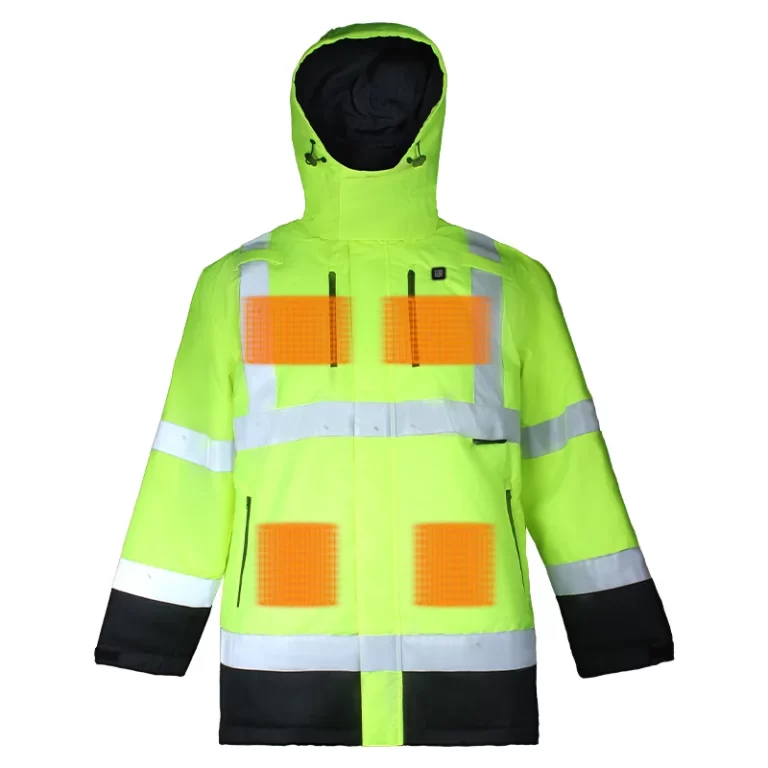
- Heated jackets — softshell, hardshell, workwear, bomber, and down-blended silhouettes; typical heating zones include left chest, right chest, mid-back, and collar.
- Heated vests — sleeveless layering pieces for hunters, anglers, motorcyclists, and warehouse workers; reflective trim variants for road crews and security.
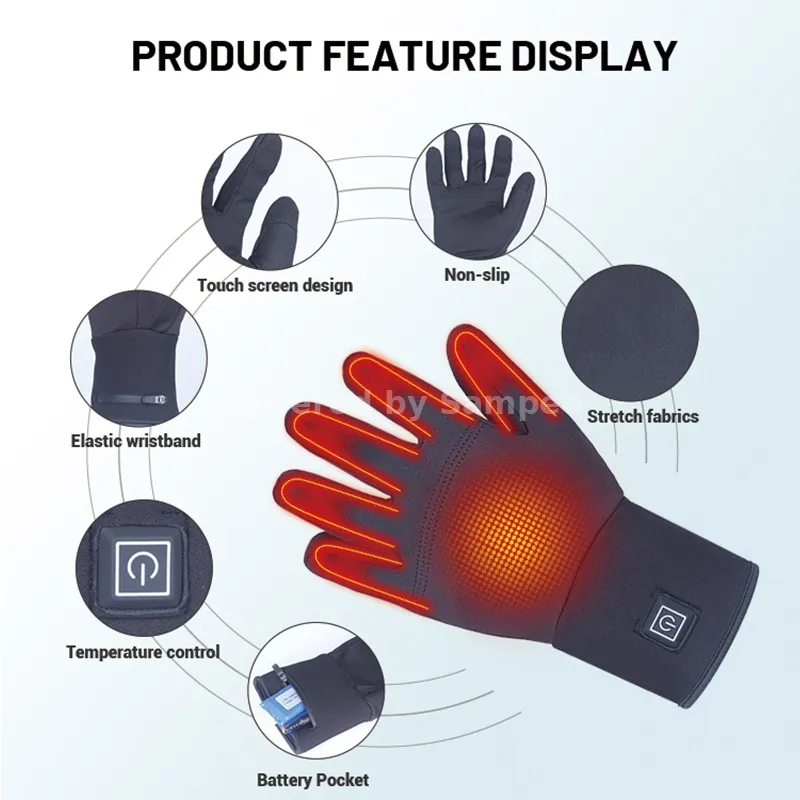
- Heated gloves and glove liners — ski, snowmobile, hunting, motorcycle, and workwear versions; heating element coverage typically runs across the back of the hand and all five fingers.
- Heated base layers — long-sleeve shirts, leggings, and balaclavas with low-profile heating elements for layering under outerwear.
- Heated socks, insoles, and footwear accessories — battery-powered warming for hunting, skiing, ice fishing, and construction.
- Specialty heated apparel — workwear coveralls, hunting pants, motorcycle jackets, equestrian apparel, and corporate-gift items.
The Heating Technology Stack: What a Buyer Needs to Understand
Before evaluating a manufacturer’s private label program, a buyer should understand the three technical subsystems that determine a heated garment’s performance, safety, and cost. These subsystems — the heating element, the battery pack, and the controller — are interdependent, and a weak link in any one of them will define the buyer’s warranty exposure and end-customer satisfaction.
Heating Element: Carbon Fiber, Graphene, Metal Wire, or Printed Ink
The heating element is the conductive layer that converts battery current into warmth. The four dominant options in 2026 are:
- Carbon fiber heating pads — the long-established default for mid-range heated apparel. Flexible, washable, reasonably priced, and easily die-cut into arbitrary shapes. Slower heat-up and less even heat distribution than newer options.
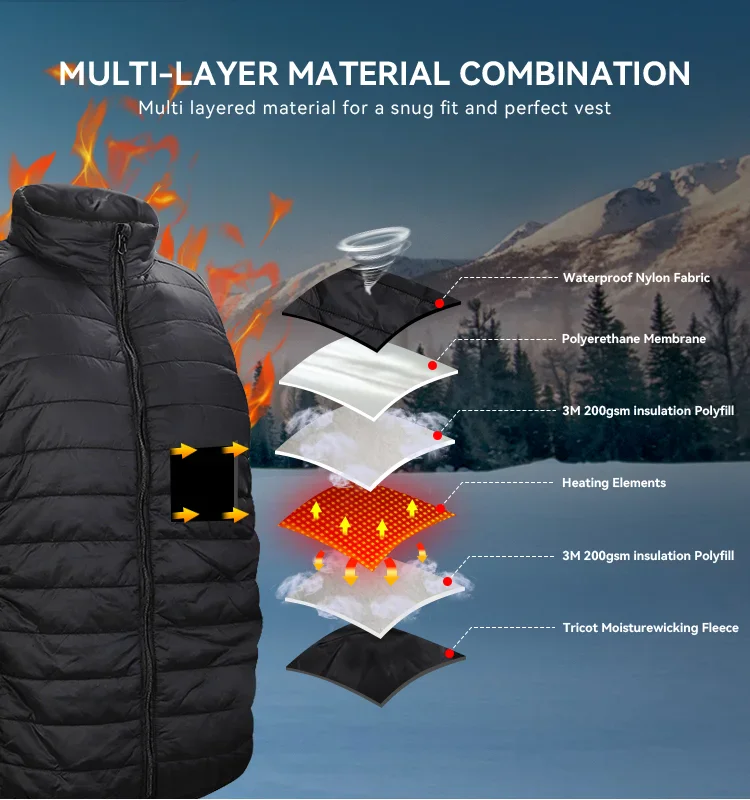
- Graphene heating films — thinner, lighter, more uniform heat distribution, faster heat-up, and a longer functional lifespan (often rated for 10,000+ bending cycles). Higher per-unit cost, but the performance gap has narrowed, and graphene is now the preferred material for premium private label programs. IMISSKY’s engineering team works primarily with graphene heating films in our heated jacket and heated vest platforms.
- Metal alloy wire (nickel-chrome, iron-chrome-aluminum) — used in some entry-level gloves and socks because it is the cheapest to produce. Heavier, stiffer, and more prone to fatigue failure after repeated bending and washing. Buyers should ask for the element’s bend-cycle rating before committing.
- Printed silver or carbon ink on fabric — emerging technology, still mostly limited to prototype and very high-end applications. Excellent flexibility and even heat, but manufacturing yields are inconsistent and the technology is not yet widely available for volume private label production.
For most private label buyers, carbon fiber or graphene will be the practical choice. The decision usually comes down to target retail price point, expected warranty period, and the wash-cycle rating the manufacturer can document.
Battery Pack: Voltage, Capacity, Chemistry, and Certification
The battery pack is the part of a heated garment that interacts with international dangerous goods regulations, airline transport rules, and consumer safety law. For a private label program, the battery is also the single largest cost component after the fabric shell, and the part most likely to be returned under warranty if it underperforms.
Key specifications a buyer should request in writing from any battery heated clothing private label supplier:
- Chemistry — lithium-ion (Li-ion) is the universal standard. Some 2026 platforms are beginning to use lithium-iron-phosphate (LiFePO4) for safety-critical workwear applications; expect a weight penalty.
- Voltage — typically 3.7V (single cell), 5V (USB-style), 7.4V (two-cell, the most common in jackets and vests), or 12V (motorcycle and high-output workwear). Higher voltage allows more heating zones and longer runtime at the same temperature setting.
- Capacity — expressed in mAh (milliamp-hours) or Wh (watt-hours). A 7.4V / 5,200 mAh pack is a common reference point for a heated jacket: roughly 2.5 to 6 hours of runtime depending on the heat setting.
- Certification — UN38.3 (mandatory for air transport of lithium cells), IEC 62133 (international safety standard for portable batteries), and CE-RED or FCC for the battery management electronics. For North American retail, UL 2054 and CSA C22.2 are also frequently requested.
- Cycle life — rated charge-discharge cycles before capacity drops below 80% of original. A consumer-grade Li-ion cell is typically rated for 500 cycles; premium cells reach 800 to 1,000. This drives warranty exposure directly.
- Connector type and proprietary lock — many manufacturers use a proprietary DC barrel or magnetic connector to lock the buyer into their own replacement-battery supply chain. This is a legitimate commercial strategy but should be disclosed in the buyer’s cost-of-ownership calculation.
Private Label Supply Chain Mechanics: MOQ, Lead Time, and Sourcing Workflow

The commercial side of a battery heated clothing private label engagement follows a fairly standardized sequence, even though the terms of every individual deal will vary. A sourcing manager should plan for the following five phases.
Phase 1: RFQ and NDA
The buyer issues a request for quotation that specifies product type, target quantity per SKU, target FOB or DDP price range (without specifying a price that would lock the manufacturer out of the deal), required certifications, branding requirements, and delivery date. The manufacturer responds with a formal quote. Both parties typically sign a non-disclosure agreement before the manufacturer shares its tech pack, fabric options, or sample tooling.
Phase 2: Samples and Prototypes
Most private label heated apparel programs include a pre-production sample phase. A buyer usually pays for one or two rounds of samples (the cost is often credited against the first production order). Sample lead time for a stock platform with a logo and care-label change is typically 7 to 14 days. A more extensive customization — for example, a new heating zone layout, a new fabric, or a non-standard color — extends sample lead time to 25 to 40 days.
Phase 3: PPAP, Inspection, and Quality Agreements
Before mass production begins, the buyer and manufacturer agree on a quality plan. In the heated apparel industry this typically includes a production part approval process (PPAP) reference document, an Acceptable Quality Level (AQL) standard for inline and final inspection (commonly ANSI/ASQ Z1.4 with 1.0 or 2.5 AQL for critical and major defects), and a pre-shipment inspection arranged by the buyer or by a third-party QC firm. Battery heated garments should be inspected for heat-zone continuity with a thermal camera, battery charge cycle verification, and washing durability.
Phase 4: Production and Shipment
Lead time from confirmed purchase order to ex-factory dispatch is typically 30 to 60 days for a private label program at a 500 to 2,000 unit MOQ, and 60 to 90 days for a larger OEM-style build with custom tooling. Buyers should agree in advance on Incoterms (FOB Shenzhen, FOB Ho Chi Minh City, DDP, or otherwise), packing specifications (individual polybag, master carton dimensions, hangtag and barcode placement), and the documentation pack that ships with each commercial invoice (commercial invoice, packing list, certificate of origin, battery MSDS, and test reports as required by the destination market).
Phase 5: After-Sales, Warranty, and Replacement Parts
A private label program does not end at delivery. The buyer should plan for warranty service (typical 12-month coverage on the heating element and 6 to 12 months on the battery pack), a small replacement-parts inventory, and an end-of-life plan for batteries returned under warranty. Most established battery heated clothing private label manufacturers will agree to supply replacement batteries and heating elements at agreed prices for at least three years after the last production run.
Compliance, Certification, and Documentation for International Markets
Compliance is the area where first-time private label buyers most often underestimate the time and cost required. Heated apparel that contains a lithium-ion battery is, from a regulatory standpoint, both a garment and a piece of consumer electronics — and is subject to rules from both categories.
United States: FCC, CPSC, and UL Standards
Heated garments sold in the US market must comply with FCC Part 15 for the battery management and radio-frequency emissions of any wireless controller. The Consumer Product Safety Commission (CPSC) enforces general product safety rules, and importers are subject to the Consumer Product Safety Improvement Act (CPSIA) tracking-label and small-parts requirements. Battery packs sold with the garment should meet UL 2054 (household and commercial batteries) or UL 9540A for larger systems. Buyers should request the test report number and the issuing lab’s accreditation scope before shipment.
European Union: CE, REACH, RoHS, and Battery Regulation (EU) 2023/1542
For sale in the EU, heated apparel typically requires CE marking under the Low Voltage Directive (2014/35/EU) and the Electromagnetic Compatibility Directive (2014/30/EU). REACH (Registration, Evaluation, Authorisation and Restriction of Chemicals) compliance must be documented for fabric chemistry, and RoHS (2011/65/EU) restricts the use of lead, mercury, cadmium, and certain phthalates in the electronic components. As of 2024, the EU Battery Regulation 2023/1542 mandates additional labeling, recycled-content, and producer-registration obligations for the battery pack, including a QR code linking to the manufacturer’s carbon footprint and recycled-content disclosures. The United States Consumer Product Safety Commission and the European Chemicals Agency publish guidance that is relevant to importers of heated apparel.
Canada, United Kingdom, Australia, and Other Markets
Canada requires CSA or cUL certification on the battery pack and follows CPSC for the garment itself. The United Kingdom has retained CE marking recognition through a transition period and is moving toward the UKCA mark; battery and EMC requirements largely mirror the EU. Australia and New Zealand require RCM (Regulatory Compliance Mark) registration, which covers EMC, electrical safety, and radio communications. Private label buyers distributing to multiple markets should request a multi-jurisdiction compliance pack from their manufacturer up front to avoid duplicated testing costs later.
How to Evaluate a Battery Heated Clothing Private Label Supplier
The right private label partner combines manufacturing capability, electrical safety engineering, textile sourcing, and international logistics under one roof. The wrong partner can leave a buyer with a 40-foot container of garments that fail customs, a battery recall, or a first production run that does not match the approved sample. The following checklist is the one we walk our own prospective customers through.
Checklist Item 1: Engineering and R&D Capability
Ask whether the manufacturer has an in-house heating-element R&D team, a battery engineering team, and a sewing and pattern-making team. Ask for examples of custom heating zone layouts they have produced. A pure assembly house will struggle with anything beyond a stock platform.
Checklist Item 2: Certification and Test Reports
Request copies of current CE, FCC, REACH, RoHS, UN38.3, and ISO 9001 certificates with the issuing body’s accreditation number visible. Verify the certificate is valid and was issued to the legal entity you are contracting with — not a sister company that is unrelated to your production line.
Checklist Item 3: Capacity, Lead Time, and Backup Production Lines
Ask for the monthly output of heated garments, the number of production lines dedicated to heated apparel, and what the contingency plan is if a line goes down. A manufacturer that produces heated garments as a side line to its main apparel output will struggle to deliver a 10,000-unit program in the agreed window.
Checklist Item 4: Communication, Sampling, and Responsiveness
The sample phase is the best predictor of how the production phase will go. A manufacturer that takes three weeks to respond to a sizing question, sends a sample with the wrong logo color, or cannot explain a fabric spec change is signaling a difficult production experience. We recommend asking for two sample rounds on the first order and timing both of them before committing to volume.
Checklist Item 5: Warranty, Replacement, and Battery Recycling
Clarify warranty terms in writing before signing the purchase order. The best private label manufacturers offer at least a 12-month warranty on the heating element and a 6 to 12 month warranty on the battery, and they will commit to a multi-year replacement-parts supply window.
Common Pitfalls First-Time Battery Heated Clothing Private Label Buyers Run Into
Across more than a decade of working with first-time private label buyers in heated apparel, the same six issues surface in roughly 80% of new programs. Each is avoidable with proper planning.
Pitfall 1: Underestimating Battery Shipping Complexity
Lithium-ion batteries are regulated as Class 9 dangerous goods for international air freight and as restricted articles for sea freight. UN38.3 test reports, battery MSDS, and a shipper’s dangerous goods declaration are mandatory for every commercial shipment. Buyers should plan for this in the cost model and the delivery schedule, not as an afterthought.
Pitfall 2: Confusing Prototype Quality with Production Quality
The sample that arrives at the buyer’s office is often hand-finished, made from hand-cut fabric, and assembled by a senior technician. The first production run is made by line operators at production speed. The gap between the two is the buyer’s biggest warranty risk. A robust PPAP and inline inspection plan closes that gap.
Pitfall 3: Ignoring Wash Test Results
A heated garment’s heating element will be washed dozens to hundreds of times over its life. The manufacturer’s heating element should be rated for at least 50 machine-wash cycles with no more than 10% drop in heat output. Buyers should request the test report for the specific element being used in their program, not a generic brochure figure.
Pitfall 4: Fabric Shell Mismatch for the Use Case
A heated jacket sold to construction crews in northern Canada needs a different fabric, seam-sealing, and reinforcement strategy than a heated vest sold to weekend hikers in California. The same heating element can sit inside very different shells. The buyer’s marketing and product team should define the end use case first, then let the manufacturer recommend the shell construction.
Pitfall 5: Controller User Experience
The controller — the small button or smartphone app that adjusts the heat setting — is the part of the garment the end user touches the most. A controller that is hard to find with gloves on, has unclear LED indicators, or pairs unreliably to a phone will generate returns and negative reviews even when the heating element and battery are working perfectly. We always recommend buyers request a sample with the proposed controller and test it in real-world conditions before locking the spec.
Pitfall 6: No Battery Recycling Program
Under the EU Battery Regulation 2023/1542 and parallel rules in North America, producers of battery-containing products are responsible for end-of-life battery collection and recycling. A buyer importing heated apparel into the EU or California needs to either join a producer responsibility organization or have its manufacturer participate in one. This is rarely a deal-breaker, but it must be addressed before the first shipment lands.
Cost Structure: What Drives Price in a Private Label Heated Garment
The unit cost of a battery heated clothing private label program is driven by four main inputs. Understanding them helps a buyer negotiate from a position of knowledge rather than a position of price.
Cost Driver 1: Fabric and Shell Construction
The outer shell fabric is usually the single largest cost component. A 300 gsm softshell with bonded fleece and a TPU membrane is materially more expensive than a 200 gsm polyester. Seam-sealed waterproof constructions, reflective trims, and reinforced high-wear areas (cuffs, hem, shoulders) all add cost in direct proportion to the engineering specification.
Cost Driver 2: Heating Element and Wiring Harness
Graphene heating films cost more per square meter than carbon fiber pads but provide better heat distribution and longer life. The number of heating zones (typically three to seven in a jacket) is a direct multiplier. A custom-shaped element for a unique pocket placement will cost more than a stock oval element.
Cost Driver 3: Battery Pack and Charger
Cell cost dominates the battery pack, and cell cost has been volatile in the Li-ion market since 2020. A 7.4V / 5,200 mAh pack with a custom private label logo on the case will cost more than a 7.4V / 4,400 mAh stock pack. The charger, the cable, and any international plug adapters are line items in the BOM.
Cost Driver 4: Certification, Tooling, and Compliance Documentation
For a first-time private label program, certification cost (FCC, CE-EMC, REACH, UN38.3, and any jurisdiction-specific marks) is typically amortized into the unit price or charged as a one-time fee per program. Custom tooling — for example, a bespoke zipper pull, a private label button, or a custom battery case — is a one-time cost that is usually amortized over the first production run.
Sustainability and 2026 Trends in Battery Heated Clothing Private Label
Two trends are reshaping the private label heated apparel market in 2026 and will define the next three to five years of product development. The first is sustainability pressure on the battery side, the second is the rise of app-connected heating systems.
Trend 1: Recycled Content and Circular Battery Programs
The EU Battery Regulation 2023/1542 mandates minimum recycled content percentages for lithium cells sold in the EU from 2027 onward and requires producers to finance the collection and recycling of used batteries. Private label buyers with European retail footprints are now asking their battery heated clothing private label manufacturers to disclose cell supplier, recycled cobalt and lithium content, and to participate in producer responsibility schemes. The market is responding with closed-loop battery take-back programs and partnerships with certified e-waste recyclers.
Trend 2: Smartphone App Controls and Connected Heating
Bluetooth Low Energy controllers paired with iOS and Android apps are now standard on premium heated apparel. The app typically allows per-zone temperature control, battery-level monitoring, and firmware updates. For B2B buyers, this opens new service and upsell opportunities — for example, a hunting brand can offer a “pre-warm” feature that turns the heating on 15 minutes before the user leaves the truck. IMISSKY’s reference platform for 2026 supports a private label white-label mobile app with the buyer’s branding and color scheme.
Frequently Asked Questions: Battery Heated Clothing Private Label
What is the typical MOQ for a battery heated clothing private label program?
For an established platform with a logo and care-label change, MOQs typically start at 300 to 500 units per SKU. OEM programs with custom heating zones or custom fabric are usually 1,000 to 3,000 units per SKU. The exact MOQ depends on the manufacturer’s tooling, fabric MOQ from the mill, and battery cell MOQ from the cell supplier.
How long does a private label heated apparel program take from RFQ to delivery?
For a private label program at a 500 to 2,000 unit MOQ, the typical timeline is 60 to 90 days from confirmed purchase order to ex-factory dispatch: 7 to 14 days for samples, 14 to 30 days for sample revision and approval, 30 to 60 days for production. OEM programs with custom tooling run longer, typically 90 to 120 days.
What certifications does a battery heated clothing private label manufacturer need to provide?
At minimum: CE-EMC, CE-LVD, FCC Part 15, REACH, RoHS, UN38.3 for the battery, and ISO 9001 for the manufacturer’s quality management system. For North American retail, UL 2054 or cUL is also commonly required. For European retail, EN ISO 13688 (general requirements for protective clothing) may be relevant for workwear variants. The exact list depends on the destination market and the retailer’s own compliance policies.
What is the typical lifespan of the heating element in a private label heated garment?
A well-engineered carbon fiber or graphene heating element is rated for 50 to 100 machine-wash cycles with no more than 10% drop in heat output, and 10,000 to 50,000 bending cycles depending on the technology. Battery packs typically last 500 to 1,000 full charge-discharge cycles before capacity drops below 80% of original. A private label buyer should expect a 12-month warranty on the heating element and 6 to 12 months on the battery pack as a baseline.
Can a private label buyer specify custom heating zones?
Yes, in an OEM or modified-ODM engagement. The buyer provides a heating zone map (a sketch showing the desired element placement and size), and the manufacturer’s heating element R&D team produces a custom die-cut or custom-printed element. The custom element will need a separate tooling charge and a small additional MOQ to justify the production setup, but the result is a uniquely shaped heating layout that matches the buyer’s product positioning.
How do end users get replacement batteries?
This is a commercial decision the buyer makes at the program outset. The most common model is that the private label buyer purchases replacement batteries directly from the manufacturer at an agreed wholesale price and resells them through its own retail or service channels. Some buyers include a replacement battery in the original garment packaging as a value-add. A few manufacturers offer a battery subscription program where the end user pays a monthly fee and receives a fresh battery every winter; this model is still emerging in 2026.
Conclusion: Building a Private Label Heated Apparel Line That Lasts
Why a Private Label Battery Heated Apparel Line Is Worth the Effort
A battery heated clothing private label program is a serious commercial commitment, but it is also one of the most defensible niche product lines a B2B buyer can add to a winter portfolio. The end customer is loyal, the product is technical enough to deter copycats, and the markup structure supports both a retailer’s margin and a manufacturer’s investment in R&D. The right private label partner brings engineering depth, certification coverage, fabric sourcing capability, and an honest assessment of what is technically feasible in your target price range.
Related Reading: Battery Heated Pants, ODM Catalog
For example, IMISSKY’s battery heated pants sourcing guide walks through the same MOQ, certification, and supply chain checklist for the heated trousers category. Buyers building a multi-product heated apparel line will reuse roughly 80% of the evaluation framework across heated jackets, heated vests, heated gloves, and heated pants — the underlying heating element and battery platform is often shared. The full heated apparel range is documented in our ODM products catalog.
The Next Step: Talking to a Manufacturer
To start a conversation about a battery heated clothing private label program with our B2B team, reach us at [email protected] or via WhatsApp. We respond to qualified RFQs within one business day.
External Resources
Official Government and Regulatory Sources
Trusted Industry References
- United States Consumer Product Safety Commission (CPSC) — federal agency enforcing product safety for consumer goods sold in the United States, including heated garments with lithium-ion batteries.
- European Commission CE Marking — official guidance on CE marking, the Low Voltage Directive, and the Electromagnetic Compatibility Directive for products sold in the European Economic Area.
- United States Occupational Safety and Health Administration (OSHA) — workplace safety standards relevant to workwear variants of battery heated clothing, including cold stress guidance.
- EU Battery Regulation 2023/1542 — full text of the European Union regulation governing battery sustainability, recycled content, labeling, and producer responsibility for the battery packs used in heated apparel.
📌 About the Author
This guide is published by the B2B content team at IMISSKY Industrial, a private label manufacturer of battery heated clothing with engineering teams in China and a production facility in Vietnam. Since 2014 IMISSKY has supported battery heated clothing private label programs for retailers, workwear distributors, hunting brands, and outdoor specialty labels across North America, Europe, and Australia.
🔗 Related Articles
• Graphene Heated Apparel
• Hunting Heated Apparel
• Contact IMISSKY Industrial