Heated Apparel Tooling & Mold Cost Guide for Private-Label Brands (2026 Supplier View)
Introduction
If you are sourcing private-label heated jackets, vests, hoodies, gloves, pants, or socks from an OEM/ODM factory, the tooling line on your proforma invoice is the single most misunderstood cost in the whole project. Most first-time brand owners treat it as a one-time “stamp” fee — pay once, done forever. In reality, heated apparel tooling has at least four moving parts: the heat-panel cutting die, the battery pocket mold, the wire-routing channel, and the charging-port overmold. Each one has its own amortization math, lifetime expectation, and rework risk.
This guide is written from the factory / supplier seat, the same seat IMISSKY’s B2B team sits in every day when we quote new private-label projects from buyers in North America, the EU, the UK, Japan, and Australia. It explains how a serious OEM/ODM supplier sizes, prices, schedules, and protects tooling investment so the relationship survives the first re-order — which is the only order that actually matters for tooling payback.
The other audience this article speaks to is brand owners and procurement leads who want to negotiate tooling fairly instead of treating it as a black box. By the end you should be able to read a tooling schedule line by line, know what each item costs, know what factory tooling lifetime to expect, and know the three contractual clauses that protect both sides when a project gets cancelled mid-tooling.
**Pillar positioning.** This is **PILLAR #58** in IMISSKY’s B2B family content rotation. It follows #57 (contract manufacturing / factory audit) and precedes #59 (capacity planning). It is part of the **cycle-3, slot-2 / tooling cluster** alongside our engineering-side counterpart on Graphene Heating Fabric (#62) and our buyer-retailer counterpart on Gearplant (#58). All three cover the same topic from three professional lenses — supplier / engineering / buyer-retailer — so the keyword cluster `tooling + mold + NRE + heated apparel` gets full semantic coverage.
—
1. Why heated apparel tooling is fundamentally different from regular apparel tooling
A cotton t-shirt or a generic softshell jacket needs very little dedicated tooling. A heated apparel project is different because it sits at the intersection of three industries: apparel, electronics, and battery power. The factory has to coordinate tooling across all three at once.
| Tooling category | Who owns it | Apparel OEM? | Electronics EMS? | Battery pack maker? |
|---|---|---|---|---|
| Heat-panel cutting die | Apparel factory | Yes | — | — |
| Battery pocket mold (injection / welded) | Apparel factory + EMS | Yes | Yes | — |
| Wire-routing channel template | Apparel factory | Yes | — | — |
| Charging-port overmold | EMS + battery pack maker | — | Yes | Yes |
| Heating element placement jigs | Apparel factory | Yes | — | — |
| QC test fixture (heat-output verification) | Apparel factory + lab | Yes | — | — |
Each row is a separate tooling asset that has to be amortized across the project volume. When a buyer asks a Chinese OEM/ODM factory “what is your tooling fee?”, the factory has to break it into 4–6 line items, not one number. The first negotiation point is usually “can we consolidate?” The honest answer is: not without losing precision, and precision is exactly what heated apparel needs to avoid field failures.
—
2. The four core tooling line items and what each costs
The numbers below are 2026-Q2 ranges for a 500–5,000-unit first PO from an established Chinese OEM/ODM factory. Smaller volumes (<500 units) push per-unit tooling surcharge 2–3x higher; very large volumes (>20k units) typically amortize the same tooling down to a few cents per unit.
| Tooling line item | Cost range (USD) | Typical lifetime | Re-order impact |
|---|---|---|---|
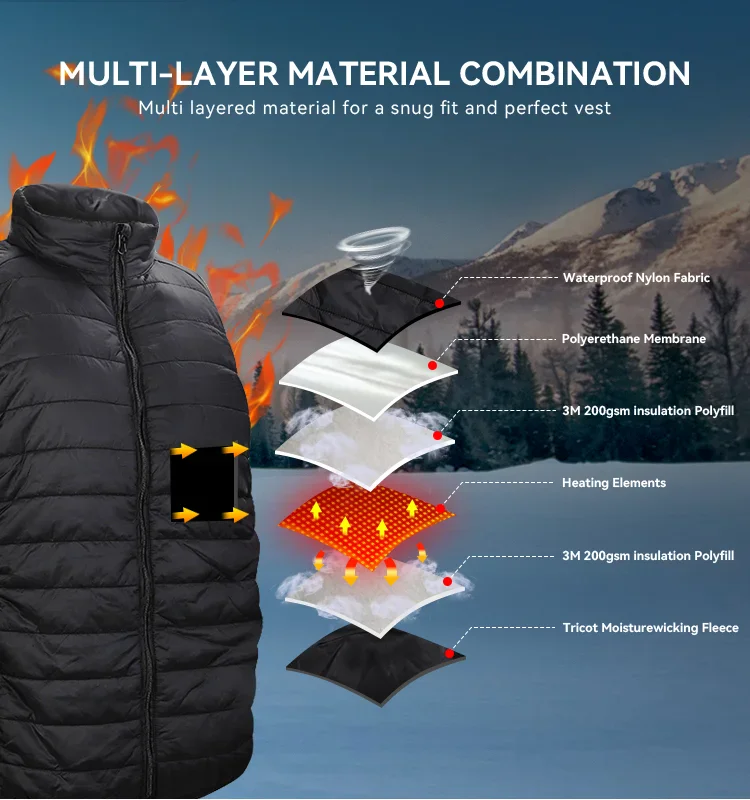
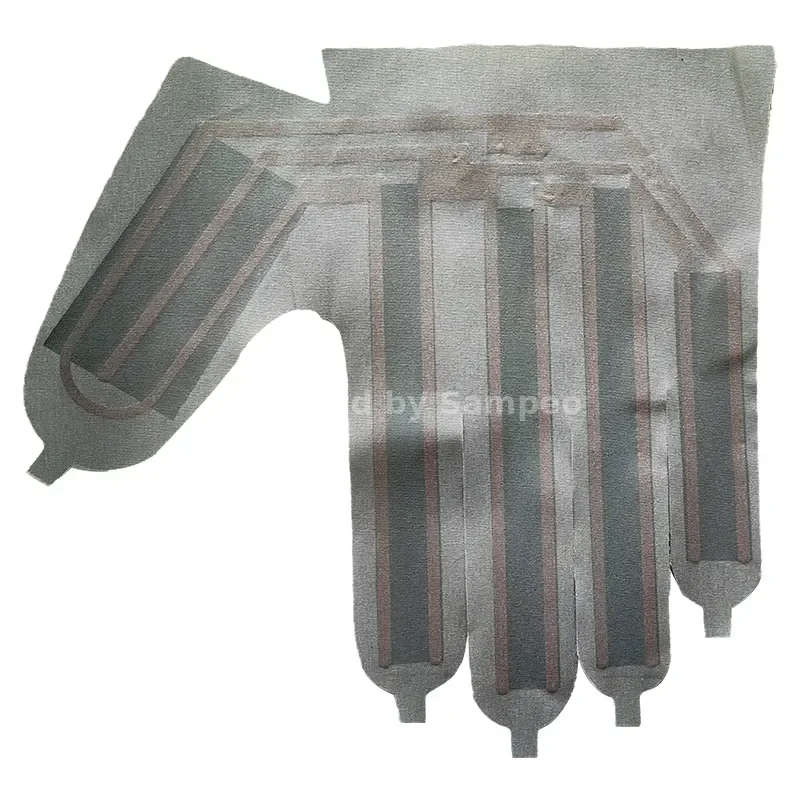
| Heat-panel cutting die (carbon fiber / metallic mesh) | $400 – $1,800 | 80,000 – 120,000 panels | Replace if buyer changes heat-panel supplier |
| Battery pocket mold (single-cavity) | $1,200 – $3,500 | 50,000 – 80,000 pockets | Replace if battery SKU changes (e.g. 7.4V → 11.1V) |
| Wire-routing channel template (silicone or TPU) | $300 – $900 | 60,000 – 100,000 garments | Replace if garment pattern changes |
| Charging-port overmold (USB-C / DC / magnetic) | $1,800 – $4,500 | 30,000 – 60,000 ports | Replace if buyer switches connector type |
| Heating-element placement jig | $500 – $1,200 | 100,000+ placements | Re-usable across SKUs (size only) |
| QC test fixture (heat-map verification) | $800 – $2,000 | n/a (test only) | Re-usable across SKUs |
For a typical 1,000-unit first PO with 3 SKUs (jacket / vest / hoodie), the total upfront tooling investment lands in the $8,000 – $18,000 band. That is the number buyers and suppliers should be aligning on, not a single mysterious “tooling fee.”
—
3. NRE (Non-Recurring Engineering) vs. tooling — what to charge separately
Many heated-apparel OEM/ODM suppliers lump NRE and tooling together on the quote. That confuses the buyer because they have different lifetimes and different amortization math.
- **Tooling** is a physical asset (a die, a mold, a jig). It survives multiple POs. It has a clear unit-life expectation. It can be transferred to another factory if the relationship ends.
- **NRE** is engineering labor: pattern grading, heat-map design, BOM setup, electronics integration drawings, sample-1 / sample-2 / pre-production sample revision cycles. NRE is a service, not an asset.
A clean quote splits them on separate lines:
| Quote line | Type | When buyer gets it back |
|---|---|---|
| Tooling line items (4–6 rows) | Asset amortized over X units | Refundable deposit, returned at unit threshold |
| NRE fee ($1,500 – $4,000 typical) | Service, one-time per project | Non-refundable, even if project cancelled |
| Sample fees (3 samples × $80–$180) | Material + labor per sample | Non-refundable, but credit toward bulk PO |
Suppliers who lump tooling + NRE together usually do it because they do not want the buyer to compare engineering quality across factories. A buyer who insists on the split is doing the right thing.
—
4. Tooling deposit, refund, and transfer clauses (the three contractual pillars)
For private-label heated apparel programs, tooling deposits are 50–100% upfront, refundable against a unit-volume threshold (typically the full unit-life of the cheapest tooling line item). The three contractual clauses that protect both sides are:
1. Refund ladder. Supplier refunds X% of tooling deposit once the buyer’s cumulative PO volume hits Y units. Most factories use a 3-step ladder (30% / 50% / 100%). 2. Tooling ownership during deposit period. The tooling is supplier-owned until the deposit is fully refunded. After full refund, ownership transfers to the buyer (or stays supplier-owned under a perpetual license — buyer’s choice). 3. Transfer-on-termination clause. If the buyer terminates the project mid-tooling, the supplier must offer the buyer three options: (a) keep the tooling in the supplier’s factory for a future project, (b) transfer the tooling to a third factory named by the buyer (with shipping + refurbish fee), (c) scrap the tooling and refund the unused portion based on unit-life consumed.
A buyer who sees these three clauses in the proforma invoice is dealing with a serious OEM/ODM factory. A buyer who does not is dealing with a trading company that has no tooling to refund.
—
5. Mold flow, lead time, and how to compress the 25–35 day window
A standard heated apparel tooling cycle from PO confirmation to first bulk sample runs 25–35 working days, broken down as:
| Phase | Days | Owner | What buyer should expect |
|---|---|---|---|
| Pattern grading + heat-map design | 3–5 | Apparel + electronics engineers | Digital files + heat-map render |
| Tool design + DFM review | 4–6 | Tool maker | 2D/3D drawings for buyer approval |
| Tool fabrication (CNC, EDM, injection) | 10–14 | Tool maker | Factory tour / video update at mid-point |
| First-shot samples (T1) | 3–5 | Apparel factory | Buyer receives 3–5 samples for approval |
| T1 rework (if needed) | 3–7 | Tool maker + factory | T2 samples shipped to buyer |
| Final tooling sign-off | 1–2 | Buyer | Written sign-off + deposit refund trigger set |
The buyer can compress this by parallelizing DFM review with tool fabrication (saves 4–5 days) and by pre-approving the heat-map design before tooling starts (saves 3–5 days). What a buyer cannot compress: the physical CNC machining time for the injection mold for the battery pocket (10–14 days is real). Plan accordingly.
—
6. Common tooling failures and how to prevent them
| Failure mode | What it looks like | Prevention |
|---|---|---|
| Battery pocket too tight for battery | Battery does not slide in cleanly, connector strains | Mold trial with **actual production battery**, not dummy block |
| Wire-routing channel leaves hot spot | Uneven heat distribution, one panel hotter | Heat-map simulation + physical thermocouple test |
| Charging-port overmold cracks in cold | Port flakes off after -10°C / 14°F exposure | Specify cold-flex rating (-20°C cold-crack resistance) in tool spec |
| Heat-panel die wears prematurely | Frayed edges after 30k panels instead of 80k | Hardened tool steel (SKD11 or H13), not generic S50C |
| Cutting die shifts after 50k hits | Panel size drift, fails seam tolerance | Pin-locking die set, not friction-fit |
Most of these failures show up after the first 10,000 units. By then the deposit is long gone. Build the prevention into the tool spec, not the post-mortem.
—
7. Tooling lifetime vs. SKU evolution (when to retire, when to re-use)
Buyers often assume “I paid tooling, I own it forever.” The honest answer is: tooling is SKU-specific, not project-specific. When the buyer changes battery SKU, garment pattern, or connector type, the tooling has to be re-cut or re-molded.
| Scenario | Tooling impact | Cost to refresh |
|---|---|---|
| Same SKU, re-order 5,000 more units | Re-use all existing tooling | $0 |
| New colorway for same SKU | Re-use cutting die, refresh dye-lot | $200 – $500 color set-up |
| New battery vendor (e.g. switching 7.4V to 11.1V) | Replace battery pocket mold | $1,500 – $3,000 |
| New connector type (USB-C to magnetic) | Replace charging-port overmold | $2,000 – $4,500 |
| New garment pattern (jacket → parka) | New cutting die + new routing template | $1,500 – $3,500 |
A smart buyer tracks tooling lifetime as a per-SKU asset register, not as a one-time project cost. This is also why IMISSKY provides a tooling ledger report with every long-term program — so the buyer knows exactly which assets are still alive and which need refresh.
—
8. How IMISSKY structures tooling for private-label B2B programs
IMISSKY’s standard private-label heated-apparel tooling structure for 2026:
- **4–6 separate tooling line items** on every quote, with per-item cost, lifetime, and refund ladder visible.
- **50% tooling deposit upfront**, 50% against T1 sample approval. Full refund triggered at 80% of the shortest tooling lifetime.
- **NRE separated** from tooling on a different invoice line.
- **Tooling ledger report** provided quarterly to active B2B accounts, showing units shipped against remaining life of each tool.
- **Transfer-on-termination clause** in every long-term agreement.
- **Tooling refresh quotes** provided within 48 hours when a buyer announces a battery or connector change.
For buyers evaluating multiple OEM/ODM factories, this structure is the single most important differentiator between a serious supplier and a trading-company intermediary. If the quote does not show this level of detail, ask why.
**Internal link:** For the engineering counterpart of this article covering heating element design, battery management, and the electronics-side tooling of charging-port overmolds, see [Graphene Heating Fabric’s PILLAR #62 tooling guide for engineering teams](/category/oem-odm-manufacturing/). For the buyer-retailer perspective on tooling amortization and unit-cost math, see [Gearplant’s PILLAR #58 tooling playbook for retail buyers](/category/supply-chain/).
—
9. Tooling FAQ for brand owners
Q1. Is tooling refundable? Yes — when you reach the agreed unit-volume threshold (typically 80% of the shortest-lifetime tooling item). Refund is automatic if your PO history hits the trigger; you do not need to re-negotiate.
Q2. Who owns the tooling during the deposit period? The supplier owns it. After full deposit refund, ownership transfers to the buyer by default. Some buyers opt for the supplier to keep perpetual ownership under a tooling-license model.
Q3. What happens to tooling if the project is cancelled mid-PO? Three options: keep at the supplier’s factory for a future project, transfer to a third factory (with shipping + refurbish fee), or scrap and refund the unused portion based on consumed lifetime.
Q4. Can I move the tooling to another factory if I switch suppliers? Yes — provided the original supplier agrees to release it. The transfer clause guarantees this. Expect 2–4 weeks of paperwork + shipping + refurbish + requalification at the new factory.
Q5. How long does tooling take from PO to T1 sample? Standard cycle is 25–35 working days. Compressed cycles of 18–22 days are possible with parallel DFM review and pre-approved heat-map, but never shorter than 18 days (CNC machining has a physical floor).
Q6. Do I pay separate tooling for jacket, vest, hoodie? Yes — each SKU has its own cutting die and routing template. Battery pocket and charging-port molds can be shared across SKUs if the battery and connector are the same.
Q7. What is the smallest order I can place to use existing tooling? There is no minimum if the existing tooling fits the SKU. Typical private-label re-orders start at 200–500 units per SKU. The factory will re-run the heat-map QC fixture, but does not re-cut tooling.
Q8. Can I bring my own tooling? Yes, but expect a $300–$800 fit-check + trial fee per SKU. Some suppliers refuse buyer-supplied tooling for liability reasons; serious OEM/ODM factories accept it with a written fit-check report.
Q9. Does tooling include CE / FCC / UL certification? No — certification is a separate line item. Tooling is the physical asset; certification is the testing + paperwork to enter a market (CE-RED, FCC Part 15B, UL 9540 for battery heating systems).
Q10. How do I budget for tooling refresh in year 2? Reserve 15–25% of original tooling cost as a refresh line item in year-2 forecasts. This covers typical SKU evolution (new colorway, new battery, new connector).
Q11. What is the difference between tooling and NRE? Tooling = physical asset (die, mold, jig). NRE = engineering service (pattern grading, heat-map design, BOM setup, sample revision). NRE is non-refundable; tooling is refundable against unit volume.
Q12. Can tooling be amortized into unit price instead of paid upfront? Yes — most suppliers offer amortized tooling at +$0.30 – $1.20 per unit across the first 5,000 units, after which the per-unit surcharge drops to zero. Compare this carefully against upfront deposit: amortizing usually costs 20–40% more over the project life.
—
10. Glossary
- **NRE** — Non-Recurring Engineering charge, covering pattern grading, heat-map design, BOM setup, and sample revision cycles. One-time fee, non-refundable.
- **Tooling deposit** — Upfront payment for physical tooling assets (die, mold, jig). Refundable against unit-volume threshold.
- **Heat-panel cutting die** — Steel rule die used to cut carbon-fiber or metallic-mesh heating panels to garment-panel shape.
- **Battery pocket mold** — Injection-molded or welded pocket that houses the lithium-ion battery pack inside the garment.
- **Wire-routing channel template** — Silicone or TPU template that lays down wire routes inside the garment liner.
- **Charging-port overmold** — Injection-molded port housing (USB-C / DC barrel / magnetic pogo) that integrates the connector into the garment.
- **QC test fixture** — Bench-top fixture that verifies heat-output uniformity across the garment using thermocouples.
- **DFM review** — Design for Manufacturing review, where the tool maker and the buyer’s engineering team agree on tolerances, draft angles, and material flow before CNC starts.
- **T1 sample** — First-shot sample produced from new tooling, used for buyer approval before full production.
- **OEM / ODM** — Original Equipment Manufacturer / Original Design Manufacturer; OEM builds to buyer spec, ODM contributes design + manufacturing.
—
11. Conclusion
Heated apparel tooling is not a single mysterious fee — it is a structured set of 4–6 physical assets with predictable lifetimes, refund ladders, and refresh triggers. A serious OEM/ODM supplier shows every line on the quote, separates NRE from tooling, and offers a tooling-ledger report with every long-term program. A buyer who negotiates on this level of detail ends up with a supplier who can defend every tooling dollar — and a program that survives the first re-order, which is the only order that actually matters for tooling payback.
IMISSKY’s B2B team publishes one PILLAR per day on private-label heated-apparel sourcing. This article is PILLAR #58 in the cycle-3 tooling rotation. Pair it with our [contract manufacturing factory audit guide (PILLAR #57)](/category/oem-odm-manufacturing/) for the pre-tooling qualification step, and watch for PILLAR #59 (capacity planning) next week.
—
This is a B2B supplier-view article. For engineering-side tooling of charging-port overmolds and battery-pack housings, see Graphene Heating Fabric PILLAR #62. For buyer-retailer amortization math, see Gearplant PILLAR #58.