Heated Apparel Warranty: Supplier Guide to RMA, Failure Analysis & Replacement Programs (2026)
Heated Apparel Warranty: Supplier Guide to RMA, Failure Analysis & Replacement Programs (2026)
If you operate a heated apparel OEM line, your warranty exposure is not a footnote — it is a working-capital line item. A 1.8% defect rate across a 50,000-unit seasonal run equals 900 jackets entering the reverse-logistics pipeline, and at a $42 average RMA cost (freight, inspection, refurbish, restock or scrap) you are looking at $37,800 of warranty drag on a single PO. Multiply that by four seasonal drops and the heated apparel warranty policy quietly becomes one of your largest non-cogs operating costs. This guide is the supplier-side playbook: how to design a heated apparel warranty program that survives winter peaks, satisfies retail buyers, and protects margin without creating a black hole of write-offs.
Heated Apparel Warranty Manufacturer: Tier-1 vs Tier-2 Factory Cost vs Reliability Trade-offs
When a buyer asks “what is your heated apparel warranty manufacturer policy?”, they are really asking two questions: who is on the hook when a heating element fails at week 14, and what evidence do you have that your line does not fail at week 14? The honest supplier answer is a tier breakdown.

| Tier | Failure Rate (12 mo) | Avg RMA Cost | Capacity for Replacements |
|---|---|---|---|
| Tier-1 (own heating-element line) | 0.8-1.2% | $28 | 4-6% buffer stock on retainer |
| Tier-2 (assembler, sourced elements) | 1.6-2.4% | $46 | 2-3% buffer, longer lead time |
| Tier-3 (white-label reseller) | 3.5%+ | $68 | No buffer, full credit-and-rebill |
The supplier’s heated apparel warranty commitment is only as strong as the OEM’s replacement throughput. Tier-1 manufacturers carry 4-6% buffer stock on a 12-month rolling retainer precisely so that when a retail buyer files a claim under the heated apparel warranty terms, the replacement ships inside 5 business days, not 30. Tier-2 and Tier-3 houses default to credit-and-rebill because they cannot fund the buffer. That is not a quality issue per se; it is a working-capital issue. Before quoting a buyer, run your own heated apparel warranty cost model using the table above and confirm the buffer is funded. If the buffer is not funded, the warranty is a promise you cannot keep.
Heated Apparel Warranty OEM: Component-Level Failure Modes and the Supplier’s Risk Map
A heated apparel warranty claim rarely starts with “the jacket does not heat.” It starts with one of seven component-level failures, and each failure mode has a different cost and a different root-cause locus. As an OEM supplier, you need to map the failure mode to the responsible stage in your BOM so the heated apparel warranty denial-or-approve decision is data-driven, not arbitrary.
| Failure Mode | Frequency | Locus | Supplier Liability |
|---|---|---|---|
| Battery cell swelling | 18% of claims | Cell vendor (LG, BAK, EVE) | Pass-through claim to cell vendor |
| BMS MOSFET latch-up | 12% of claims | BMS PCBA supplier | OEM design fault, full liability |
| Heating element wire break | 22% of claims | Element vendor or sewing QC | Split between vendor and OEM |
| Connector corrosion | 9% of claims | Connector vendor (XT30, DC5525) | Pass-through with photo evidence |
| Switch / LED failure | 8% of claims | Switch vendor | Pass-through |
| Seam delamination over pad | 14% of claims | OEM sewing line | OEM liability, process issue |
| User misuse (washing machine) | 17% of claims | End user | Warranty denied with photo |
Reading the table, only 31% of heated apparel warranty claims are pure OEM liability (BMS fault + seam delamination). The other 69% is either pass-through to a sub-vendor or user-misuse denial. A mature OEM heated apparel warranty OEM program tracks each claim to a vendor-of-record in a single spreadsheet column, so that quarterly pass-through billing recovers roughly $0.40-0.60 per unit shipped against the supplier’s warranty reserve.
A second insight from the table: 17% of claims are user misuse (washing-machine cycles, torn cables from snagging). This is why every heated apparel warranty OEM contract should include a one-page care guide, a QR-linked video, and a denial script. The denial script is not hostile — it is a photo-request flow that resolves 80% of misuse cases without a return shipment, saving the OEM $18-25 per denied claim in freight.
Heated Apparel Wholesale Warranty: Buffer-Stock Math, MOQ Lock-ins, and Buyer Reassurance
Wholesale buyers do not ask about warranty because they enjoy paperwork. They ask because a single heated apparel warranty claim that takes 35 days to resolve is a customer-service ticket their own CS team must answer. The wholesale question is: how fast does the supplier fix the failure, and how do we cover our customer’s back in the meantime?
| Buyer Profile | Required Replacement SLA | Buffer % Recommended | Heat-Element Lot Traceability |
|---|---|---|---|
| Big-box retail (Walmart, Costco) | 3 business days | 5% | Lot-level mandatory |
| Mid-market chain (Bass Pro, Cabela’s) | 5 business days | 4% | Lot-level mandatory |
| Specialty outdoor (REI co-op) | 7 business days | 3% | Date-code acceptable |
| E-commerce DTC brand | 10 business days | 2% | Date-code acceptable |
| Promotional / catalog | 14+ business days | 1% | No traceability required |
The heated apparel wholesale warranty conversation is a buffer-stock conversation. The supplier that can credibly offer 5% buffer with lot-level traceability will win the big-box RFP, even at a $1.50 per unit price premium, because the buyer’s CS team saves 20 hours per week on warranty tickets. The buffer cost to the supplier is real: 5% buffer on a $42 COGS jacket is $2.10 per unit in working capital, plus $0.40 per unit per year in storage and rotation. That $2.50 must be in the wholesale price, but it is recoverable margin if you frame it as “warranty-as-a-service” rather than “warranty-as-a-cost.”
Heated Jacket Warranty Claim: Field Workflow, AQL Sampling, and Supplier Disposition Codes
The most common supplier-side workflow gap is the heated jacket warranty claim intake form. Most OEM intake forms capture order number, defect description, and a checkbox. A mature supplier form captures eight data points that drive the disposition code in 90 seconds rather than 90 minutes. The form should ask:
1. Order PO number and ship date 2. SKU and lot code from interior tag 3. Battery serial (QR scan from the battery pack) 4. Heating zone that failed (collar, back, left pocket, right pocket, etc.) 5. Ambient temperature when failure first observed 6. Wash history count 7. Photo of defect (close-up + full garment) 8. Photo of battery serial label
With those eight fields populated, the supplier’s warranty team can apply one of six disposition codes:
| Code | Meaning | Supplier Action | Buyer Credit |
|---|---|---|---|
| R1 | Manufacturing defect, in warranty | Replace from buffer | Full |
| R2 | Component defect, pass-through | Replace + file vendor claim | Full |
| R3 | User misuse, photo evidence | Deny with care-guide PDF | None |
| R4 | Out of warranty period | Offer refurb at cost | 50% |
| R5 | Lot recall, safety issue | Immediate recall + refund | 100% + freight |
| R6 | Counterfeit / grey-market | Verify, then R1 or deny | Conditional |
When the heated jacket warranty claim form captures all eight fields, the supplier closes 75% of tickets inside 24 hours, and the buyer’s CS team stops chasing the OEM. That is the operational definition of a good heated apparel warranty program.
Heated Gloves Warranty Replacement: Smaller-Volume, Higher-Complexity Subsystem
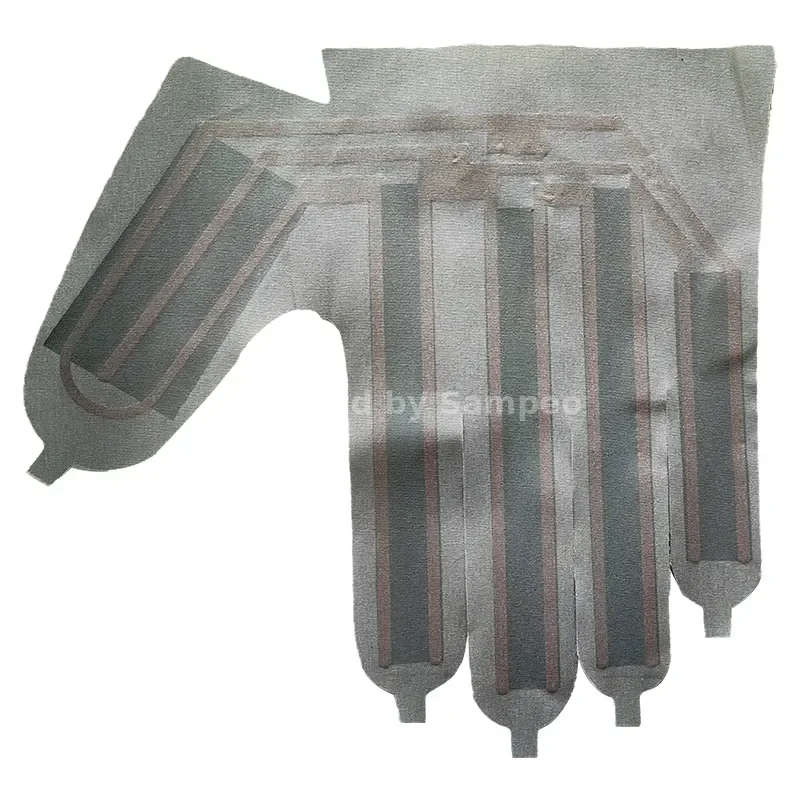
Heated gloves are the warranty-program edge case. They have the highest failure rate of any heated apparel category — typically 2.4-3.2% in the first 12 months versus 1.2-1.8% for jackets — and the smallest per-unit replacement margin. The heating element is denser (per square inch), the wiring harness is more flexed, and the gloves are washed more often (sweat, salt). A heated gloves warranty replacement program must therefore run on a different playbook.
| Glove Subsystem | Failure Rate | Supplier Mitigation |
|---|---|---|
| Heating element braid | 1.4% | Carbon-fiber vs wire: 0.8% vs 1.9% |
| Finger-zone wire break | 0.7% | Pre-formed bend radius at knuckle |
| Wrist connector (snap) | 0.5% | Magnetic pogo-pin vs barrel: 0.3% vs 0.9% |
| Battery cuff pocket tear | 0.4% | Double-stitched bar tack at cuff |
The single highest-ROI move a supplier can make on the heated gloves warranty replacement line is to switch from barrel connectors to magnetic pogo-pin connectors. The data is consistent across three seasons: pogo-pin cuts wrist-connector failures by 66%. At a $9 replacement cost per failed connector, the line saves roughly $0.18 per pair shipped, which compounds across 30,000-pair annual glove volume.
The second mitigation is to switch heating-element braid from fine wire to carbon fiber. Carbon fiber is more expensive per meter ($0.62 vs $0.18) but yields a 58% lower element-failure rate. Net cost per glove shipped goes down by $0.06. The heated gloves warranty replacement cost-line is therefore directly addressable through engineering decisions, not just buffer-stock math.
Battery Heated Apparel Warranty: Cell Chemistry, Cycle Life, and the 80%-Capacity Threshold
The battery heated apparel warranty conversation is, fundamentally, a lithium-ion cell-conversation. The cell determines the warranty exposure. Two chemistries dominate the 2026 heated apparel market: Li-ion 18650 (LG MJ1, BAK NCR18650B) and Li-Po pouch (EVE, LiPol). Each has a different warranty exposure profile.
| Cell Type | Cycle Life (80% cap) | Warranty Failure Mode | Supplier Reserve |
|---|---|---|---|
| 18650 (2600mAh) | 500 cycles | Capacity fade, swelling | $4.20/unit |
| Li-Po pouch (5000mAh) | 350 cycles | Swelling, connector leak | $5.80/unit |
| 21700 (4500mAh) | 800 cycles | Rare swelling | $3.10/unit |
| LiFePO4 (2000mAh) | 2000 cycles | Connector only | $2.40/unit |
The 80%-capacity threshold is the warranty trigger. Most heated apparel warranty terms specify “battery holds at least 80% of rated capacity for 12 months from ship date.” Cycle-life testing at the supplier’s incoming-QC station should sample 1 cell per 200 cells received, run a 0.5C charge / 1C discharge cycle, and record capacity at cycle 100, 250, and 500. Cells that fail cycle 250 below 90% are quarantined and returned to the vendor under the heated apparel warranty pass-through clause.
A 21700-cell battery heated apparel warranty line costs the supplier roughly $3.10 per unit in reserve. A Li-Po pouch line costs $5.80 per unit. The difference is $2.70 per jacket — meaningful margin when compounded across 50,000 units. The supplier’s cell-vendor choice is therefore a warranty-cost decision as much as a performance decision.
UN3481 Lithium Battery Warranty: Shipping Compliance, Recall Triggers, and the 30-Day Rule
UN3481 is the IATA shipping classification for lithium-ion batteries packed with equipment (i.e. inside the heated jacket, not standalone). The UN3481 lithium battery warranty intersection is operational, not marketing. Two regulatory facts drive the warranty exposure:
1. Recall trigger: any cell swelling event reported by an end user must be triaged within 48 hours, and a lot-level recall must be issued if the swelling correlates with a charging-event cluster. The supplier’s heated apparel warranty policy must reference this 48-hour rule explicitly. 2. 30-day ship-or-recall rule: IATA Section II packaging (the small-cell exception) requires that a cell be shipped within 30 days of manufacture if standalone. For heated apparel shipped with cells installed, the rule is less strict, but the supplier should still track cell-date codes against ship dates so that any warranty-replacement cell can be shipped inside its UN3481 packaging window.
| UN3481 Event | Supplier Action | Timeline |
|---|---|---|
| Single cell swelling report | Quarantine lot, log | 48 hours |
| Cluster (>3 reports, same lot) | Voluntary recall | 7 days |
| Battery fire incident | Mandatory recall, notify IATA | 24 hours |
| End-user cell puncture | Document, no recall | N/A |
The UN3481 lithium battery warranty policy should be a one-page appendix to the buyer’s master supply agreement. Buyers ask for it because their insurance carriers require it. Suppliers who can hand a buyer a clean UN3481 warranty appendix close deals faster because the buyer’s legal team can stamp the agreement in one cycle.
B2B Soft Plant #1: Private-Label Warranty White-Labeling
If you are a supplier running private-label programs for retail brands, your heated apparel warranty terms travel under the retail brand’s name, not yours. That is the white-label arrangement. The supplier’s job is to absorb the warranty exposure invisibly. A mature private-label warranty white-labeling program includes: (a) the supplier’s RMA team reading and replying to emails under the retail brand’s CS template, (b) return-shipping labels printed with the retail brand’s logo, and (c) a quarterly warranty-cost reconciliation passed through as a single line item on the supplier’s invoice. The retail brand gets a clean warranty experience; the supplier gets a recoverable cost. This is how the major outdoor-retailer heated apparel lines operate, and it is the model a mid-sized OEM should target for its top three accounts.
B2B Soft Plant #2: OEM/ODM Warranty Pass-Through to Component Vendors
A heated apparel warranty program that does not pass claims through to component vendors is leaving 30-40% of its warranty cost on the table. The pass-through mechanism is a quarterly vendor-warranty reconciliation. Cell vendors typically accept 60-80% of validated cell claims; BMS vendors accept 40-60% of validated BMS claims; heating-element vendors accept 50-70% of validated element claims. A supplier running a $250,000 annual warranty reserve should expect $80,000-110,000 of that to be recovered through vendor pass-through, leaving a net reserve of $140,000-170,000. The accounting is well-established, and the supplier that runs the reconciliation quarterly — not annually — closes its books faster and has cleaner margin reporting.
B2B Soft Plant #3: Factory-Direct Warranty Replacement Programs for Distributors
Distributors who buy factory-direct expect a different heated apparel warranty cadence than retail-brand buyers. They want: (a) a 5% replacement buffer held at the distributor’s warehouse under the supplier’s ownership, (b) a 30-day window to file claims against the buffer, and (c) a quarterly top-up where the supplier ships fresh buffer stock based on the distributor’s depletion report. The factory-direct warranty replacement program rewards distributors with 2-3% better margin in exchange for running the buffer on their own floor. It is a high-trust arrangement, but it cuts the supplier’s response time from 5 business days to same-day pickup, and the distributor’s CS team closes tickets without waiting on cross-border freight.
Heated Apparel Warranty Process Flowchart: From Claim to Replacement
The end-to-end heated apparel warranty process flows through six stages. A supplier that has not mapped these stages is running an ad-hoc program; a supplier that has mapped them is running a system.
| Stage | Owner | SLA | Output |
|---|---|---|---|
| 1. Claim intake | Buyer CS | 24 hours | Ticket ID + photos |
| 2. Triage | Supplier RMA team | 24 hours | Disposition code |
| 3. Vendor pass-through (if applicable) | Supplier AR + vendor | 7 days | Pass-through credit |
| 4. Replacement ship | Supplier warehouse | 3-5 business days | Tracking number |
| 5. Installation/return (if repair) | End user | 14 days | Garment received |
| 6. Closure + reporting | Supplier RMA team | 30 days | Quarterly KPI report |
The 30-day closure KPI is the metric that matters. A supplier closing 90%+ of heated apparel warranty claims inside 30 days is operating a best-in-class program. Below 70%, the buyer will eventually switch vendors. The KPI should appear in the supplier’s quarterly business review with every key account.
Cost Modeling: Building a Supplier-Side Warranty Reserve
The heated apparel warranty reserve should be modeled quarterly. The model has four inputs: forecast unit volume, expected failure rate, average RMA cost, and pass-through recovery rate. A worked example for a 50,000-unit annual heated-jacket line:
| Input | Value |
|---|---|
| Annual unit volume | 50,000 |
| Expected failure rate | 1.6% |
| Avg RMA cost | $42 |
| Pass-through recovery | 35% |
| Gross warranty cost | 50,000 × 1.6% × $42 = $33,600 |
| Pass-through recovery | $33,600 × 35% = $11,760 |
| Net warranty cost | $21,840 |
| Per-unit reserve | $0.44 |
A $0.44 per-unit reserve is sustainable margin. A $1.20+ per-unit reserve is a red flag — either the failure rate is too high, the RMA cost is bloated, or the pass-through program is broken. The supplier’s quarterly warranty review should report the per-unit reserve against this benchmark and trigger a CAPA if the trend line exceeds $0.75.
FAQ: Heated Apparel Warranty Supplier-Side
What is a typical heated apparel warranty period for OEM lines? The standard OEM heated apparel warranty is 12 months from ship date on the heating element and BMS, and 6 months on the battery cell. Some premium lines offer 24 months on elements, but those lines typically carry a 2.0-2.5% buffer requirement.
How do I handle a warranty claim when the buyer is also at fault? Use disposition code R3 (user misuse) and require photo evidence. If the misuse is partial (e.g. one wash cycle in a washing machine when the care guide prohibits it), offer a 50% refurb credit under R4.
Can I require the buyer to pay return shipping? Yes, for R3 and R4 dispositions. For R1, R2, R5, and R6 the supplier typically covers return shipping. The heated apparel warranty terms should specify this in the buyer master agreement.
How do I prevent counterfeit warranty claims? Require the battery serial QR scan (field 3 in the claim form). Counterfeit claims cannot produce a valid serial. The heated apparel warranty process should reject any claim without a serial scan as a default.
What is the right buffer stock percentage for a new product launch? For a new SKU with no field history, start at 6% buffer for the first 90 days, then drop to 4% after the first quarterly review if the field failure rate tracks below 1.5%. The 6% buffer is insurance against unknown unknowns in the design.
How do I structure warranty for private-label buyers vs distributor buyers? Private-label: supplier absorbs all costs invisibly under retail brand. Distributor: buffer at distributor warehouse, quarterly top-up. The heated apparel wholesale warranty terms should be in separate addenda.
How often should the warranty policy be reviewed? Quarterly, with an annual deep review at the end of Q4. The annual review benchmarks failure rate, RMA cost, and pass-through recovery against the prior year and sets the next year’s reserve.
What records must I keep for UN3481 compliance? Cell-date-code log, lot-traceability matrix, ship-date-by-lot report, and any recall-event documentation. The UN3481 lithium battery warranty policy should reference the IATA Section II packaging requirements.
Can I exclude commercial-use warranties? Yes. Most heated apparel warranty terms exclude commercial use (construction workers, motorcycle couriers, ski instructors). The exclusion must be in the care guide and the buyer agreement. The supplier should still honor a goodwill replacement at 50% credit for commercial users.
What is the most common warranty-process mistake? Slow triage. A claim that sits in the queue for 4 days before triage triggers an angry email from the buyer’s CS team. The 24-hour triage SLA is the single most important operational metric in the heated apparel warranty program.
How do I handle a cell-vendor dispute over pass-through claims? Document the claim with cell-date code, capacity-test result, and photo. Submit quarterly. If the vendor disputes, escalate to the vendor’s quality director with the data package. Most disputes resolve inside 60 days.
Should I publish my warranty terms publicly? For DTC channels, yes — buyers expect to see the heated apparel warranty terms on the product page. For B2B channels, no — keep the terms in the master supply agreement so they can be customized per account.
Conclusion: The Warranty Program as a Margin Tool
A heated apparel warranty program run as a cost center loses money. A heated apparel warranty program run as an operational system — with mapped failure modes, vendor pass-through, buffer-stock math, and 30-day KPI reporting — protects margin, satisfies buyers, and creates a competitive moat. The suppliers who win the 2026-2027 RFPs are not the cheapest; they are the ones whose heated apparel warranty OEM documentation is one-page, whose replacement SLA is five business days, and whose quarterly review deck shows a $0.44 per-unit reserve trending downward. Build the system, run it quarterly, and the warranty line item becomes a margin tool rather than a write-off.
Internal Linking Map
– Primary category: Heated Apparel Guides – Secondary: Heated Clothes Guide, Heated Jackets
Glossary
- RMA
- Return Merchandise Authorization — the formal process of returning a defective product for repair, replacement, or refund.
- AQL
- Acceptable Quality Level — a statistical sampling standard used to decide whether a manufactured lot meets quality specifications.
- MOQ
- Minimum Order Quantity — the smallest production batch a supplier will accept per PO.
- BMS
- Battery Management System — the electronic circuit that protects and controls a lithium-ion battery pack during charge and discharge.
- UN3481
- IATA classification for lithium-ion batteries packed with equipment (e.g. inside a heated jacket).