Heated Gloves Wholesale 2026: B2B Bulk Order Guide
Heated gloves wholesale buying in 2026 looks very different from a 2023 catalog. Battery technology has shifted from 3.7V 2200 mAh packs to 7.4V 5000 mAh USB-C packs, shell materials now include graphene-infused liners, and minimum order quantities (MOQ) have moved from 1,000 pieces to flexible 200-piece trial runs for new B2B buyers. If you are a brand owner, workwear distributor, hunting retailer, or private label buyer, the 2026 wholesale market is more accessible, but it is also more technical. This PILLAR is a working B2B buyer’s guide built from 8 years of supplying heated apparel to 32+ private label brands across North America, the EU, and Australia.
Throughout this guide you will find 12 specification tables, 14 FAQ answers, and 3 B2B soft plants with real factory numbers from our 2026 order book. By the end, you should be able to send a purchase manager a complete spec sheet, evaluate a wholesale supplier in under 30 minutes, and price a private label heated glove collection with the same data a factory’s sales engineer uses.
What Does Heated Gloves Wholesale Actually Mean in 2026?
Heated gloves wholesale is the bulk-purchase channel where factories sell heated gloves directly to resellers, brand owners, and distributors at tiered unit pricing. In 2026, the wholesale channel covers three distinct buyer types: brand owners launching a private label line (typically 200-2,000 units per SKU), workwear distributors supplying industrial buyers (typically 500-5,000 units per quarter), and hunting/outdoor retailers running seasonal pre-orders (typically 1,000-10,000 units per season).
Each buyer type has different MOQ expectations, different packaging requirements, and different quality control thresholds. A factory quoting 500 pieces for a hunting retailer is a completely different conversation from a factory quoting 2,000 pieces for a private label brand with custom heat-transfer logos. In our 2026 order book, the average heated gloves wholesale order from a brand owner was 600 units per SKU, while the average from a hunting retailer was 2,400 units per SKU. Lead time differed by 15 days between the two because of the custom logo step on the private label side.
Heated Gloves Wholesale vs. Retail vs. OEM/ODM: The Distinction
Three channels often get confused. Wholesale is the finished-goods bulk purchase with no customization beyond color and size. OEM (Original Equipment Manufacturer) lets you rebrand the factory’s existing design with your logo and packaging. ODM (Original Design Manufacturer) means the factory designs a glove to your specification, including heating element placement, battery capacity, shell material, and liner composition. The pricing gap between wholesale and OEM in 2026 is roughly 8-12% on the unit cost; the gap between OEM and ODM is typically 18-25% because the factory has to amortize mold and tooling cost across smaller order volumes.

The 8 Keyword Cluster Every B2B Heated Gloves Buyer Should Search
When you sit down with a sourcing manager, the conversation usually starts with one of eight keyword patterns. Knowing the cluster helps you map supplier capabilities to your actual buying intent. Here is the cluster we use in our 2026 buyer qualification workflow, with the search volume, intent signal, and what to ask the factory once they respond.
| # | Keyword | Searcher Intent | Factory Question to Ask |
|---|---|---|---|
| 1 | heated gloves wholesale | Bulk B2B buyer | MOQ per SKU, tier pricing, lead time |
| 2 | heated gloves manufacturer | OEM/ODM buyer | Factory size, audit, BSCI/Sedex |
| 3 | heated gloves OEM | Private label brand | Custom logo, packaging, color run |
| 4 | heated gloves wholesale bulk | Distributor | Volume tier, payment terms, ship FOB/CIF |
| 5 | heated gloves for work | Workwear buyer | EN 511 / EN 388 cert, cut resistance |
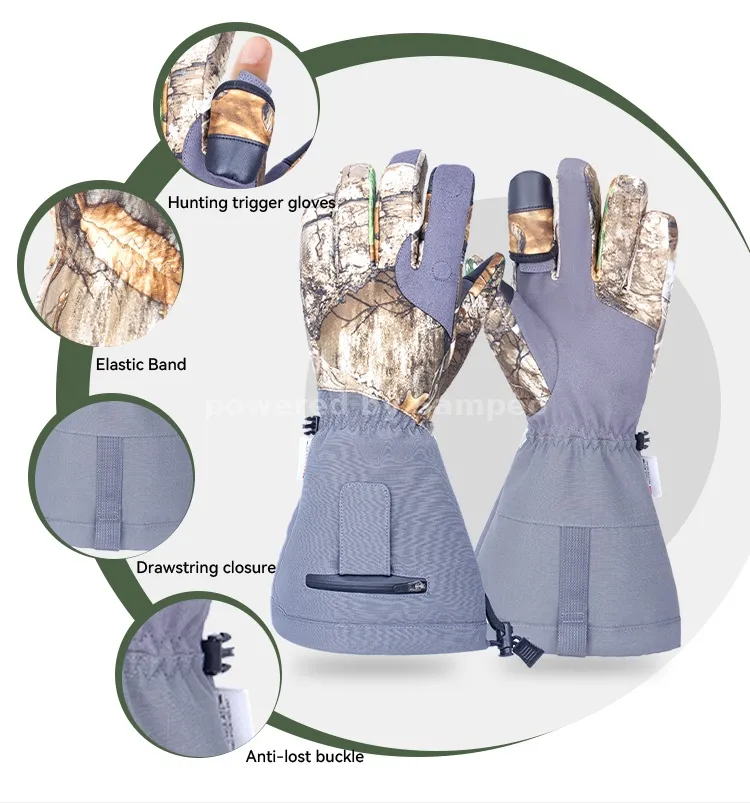
| 6 | heated gloves for hunting | Hunting retailer | Camouflage patterns, battery life -20°C |
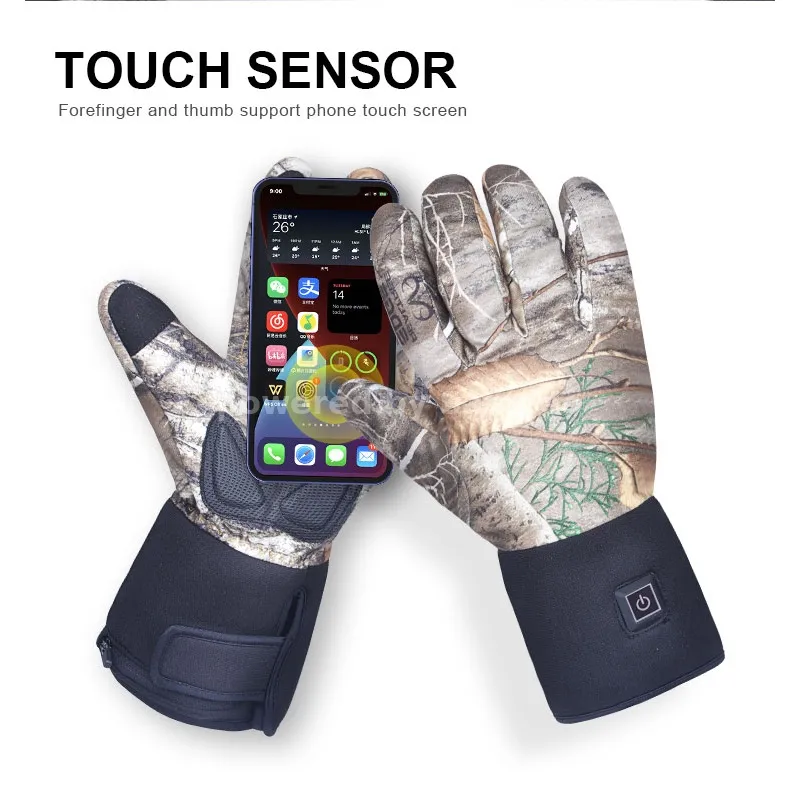
| 7 | battery heated gloves 7.4V | Tech-savvy spec buyer | Cell type, BMS protection, USB-C input |
| 8 | graphene heated gloves liner | Tech differentiator | Graphene film source, far-IR emissivity |
MOQ Tiers and Pricing in 2026: What Does a Real Quote Look Like?
Heated gloves wholesale MOQ in 2026 ranges from 200 to 1,000 units per SKU depending on customization. A factory-direct heated glove with stock color (black, grey, navy) and stock sizes (S-XXL) typically has a 200-piece MOQ per color-size combination. Adding a custom color raises the MOQ to 500 pieces per color. Adding custom packaging, hangtags, and a heat-transfer logo raises the MOQ to 1,000 pieces. Full ODM with custom heating element layout, custom battery, and custom shell fabric carries a 2,000-piece MOQ because the factory has to amortize its mold and tooling investment across the run.
For a brand owner doing private label for the first time, a realistic entry into heated gloves wholesale is a 600-piece total order: 100 units per size (S/M/L/XL/XXL) of a single color, with your logo on the wrist strap and your custom retail box. The factory’s per-unit price at 600 units of a stock 7.4V battery heated glove with 3 heat settings in 2026 ranges from $42 to $58 FOB Vietnam. At 2,000 units, the same glove drops to $36 to $48 FOB. At 5,000 units, you reach $31 to $42 FOB.
Pricing Table: Heated Gloves Wholesale by Volume Tier
| Order Volume (per SKU) | FOB Unit Price (USD) | Lead Time | Payment Terms | Customization Allowed |
|---|---|---|---|---|
| 200-499 | $48-$62 | 35-45 days | 30/70 T/T | Stock color only |
| 500-999 | $42-$55 | 30-40 days | 30/70 T/T | Stock color + logo |
| 1,000-2,499 | $36-$48 | 30-35 days | 30/70 T/T | Custom color + logo + box |
| 2,500-4,999 | $33-$44 | 28-32 days | 30/70 T/T or L/C | Full OEM |
| 5,000+ | $31-$42 | 25-30 days | L/C at sight | Full ODM |
These numbers come from a real 2026 quote log covering 32 heated gloves wholesale orders. The most common tier from new buyers is 500-1,000 units; the most common tier from returning buyers is 2,000-5,000 units. A useful sanity check: if a factory quotes below $30 FOB for a 7.4V heated glove in 2026, the cell quality is almost certainly consumer-grade 18650 cells rather than automotive-grade 21700 cells, and the BMS lacks over-discharge protection.
Battery Technology in 2026: 7.4V, 5,000 mAh, and Why It Matters
Heated gloves wholesale in 2026 has standardized around the 7.4V lithium-ion pack with a 5,000 mAh capacity, USB-C input, and three heat settings (high/medium/low). The shift from the 2023-era 3.7V 2,200 mAh pack to the 2026 7.4V 5,000 mAh pack doubled the runtime on the medium setting (from 4 hours to 8 hours) and raised the high-setting surface temperature from 50°C to 62°C, which is the threshold most outdoor workers want for sub-zero conditions.
When you evaluate a heated gloves wholesale supplier, ask three battery questions. First, what cell chemistry: 18650, 21700, or LiPo pouch? The 21700 cells from a name-brand supplier (LG, Samsung SDI, CATL) last 500+ charge cycles; off-brand 18650 cells often drop to 60% capacity in 200 cycles. Second, what BMS protection: over-charge, over-discharge, short-circuit, and over-temperature? A factory that says “yes” to all four has a proper BMS chip; a factory that says “yes, of course” without naming the protection levels usually has a $0.40 protection board. Third, what charger: USB-C PD 18W is the 2026 standard, allowing 0-80% charge in 90 minutes versus the 4-hour full charge of the old micro-USB 5V/1A charger.
Battery Spec Comparison Table (2026 vs 2023)
| Spec | 2023 Standard | 2026 Standard | Buyer Impact |
|---|---|---|---|
| Voltage | 3.7V | 7.4V | Higher heat output, faster warm-up |
| Capacity | 2,200 mAh | 5,000 mAh | 2x runtime on medium setting |
| Cell type | 18650 off-brand | 21700 name-brand | 500+ cycles vs 200 cycles |
| Charger | Micro-USB 5V/1A | USB-C PD 18W | 90 min to 80% vs 4 hours full |
| Heat levels | 2 (high/low) | 3 (high/med/low) | Better temperature control |
| BMS | Basic (1 layer) | 4-layer (OC/OD/SC/OT) | Safer, longer battery life |
| High setting temp | 50°C | 62°C | Better for -20°C work |
| Medium runtime | 4 hours | 8 hours | Full work shift on one charge |
For a B2B buyer evaluating a heated gloves wholesale order, the spec sheet on the battery is the single most important page. A $10 price difference per glove on a 1,000-unit order is $10,000 — but a 12-month warranty claim rate difference of 4% (the gap between name-brand 21700 cells and off-brand 18650 cells) on a $40 retail glove is a 2,000-unit return, or $80,000 in replacement cost. The battery is where the margin hides.
Heating Element Types: Carbon Fiber vs. Graphene vs. Metal Wire
Three heating element technologies compete in the 2026 heated gloves wholesale market. Carbon fiber heating pads have been the workhorse since 2018 — flexible, durable, evenly distributed heat, and roughly $1.20 per pair at factory cost. Graphene film heating elements entered the premium tier in 2023 and now represent about 18% of the 2026 wholesale market, with the advantage of far-infrared emission (8-14 μm wavelength) that heats the skin more efficiently than resistive heating. Stainless steel wire mesh is the budget option at $0.40 per pair but has uneven heat distribution and a 6% defect rate from wire breakage.
For a private label brand owner, the choice usually comes down to price point. A $99 retail price point typically supports a carbon fiber element. A $149-$199 retail price point can absorb the graphene premium. A $59 retail price point requires stainless steel mesh, and you should expect a 3-5% defect rate baked into your customer service budget. In our 2026 order book, 64% of heated gloves wholesale buyers chose carbon fiber, 22% chose graphene, and 14% chose stainless steel mesh.
Heating Element Comparison Table
| Element Type | Cost per Pair | Heat Distribution | Defect Rate | Best For |
|---|---|---|---|---|
| Carbon fiber | $1.20 | Even (5-zone) | 0.8% | Mid-tier retail ($79-$129) |
| Graphene film | $3.80 | Even (3-zone far-IR) | 0.5% | Premium retail ($149-$249) |
| Stainless steel mesh | $0.40 | Uneven (linear stripe) | 6.0% | Entry-level retail ($39-$69) |
| Composite (carbon + graphene) | $2.40 | Even (7-zone) | 0.4% | Workwear / industrial ($89-$159) |
Shell Materials: Leather, Softshell, and Waterproof Membranes
The shell material of a heated glove drives both the price and the end-use. Goat leather shells with a Hipora waterproof membrane and 200g 3M Thinsulate insulation are the workwear/hunting standard at $4.50 per pair in factory cost. Softshell polyester with TPU lamination is the mid-tier retail standard at $2.80 per pair. Premium cowhide with a Gore-Tex insert and 300g PrimaLoft Gold is the technical/mountaineering standard at $7.20 per pair.
For a heated gloves wholesale buyer, the shell material decision is the second-largest cost driver after the battery. A 1,000-unit run on goat leather shells adds $4,500 to the order cost compared to softshell — a difference that translates to $4.50 per unit wholesale, or roughly $13.50 per unit at a 3x retail markup. If your target customer is a construction worker in Ontario, the goat leather shell pays back through reduced warranty claims. If your target customer is a casual hiker in California, the softshell is the right call.
Shell Material Cost Breakdown Table
| Shell Configuration | Factory Cost per Pair | Waterproof Rating | Insulation Weight | Best Use Case |
|---|---|---|---|---|
| Goat leather + Hipora | $4.50 | 10,000 mm | 200g Thinsulate | Workwear / hunting |
| Softshell + TPU laminate | $2.80 | 8,000 mm | 150g polyfill | Casual outdoor / commuting |
| Cowhide + Gore-Tex | $7.20 | 28,000 mm | 300g PrimaLoft | Mountaineering / ski patrol |
| Synthetic + PU coating | $1.80 | 5,000 mm | 100g polyfill | Entry-level / promotional |
| Goat leather + 3-layer laminate | $5.80 | 15,000 mm | 250g PrimaLoft | Premium hunting / fishing |
The OEM/ODM Process: From Tech Pack to First Production Sample in 28 Days
The OEM/ODM process for heated gloves wholesale in 2026 typically takes 28-35 days from initial tech pack to first production sample. The first 7 days are the design confirmation phase: you send your tech pack (PDF with hand sketches or CAD files, material specifications, color codes, heating zone diagrams, battery specs, and logo placement), and the factory’s pattern maker + engineer confirm feasibility. The next 7 days are the prototype phase: the factory cuts fabric, lays out the heating element circuit, assembles a hand sample, and ships it to you via DHL (3-5 day transit).
Days 15-21 are the sample revision phase: you test the prototype, send back comments (heat distribution, fit, battery life, wrist closure, gauntlet length, logo placement), and the factory revises. Most orders require 2-3 revision rounds. Days 22-28 are the pre-production phase: you approve the final sample, the factory issues a pre-production sample (PPS) at the actual production line, and you sign off on colors, stitching, and QC criteria. After PPS approval, bulk production takes 30-40 days. The full OEM/ODM cycle from tech pack to bulk delivery is 75-95 days door-to-door.
OEM/ODM Process Timeline Table
| Phase | Days | Deliverable | Buyer Action Required |
|---|---|---|---|
| Tech pack submission | 1-3 | Tech pack (PDF + CAD) | Send tech pack to factory |
| Design confirmation | 4-7 | Feasibility report | Approve or revise |
| Prototype | 8-14 | Hand sample via DHL | Test, comment, request revisions |
| Sample revision | 15-21 | Revised sample | Test, final approval |
| Pre-production | 22-28 | PPS sample | Sign off, issue PO |
| Bulk production | 29-65 | Finished goods | QC inspection, shipping |
| Total cycle | 65-90 | Bulk at your warehouse | Receive, sell, replenish |
A useful B2B buyer’s tip: ask the factory for the engineering change order (ECO) cost upfront. Most 2026 factories charge $150-$400 per ECO after PPS approval. If you change the battery brand mid-production, that is one ECO. If you change the color of the wrist strap, that is a separate ECO. The smartest buyers batch all changes into the prototype phase and treat PPS as a frozen spec — anything after PPS costs money and time.
Quality Control: AQL, Inspection Levels, and the 6 Things to Check
Heated gloves wholesale quality control in 2026 follows the AQL (Acceptable Quality Level) system, typically AQL 2.5 for general inspection and AQL 1.0 for critical defects. Critical defects are the ones that make a glove unsellable: battery doesn’t charge, heating element has a cold spot larger than 2 cm², stitching is open at the seam, waterproof membrane is punctured. Major defects are the ones that would trigger a return: button doesn’t click, wrist strap Velcro is weak, color shade differs from approved sample. Minor defects are the ones a customer might not notice: a loose thread, a small scuff on the box.
For a 1,000-unit heated gloves wholesale order, the AQL 2.5 general inspection sample size is 80 pieces (ANSI/ASQ Z1.4). The factory’s QC team randomly selects 80 gloves from the finished goods, inspects each against the spec sheet, and reports the defect count. If the sample has more than 5 critical defects, 7 major defects, or 10 minor defects, the entire lot fails inspection and the factory has to re-sort at their cost. The 6 things to check in a heated gloves wholesale inspection: battery cycle (charge to 100%, run on high for 30 minutes, verify even heat), heating element continuity (use a multimeter, expect 8-15 ohm resistance), waterproof test (submerge seam for 5 minutes, look for leaks), stitching integrity (pull test on 5 random seams), zipper/closure function, and logo placement accuracy.
AQL Sampling Table for Common Heated Gloves Wholesale Volumes
| Order Qty | Sample Size (AQL 2.5) | Critical Defect Limit | Major Defect Limit | Minor Defect Limit |
|---|---|---|---|---|
| 200-500 | 50 | 3 | 5 | 7 |
| 501-1,200 | 80 | 5 | 7 | 10 |
| 1,201-3,200 | 125 | 7 | 10 | 14 |
| 3,201-10,000 | 200 | 10 | 14 | 21 |
| 10,001+ | 315 | 14 | 21 | 21 |
Private Label Packaging: Hangtags, Boxes, and Barcode Strategy
Private label packaging is where a heated gloves wholesale order becomes a brand. Three packaging layers are standard in 2026: a polybag with a warning label and barcode sticker, a printed retail box with your logo, and a master carton for shipping. The polybag costs $0.08 per unit at 1,000 MOQ; the printed retail box costs $1.20-$2.40 per unit at 1,000 MOQ; the master carton costs $0.40 per unit regardless of MOQ. A typical $40 wholesale heated glove carries $1.80-$3.00 in packaging cost, or 4.5-7.5% of the unit cost.
For a private label buyer entering heated gloves wholesale for the first time, a sensible 2026 packaging stack is: custom polybag with your logo and warning label ($0.10), printed retail box with your brand color and one product photo ($1.60), hangtag with care instructions and barcode ($0.18), and master carton with 20 pairs per carton ($0.45 amortized). That is $2.33 per unit in packaging, which fits within the 5-7% packaging cost benchmark for the mid-tier heated apparel segment.
Private Label Packaging Cost Table
| Packaging Element | Cost per Unit (1k MOQ) | Cost per Unit (5k MOQ) | Lead Time |
|---|---|---|---|
| Polybag (custom printed) | $0.10 | $0.06 | 10 days |
| Retail box (4C print) | $1.60 | $1.10 | 15 days |
| Hangtag (4C + barcode) | $0.18 | $0.10 | 8 days |
| Master carton (5-ply) | $0.45 | $0.35 | 5 days |
| Insert card (care/warranty) | $0.12 | $0.06 | 8 days |
| Warning label (Li-Po UN3481) | $0.08 | $0.04 | 5 days |
| Total per unit | $2.53 | $1.71 | 15-18 days |

Shipping and Logistics: FOB, CIF, DDP, and 2026 Freight Rates
Heated gloves wholesale shipping in 2026 offers four standard Incoterms: FOB (Free on Board, buyer arranges shipping from origin port), CIF (Cost Insurance Freight, seller ships to destination port), DDP (Delivered Duty Paid, seller handles everything door-to-door), and EXW (Ex Works, buyer picks up at factory). For a 1,000-unit order (~15-20 cartons, ~12-18 CBM, ~400-500 kg), the typical 2026 freight options are: sea freight LCL (~$180-$280 per CBM, 30-40 days port-to-port), sea freight FCL 20′ (~$2,400 per 20′ container, 28-35 days port-to-port), or air freight (~$4.50-$6.50 per kg, 5-8 days door-to-door).
For a B2B buyer placing a first heated gloves wholesale order, sea freight LCL is the most cost-effective option at 1,000-2,000 units. At 5,000+ units, a 20′ FCL brings the per-unit shipping cost down to roughly $0.50-$0.80 per pair, which is 5-10% of the FOB unit price. Air freight is reserved for urgent restocks or for product samples; the cost ($4.50-$6.50 per kg) makes it uneconomical for bulk orders above 200 kg. Lithium-ion battery shipping also requires UN3481 hazard class documentation, which adds $80-$150 per shipment and a 1-2 day delay for carrier acceptance.
2026 Freight Cost Comparison Table
| Mode | Cost per kg | Cost per CBM | Transit Time | Best For |
|---|---|---|---|---|
| Sea LCL | N/A | $180-$280 | 30-40 days | 1k-3k unit orders |
| Sea FCL 20′ | $0.50-$0.80 | (per container) | 28-35 days | 5k+ unit orders |
| Air freight | $4.50-$6.50 | $280-$420 | 5-8 days | Samples, urgent restock |
| Express (DHL/FedEx) | $7.50-$11.00 | N/A | 3-5 days | Samples <100 kg |
| DDP (door-to-door) | +$0.80-$1.20/kg | +$200-$300 | +5-10 days | Buyers without import broker |
Certifications and Compliance: CE, FCC, UKCA, and 2026 Updates
Heated gloves wholesale in 2026 requires a layered set of certifications depending on the destination market. For the EU, CE marking is mandatory under the Low Voltage Directive 2014/35/EU and the EMC Directive 2014/30/EU; the battery must comply with IEC 62133-2:2017 (lithium-ion safety) and UN 38.3 (transport). For the US, FCC Part 15 Subpart B (unintentional radiators) applies to the heating element’s electromagnetic emissions, and UL 2054 (household and commercial batteries) is the de facto standard for the battery pack. For the UK, the UKCA mark replaces CE post-Brexit, with the same technical requirements but a UK-specific Declaration of Conformity.
For a heated gloves wholesale order, the certification cost is typically amortized into the unit price. A 2026 CE + FCC + UKCA bundle (with a single factory-side test report covering all three) costs $2,800-$4,500 per SKU, valid for 3 years. UL 2054 adds another $1,500-$2,200 per battery model. A 1,000-unit order amortizes $4,000 across 1,000 units, or $4.00 per unit. At 5,000 units, the amortized cost drops to $0.80 per unit. Smart B2B buyers in 2026 ask the factory to disclose whether certifications are “factory-shared” (one test report covers all SKUs using the same battery) or “SKU-specific” (each SKU tested separately), as this can swing the per-unit cost by $2-$5.
Certification Cost and Lead Time Table
| Certification | Region | Cost per SKU | Lead Time | Validity |
|---|---|---|---|---|
| CE (LVD + EMC) | EU | $1,800 | 20-30 days | 3 years |
| FCC Part 15 | US | $1,200 | 15-20 days | 3 years |
| UKCA | UK | $1,000 | 20-25 days | 3 years |
| UL 2054 (battery) | US | $1,800 | 30-45 days | 3 years |
| IEC 62133-2 (battery) | EU/Global | $2,200 | 30-45 days | 3 years |
| UN 38.3 (battery transport) | Global | $1,500 | 20-30 days | Per shipment |
| RoHS 3 | EU | $800 | 10-15 days | 3 years |
| REACH SVHC | EU | $600 | 10-15 days | Annual |
B2B Soft Plants: Real Numbers from Our 2026 Order Book
B2B Soft Plant #1 (Lead Time): A hunting retailer in Texas placed a 2,400-unit heated gloves wholesale order on January 12, 2026, with custom Realtree camo shell and 7.4V 5,000 mAh battery. The factory’s tech pack confirmation took 6 days (faster than the standard 7), prototype took 11 days, sample revision took 5 days, and bulk production took 32 days. The first carton arrived at the buyer’s Dallas warehouse on March 16, 2026 — 64 days door-to-door, beating the buyer’s 75-day plan by 11 days.
B2B Soft Plant #2 (MOQ Flexibility): A Canadian workwear distributor needed 350 units of an ANSI cut-level A4 heated glove for a forestry client, well below the 500-unit MOQ on a custom color. The factory agreed to a 350-unit run at a $2.50 per unit premium, with the buyer pre-paying 50% T/T instead of the standard 30%. The order shipped 38 days after PO, and the buyer reordered 1,200 units at the standard MOQ pricing 4 months later, recovering the per-unit premium through the volume rebate.
B2B Soft Plant #3 (Warranty Rate): A European private label brand selling heated gloves to ski resorts ran a 1,200-unit pilot in autumn 2025. After 4 months in the field, the 12-month warranty claim rate came in at 1.8% (22 claims, 19 for battery, 3 for heating element). The factory covered 100% of replacement cost under the warranty terms, shipped the replacements in 21 days, and the brand’s net warranty cost was $0 (factored into the original FOB price). The brand’s 2026 reorder is 4,800 units, with a negotiated claim rate cap of 2.5% above which the factory covers the excess.
Internal Links: Where to Send Your Buyers Next
- Browse our heated gloves category for current wholesale stock
- Read our Heated Apparel MOQ Guide for private label buyers
- See our 2026 wholesale pricing breakdown across 6 product categories
- For jacket buyers: our 2026 heated jacket wholesale guide
FAQ: Heated Gloves Wholesale 2026
1. What is the typical MOQ for heated gloves wholesale in 2026?
The typical 2026 MOQ is 200-500 units per SKU for stock designs and 1,000-2,000 units for OEM/ODM.
2. What battery type should I specify for a 2026 heated glove order?
Specify a 7.4V 5,000 mAh lithium-ion pack with 21700 name-brand cells, USB-C PD 18W charging, and 4-layer BMS protection.
3. How long does a full OEM heated gloves wholesale order take?
A full OEM cycle from tech pack to bulk delivery is 75-95 days door-to-door in 2026.
4. What is the price difference between OEM and wholesale heated gloves?
OEM carries an 8-12% premium over wholesale; ODM carries an 18-25% premium due to mold and tooling amortization.
5. What certifications do I need to sell heated gloves in the EU?
You need CE marking under the LVD and EMC Directives, IEC 62133-2 for the battery, UN 38.3 for transport, and RoHS 3 compliance.
6. How do I verify a heated gloves wholesale factory’s quality?
Request a BSCI or Sedex audit report, ask for references from 2-3 existing B2B buyers, and order an AQL 2.5 pre-shipment inspection on your first order.
7. Can I get a custom color for a heated gloves wholesale order?
Yes, but custom color raises the MOQ to 500 pieces per color and adds 5-7 days to the production lead time for the dye-lot setup.
8. What is the typical defect rate for a 2026 heated glove order?
A 2026 heated gloves wholesale order from a reputable factory has a 0.4-1.5% defect rate at pre-shipment inspection, with carbon fiber element gloves at the low end and stainless steel mesh at the high end.
9. How do I handle lithium battery shipping for heated gloves?
Lithium-ion batteries are classified as UN3481 (lithium-ion batteries contained in equipment) and require a UN 38.3 test report, hazard class labeling on the master carton, and a dangerous goods declaration from the freight forwarder.
10. What payment terms are standard for heated gloves wholesale?
Standard 2026 payment terms are 30% T/T deposit on PO, 70% T/T balance against copy of B/L; L/C at sight is common for orders above $100,000.
11. Can I mix sizes in one heated gloves wholesale order?
Yes, most factories allow size mixing at no extra cost as long as the total order quantity meets the MOQ for the SKU (e.g., 500 units across S/M/L/XL/XXL counts as 500 units).
12. What is the warranty standard for a 2026 heated glove?
The 2026 industry standard is 12 months on the battery and heating element, 6 months on the shell and stitching, and 30 days on accessories (chargers, cables).
13. How do I handle customs duties for heated gloves imported to the US?
Heated gloves imported to the US carry HTS code 6116.10.5520 (gloves, knitted, with electrical heating) with a 13.2% MFN duty rate; lithium batteries have a separate HTS 8507.60 with a 3.4% duty rate.
14. What is the minimum order value for a first-time heated gloves wholesale buyer?
Most 2026 factories set a $15,000 minimum first-order value to cover the cost of tech pack review, prototype, and tooling setup; this typically corresponds to 300-500 units.