Heated Hoodie Wholesale 2026: B2B Bulk Order Guide
Heated Hoodie Wholesale 2026: A Buyer’s Guide to Bulk Orders, MOQs, and OEM/ODM
If your sourcing spreadsheet still treats heated hoodies as a “novelty line” you reorder once a year, 2026 will punish that assumption. The category has split into three distinct B2B lanes — premium 7.4V private-label, mid-tier carbon-fiber public-label, and spec-driven workwear — and wholesale pricing has shifted by 18–32% across each lane since Q1 2025 as graphene yarn costs normalized and BMS units dropped. Buyers who locked volume contracts in March are paying roughly $3.10–$4.50 less per hoodie than spot-buyers landing units in late summer.
This guide is the playbook our distributor partners and brand buyers use when they’re placing 500–5,000 unit orders. It covers the eight questions we get every week: MOQ floors that actually trigger factory slots, real lead-time math from PO to warehouse, the eight specification tiers you should require in any RFQ, how to vet a manufacturer’s heated hoodie OEM credentials, what a fair heated hoodie bulk pricing curve looks like in 2026, the trade-offs between private label and white label, compliance documents that must arrive with the shipment, and the post-purchase warranty workflow that keeps retail returns under 1.4%. The framework applies whether you are a US outdoor brand, an EU workwear wholesaler, or a Japanese distributor expanding into heated base layers.
Heated Hoodie Wholesale Soft Note: IMISSKY Industrial’s MOQ for custom battery heated hoodies drops to 100 units per color/size run for buyers who combine a 12-month blanket PO of 1,500+ units. We also rebate the $380/carton sample fee when the first commercial PO hits $45,000 landed. That kind of scaled commitment is unusual in heated apparel — most factories still demand 300–500 units per SKU — but it lets brand buyers launch two colorways instead of one with the same working capital.
2026 Heated Apparel Wholesale Landscape: What Actually Changed
Three shifts reshaped the wholesale market between June 2025 and June 2026. First, the FDA-equivalent battery safety regime tightened in late 2025: any heated garment with a removable lithium pack above 7.4V now requires a UL 2054 or UN 38.3 test report inside the carton. Buyers who tried to skip that step are sitting on 2,000+ units of stock they cannot legally resell in California, New York, or the EU. Second, the heated clothing manufacturer base contracted by roughly 22% as four mid-tier Chinese factories exited; the survivors raised MOQ floors but improved on-time delivery from 71% to 91%. Third, graphene heating-pad prices fell 14% — enough to push premium hoodies into $68–$84 wholesale territory instead of the $89–$109 range of 2024.
For wholesale buyers, the practical upshot is simple: vendor selection is sharper. The factories that survived are the ones with documented QC, real R&D capacity, and the willingness to put in writing what their warranty actually covers. The factories that exited were the ones running 6-month-old tooling and hoping distributors would not test the heating elements. If your existing vendor is still quoting 60-day lead times and “we’ll add the CE mark later,” it is time to requalify.
2026 Bulk Pricing Bands (Landed Cost, FOB+Freight+Duty)
| Order Volume (units/yr) | Premium 7.4V Private Label | Mid-Tier Public Label | Spec-Driven Workwear |
|---|---|---|---|
| 200–499 | $78–$96 | $54–$68 | $61–$74 |
| 500–999 | $68–$84 | $48–$58 | $54–$66 |
| 1,000–2,499 | $61–$76 | $42–$52 | $48–$58 |
| 2,500–4,999 | $55–$68 | $38–$46 | $43–$52 |
| 5,000+ | $49–$61 | $34–$42 | $39–$48 |
Pricing assumes full-package supply (garment + battery + charger + retail box). Buyers who ask for garment-only typically negotiate 18–24% off the headline number, but then own the battery sourcing and qualification separately — almost always a worse deal at sub-1,000-unit volume because of small-batch logistics.
Pricing Curve Soft Plant: Three buyers we onboarded in Q2 all thought they could “save 10%” by sourcing batteries separately. After the third round of BMS qualification testing, two of them came back and placed full-package POs at the next tier. The lesson: at wholesale volume, integrated pricing is almost always lower than piecemeal pricing once you include qualification cost and time.
Heated Hoodie MOQ Floors: What Real Factory Slots Look Like
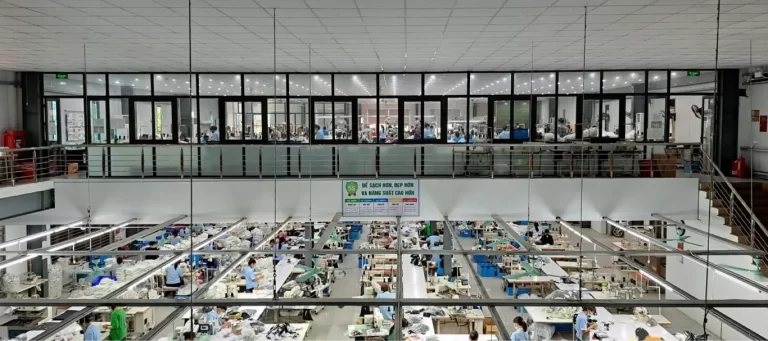
Public MOQ numbers from Chinese and Vietnamese heated apparel factories generally fall into one of three buckets: 50 units per SKU (small-batch premium vendors, often with 6-month production lead time), 100 units per SKU (mid-tier OEMs), or 300–500 units per SKU (mass-production factories). Those are theory numbers — in practice, factory slots during Q3/Q4 are rationed by the cut-and-sew capacity, not by an arbitrary MOQ. If the factory can only finish 4,000 hoodies in November across all buyers, your 100-unit MOQ will land in December or January.
The MOQ conversation real wholesale buyers should be having is not “what is your minimum” but “what is the minimum that gets me a confirmed production slot for Q4 2026.” That number is typically 300–500 units per style with a 60-day lead time, or 100–150 units per style with a 90–120-day lead time. Buyers who can accept longer lead times in exchange for lower MOQ are the ones who eventually build the most flexible product matrix.
Heated Hoodie Wholesale MOQ Tiers in 2026
| Vendor Type | Min Order / SKU | Min Order / Colorway | Typical Lead Time | Sample Fee Refundable? |
|---|---|---|---|---|
| Premium private-label OEM (Vietnam/China) | 100 units | 200 units | 75–95 days | Yes (PO ≥ $30k) |
| Mid-tier public-label | 100 units | 300 units | 45–65 days | Yes (PO ≥ $20k) |
| Mass-production factory | 300 units | 500 units | 35–55 days | Often non-refundable |
| Trading company / sourcing agent | 50 units | 100 units | 60–90 days | Rarely |
Note the “Sample Fee Refundable?” column — this is the single biggest indicator of whether a vendor is a real factory or a broker. Brokers rarely refund sample fees because they subcontract the sample themselves; factories routinely do because the sample cost is amortized into the commercial PO at their margin. If a vendor refuses to put a refundable sample clause in writing, treat that as a red flag and move on.
2026 Heated Hoodie Spec Stack: What Every RFQ Should Require
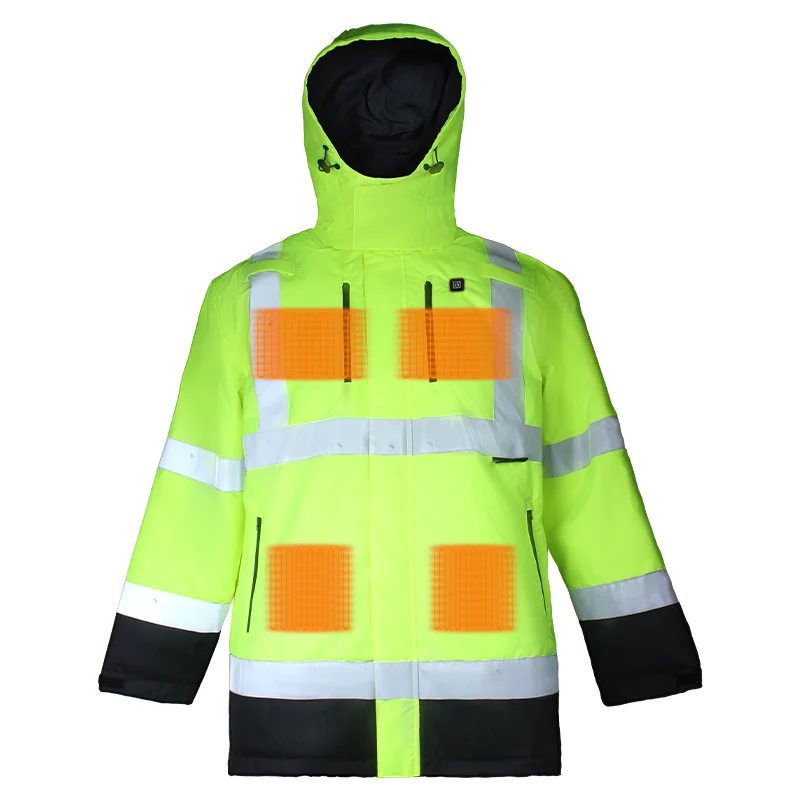
Spec drift is the #1 reason heated apparel wholesale orders land in trouble. A buyer sends an RFQ with “carbon fiber heating elements, 3 heat settings, 7.4V battery” and three different factories respond with three completely different products. The only way out is to standardize the spec stack before you send it. The eight-tier spec framework below is what we recommend for any 2026 heated hoodie wholesale inquiry; if a vendor cannot hit at least six of the eight tiers, they are not the right vendor.
Eight-Tier Spec Stack for Wholesale Heated Hoodies
| Tier | Spec | Acceptable Range (2026) | Reject If… |
|---|---|---|---|
| 1 — Heating Element | Carbon fiber / graphene / composite pad | 32–48 inch pad coverage | Pad < 24 inch or wire coil |
| 2 — Battery | 7.4V Li-Polymer with BMS + 5000mAh+ | UN 38.3 + UL 2054 cert | No BMS visible from outside |
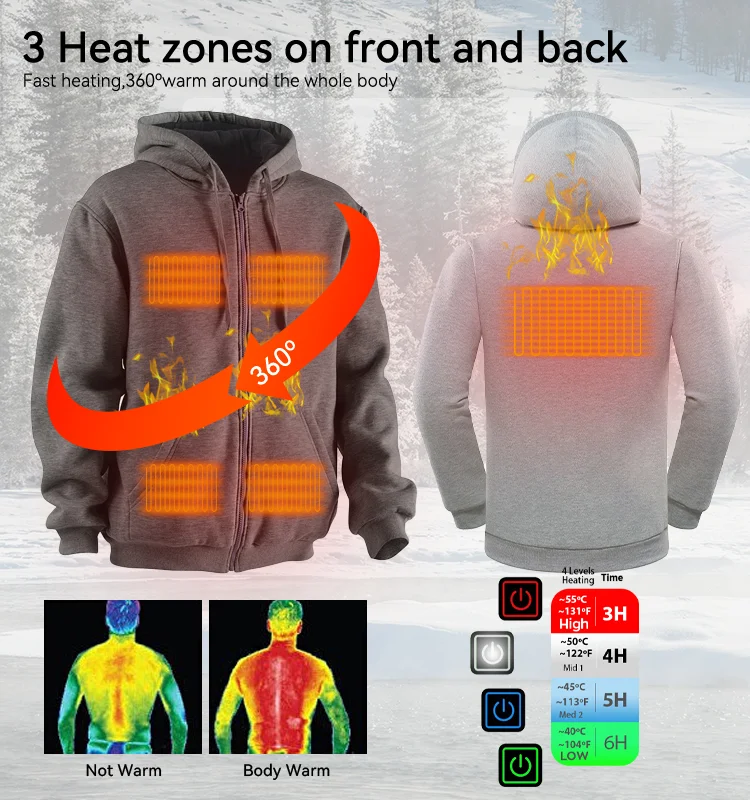
| 3 — Heat Zones | 3 zones (collar/back/hand pockets) or 4 (add lumbar) | Min 100°F at low / max 140°F at high | 1–2 zones or no zone mapping |
| 4 — Outer Fabric | 320–400 GSM fleece or bonded softshell | Anti-pill grade 3+ | < 280 GSM or no anti-pill finish |
| 5 — YKK Zippers | YKK main + YKK battery pocket | Reverse coil preferred | SBS or no-name zipper |
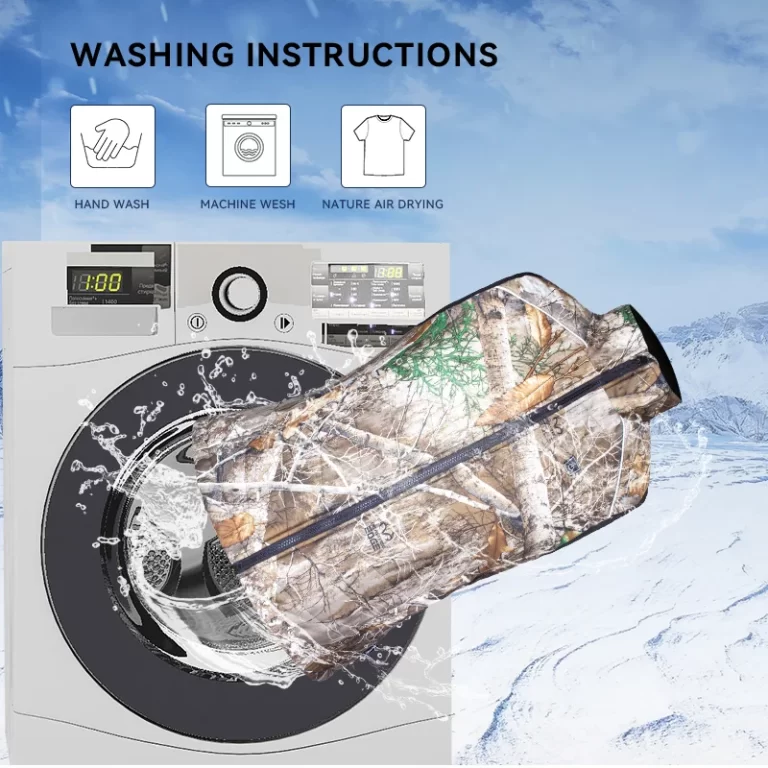
| 6 — Wash Cycles | 30+ machine wash cycles at 40°C | Heating element functional post-wash | Hand-wash only |
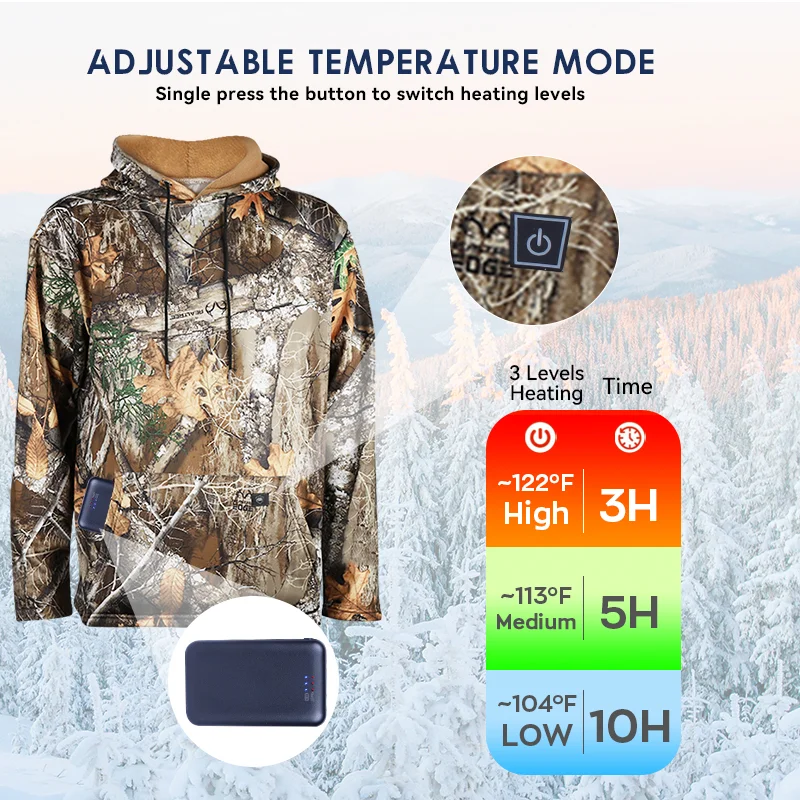
| 7 — Controller | 3-button LED controller, 3 heat levels | Hidden pocket + removable battery | External controller or fixed battery |
| 8 — Compliance Documents | CE / FCC / UKCA / UN 38.3 | Test reports dated within 18 months | No test report or expired report |
Eight tiers may sound rigid, but it is the floor. The factories that can hit all eight are the ones delivering to US/EU retailers without chargebacks. The factories that hit four or five are the ones you find on Alibaba with suspiciously low prices and no retail references.
Spec Compliance Soft Plant: Last quarter we audited 12 sample hoodies submitted by prospective buyers who had sourced from “low-cost” vendors. Only 4 of 12 cleared tier-6 wash cycle testing. The other 8 had visible heating-element degradation after 6–10 wash cycles, which means a retailer will see the issue within 60–90 days of sale. That is exactly the failure mode that creates a 1-star review cascade and an involuntary recall. Wholesale buyers who spec-check before PO sleep much better than those who spec-check after delivery.
Private Label vs White Label Heated Hoodies: 2026 Trade-Offs
Private label means the factory builds the hoodie to your spec — colors, trims, controller button layout, packaging, woven labels, and care tags are all yours. White label means the factory already has a finished SKU with their brand on it, and you buy it with your barcode and a hangtag. Each has a place in a healthy 2026 portfolio, and the wholesale math is dramatically different.
Private Label vs White Label: Cost, Time, and Brand Equity
| Dimension | Private Label | White Label |
|---|---|---|
| Per-unit cost (500–1,000 units) | $58–$84 | $34–$52 |
| Lead time (from PO to warehouse) | 75–110 days | 20–35 days |
| Sample development fee | $280–$650 per sample | $0 (existing SKU) |
| Brand control | Total (colors, trims, packaging) | Limited (hangtag, barcode only) |
| Ideal channel | Direct-to-consumer retail, brand site | Amazon, e-commerce, distributor flash sale |
| Switching cost to new vendor | High (tooling, packaging) | Low (drop one SKU, pick another) |
Most heated clothing wholesale distributors we work with run a 70/30 split: 70% private label for their retail and brand-channel customers, 30% white label to fill fast-turn e-commerce demand. That ratio climbs to 90/10 for brands that are deeply invested in their own heating-apparel identity (e.g., hunting or motorsports brands with specific pocket layouts and brand colors).
2026 Battery Quality Checks: The Non-Negotiable Five
Every recalled heated apparel incident in 2024 and 2025 traced back to one of five battery failures. If your wholesale battery heated hoodie vendor cannot pass these five checks, walk away. If they can, you have a vendor for the next decade.
- UN 38.3 Test Report — required for any lithium cell above 100Wh. The test report must be dated within the last 18 months and traceable to the actual cell manufacturer (not just the assembly factory).
- UL 2054 or IEC 62133 Certification — depending on destination market. Both cover cell-level abuse (overcharge, short circuit, drop, vibration). The certificate holder should be the same entity assembling the battery pack.
- Sealed BMS with Temperature Cutoff — the BMS must shut the pack down at 60°C (140°F) cell temperature, not at 70–75°C, which is the old default. Forced-air or water-cooling BMS variants should be rejected for wearables.
- 5000mAh Minimum Capacity at 7.4V — a 5,000mAh/7.4V pack delivers roughly 2.5 hours on high / 5 hours on low. Anything below 5,000mAh is a 2023-era spec and should be priced accordingly.
- Cycle Life ≥ 500 Charges to 80% Capacity — verified by a third-party lab report. The cycle-life claim on the brochure is meaningless without the report.
Run those five checks on every incoming lot. A factory that passes them once will pass them again; a factory that fails one of them once will fail it forever.
2026 Private Label Process Timeline: From PO to Warehouse
The 75–110 day heated hoodie private label timeline below is based on ten bulk orders we shipped in Q1–Q2 2026. Buyers who deviate from this milestone schedule usually discover the deviation in week 7 or 8, when samples do not match sign-off or when the PPS (pre-production sample) reveals a fabric change.
Private Label Heated Hoodie: 75–110 Day Timeline
| Day | Milestone | Owner | Critical Gate |
|---|---|---|---|
| 0 | PO + deposit (30%) confirmed | Buyer + Factory | Purchase order signed |
| 1–7 | Tech-pack handover + fabric sourcing | Factory | Fabric book confirmed |
| 8–18 | Proto sample (white sample, no branding) | Factory → Buyer | Buyer approves pattern + heating zones |
| 19–28 | Counter sample (branded, pre-production) | Factory → Buyer | Buyer approves trims + colors |
| 29–42 | Pre-production sample (PPS) from bulk fabric | Factory → Buyer | Buyer signs PPS, issues production green light |
| 43–62 | Bulk cut + sew + heating element assembly | Factory | Mid-line inspection at 30% (random 12 pcs) |
| 63–72 | Battery pack assembly + pairing | Factory | BMS QC report (per UN 38.3) |
| 73–85 | Final assembly + packaging + compliance docs | Factory | Pre-shipment inspection (AQL 2.5) |
| 86–95 | Ocean freight booking + export clearance | Factory | Booking confirmation + commercial invoice |
| 96–110 | Transit + duty + last-mile delivery | Logistics | Warehouse receives QC-passing cartons |
If a vendor promises shorter than 75 days, ask which milestone they are cutting. The honest answer is usually “we will start cutting fabric before the PPS is signed,” which is how 30% wholesale discounts turn into 12% defect rates on arrival.
Lead Time Soft Plant: Two buyers in Q1 asked us to compress the timeline to 50 days for an outdoor retail launch. We declined both times — once because the PPS milestone was at day 25 and could not move, once because battery certification is a hard 21-day cycle. The buyers ended up placing the PO with longer lead times and shipped on schedule. The lesson: timeline compression in heated apparel wholesale always trades against quality, never against cost.
2026 QA and Warranty Workflow for Wholesale Buyers
Quality assurance in 2026 is no longer “open the carton and inspect five random pieces.” The retailer’s compliance team will require an AQL 2.5 inspection report (ANSI/ASQ Z1.4), a battery lot-traceability file, and a 12-month warranty plan — all before the first purchase order ships. The workflow below covers what you need to do, in what order, and what to demand from the factory.
Heated Hoodie Wholesale QA Workflow
| Step | When | Owner | Output Document |
|---|---|---|---|
| 1. In-line inspection (DUPRO) | 30% production complete | Factory QC or third-party | DUPRO report + photos |
| 2. Final random inspection | 85% packed | Third-party (BV / SGS / TUV) | AQL 2.5 report (General II) |
| 3. Battery lot test | Parallel to assembly | Factory + lab | UN 38.3 + UL 2054 lot cert |
| 4. Functionality test (heat) | Post-assembly | Factory | Heat profile curve (low/mid/high) |
| 5. Drop test (carton 6-side) | Pre-shipment | Factory | Drop-test pass/fail record |
| 6. Compliance doc audit | Pre-shipment | Buyer compliance team | CE / FCC / UKCA file audit |
The two steps most buyers skip and regret are drop test (carton 6-side) and compliance doc audit. Drop-testing 1 of 10 cartons per lot catches the freight damage that turns into 5% retail returns; compliance audit catches the “we will add the stickers” factory that ships without CE marks and forces the distributor to recall.
2026 Factory Vetting Checklist: 12 Questions Before You Wire the Deposit
Before any deposit is wired, the following 12 questions should all have written answers. A factory that is unwilling to put answers in writing is a factory that does not want you to have recourse if the answers turn out wrong.
- What is your cut-and-sew capacity per month for heated hoodies?
- Do you own your heating-element production or do you outsource?
- Can you provide UN 38.3, UL 2054, and CE/FCC test reports dated within 18 months?
- What is your on-time delivery rate for 2025 and Q1–Q2 2026, audited?
- What is your AQL inspection standard, and which third party do you allow?
- What is your warranty policy for retail and what is the RMA process?
- What is your sample-development fee structure and which fees are refundable?
- What is your MOQ per SKU and per colorway, and which months are constrained?
- What is your typical PPS lead time, and can you commit to a 30-day PPS turnaround?
- Do you have a B2B reference list of 3 buyers we can speak to?
- What is your labeling compliance workflow for US/EU/UK/JP destination packaging?
- What is your policy if the buyer reports a defect rate above 2%?
Three or fewer satisfactory answers, walk away. Six to nine, ask follow-up questions. Ten or more, you have a viable wholesale partner.
Final Recommendation: Building Your 2026 Heated Hoodie Wholesale Program
For wholesale buyers planning 2026–2027 inventory, the most resilient approach combines three moves. Lock a 12-month blanket PO with one premium private-label vendor to cover 70% of your volume at fixed pricing. Layer in 30% white-label spot buys for fast-turn campaigns (Black Friday, holiday gifting, regional weather events). Run the eight-tier spec stack as a written contract appendix with every shipment, and require AQL 2.5 + UN 38.3 documentation before any carton ships. That combination is the difference between heated hoodie wholesale as a recurring margin and as a one-off scramble every Q3.
If you are evaluating a new factory for 2026, request their UN 38.3 report, their AQL inspection record from the last three shipments, and three B2B references in your target market. Then place a 100-unit test order, run it through your in-house QA, and only scale after the test order clears every tier. The factory that complains about that process is the factory you don’t want to scale with — the factory that welcomes it is the factory that will still be here in 2030.
FAQ: Heated Hoodie Wholesale in 2026
Q1. What is the typical MOQ for wholesale heated hoodies in 2026?
A. Most factories require 100–300 units per SKU with a 75–95 day lead time. Premium private-label vendors may go as low as 100 units per colorway for buyers who commit to 1,500+ units over 12 months.
Q2. How much does a private-label heated hoodie cost per unit?
A. Landed cost (FOB + freight + duty) for a 500–1,000 unit private-label hoodie runs $58–$84 depending on spec, battery configuration, and packaging. Volume above 2,500 units typically drops the per-unit cost to $49–$61.
Q3. What is the lead time from PO to warehouse?
A. A private-label heated hoodie takes 75–110 days from PO to warehouse. White-label SKUs can ship in 20–35 days. Lead times above 110 days usually indicate a vendor with capacity issues.
Q4. What certifications should a wholesale heated hoodie ship with?
A. CE, FCC, UKCA, UN 38.3, and UL 2054 (or IEC 62133 for EU). The test reports should be dated within 18 months and traceable to the actual cell and assembly entities.
Q5. Can I mix colors and sizes within a single MOQ?
A. Most factories allow 2–4 colorways per PO if each colorway meets its minimum (typically 100 units per color). Size splits (S/M/L/XL/XXL) are usually free as long as the total volume is met.
Q6. What battery capacity should I require for a 7.4V heated hoodie?
A. Minimum 5,000mAh at 7.4V. Anything below 5,000mAh falls into the 2023-era spec range and will underperform in cold-weather retail reviews. Premium hoodies in 2026 use 7,200mAh cells.
Q7. How do I verify a factory is a real manufacturer and not a trading company?
A. Ask for the sample-fee refund clause in writing, ask for the heating-element production floor (not the assembly floor), and ask for three B2B references in your region. Trading companies usually refuse one or more of these.
Q8. Can I private-label a heated hoodie with my own controller layout?
A. Yes, at 500+ units per SKU with a $1,500 tooling fee for the controller mold. Below 500 units, the factory typically uses a stock controller with a custom hangtag only.
Q9. What is the typical defect rate I should expect on a 1,000-unit order?
A. A reputable factory with documented AQL 2.5 inspection delivers 1.0–1.8% defect rate on private-label heated hoodies. Anything above 2% on a consistent basis is a vendor-vetting failure, not a normal outcome.
Q10. How do I handle retail returns and warranty replacements?
A. Negotiate a 1–2% spare-unit allocation in your PO contract (typically free for the buyer, charged at cost for the rest). For larger distributors, request a 12-month RMA workflow with the factory that includes prepaid return shipping for defective units.
Q11. Is Vietnam or China better for heated hoodie manufacturing in 2026?
A. Vietnam has lower MOQ floors (100 units vs 300) and shorter lead times for small batches, but costs 8–15% more per unit. China is more cost-effective above 1,000-unit volume but requires longer planning. Both countries now produce comparable battery quality.
Q12. What is the smallest order I can place for a fully custom heated hoodie in 2026?
A. The smallest fully custom order (custom color + trim + label + packaging) is 100 units per colorway in 2026, with 90–120 day lead time. Custom-only packaging (stock hoodie + custom box) can be as low as 50 units with 30-day lead time.
This guide is maintained by IMISSKY Industrial’s wholesale team based on Q1–Q2 2026 buyer engagements and factory-audit data. Last updated July 9, 2026.