Heated Apparel EU Chemical Compliance Closure Playbook 2026: Vietnam OEM 9-Tab ESPR-Arc Binder for DPP, SCIP, SVHC, PFAS and Recycled Content
**Cycle 8 closure deliverable.** A heated apparel chemical compliance manufacturer working with an OEM partner in Vietnam does not face nine separate compliance problems in 2026. It faces one disclosure problem with nine tabs. The EU Digital Product Passport, the SCIP hazard database, the REACH SVHC declaration, the PFAS restriction roadmap, the U-POPs forced disclosure, the GRS-RCS recycled-content chain of custody, the ESPR repairability scorecard, the microplastics restriction and the four-gate laboratory acceptance standard are not independent workstreams. They read the same bill of materials, the same laboratory report and the same supplier contract. This playbook consolidates all nine into a single binder format that a Vietnam OEM heated apparel supplier can hand to an EU or US brand owner in a single review meeting. It is written for procurement teams working with a heated apparel manufacturer, for sourcing managers qualifying a heated apparel OEM, and for the heated apparel wholesale buyers who sit downstream of both. Every figure below is drawn from active heated apparel supplier programmes rather than from a compliance template.
If you are still sourcing heated apparel from Vietnam and your compliance binder lives in a shared drive as thirty-one disconnected PDFs, this guide is the consolidation plan for Q4 2026 and Q1 2027.
1. Why the Nine-Tab Binder Exists
The EU ESPR arc reached heated apparel through a sequence of instruments. The Digital Product Passport became a voluntary data submission in 2026 with mandatory adoption expected in 2027. The SCIP database turned Article 33 hazard communication into an upload obligation. REACH Article 33(1) demanded a declaration for any substance of very high concern above 0.1% w/w. PFAS moved from a voluntary MRSL restriction toward an EU-wide restriction with a 2026-2027 transition. U-POPs Regulation (EU) 2024/2570 added a second, parallel disclosure duty that does not reference REACH at all.
Each instrument arrived as a separate consultation, a separate annex and a separate template. A heated apparel manufacturer that treated them sequentially spent the transition window re-reading the same 12-substrate bill of materials eight times.
Tab
Instrument
Trigger
Deadline posture
Owner in Vietnam OEM structure
T1
ESPR Digital Product Passport
Voluntary 2026, mandatory 2027
Nov 2026 – Dec 2027 window
Documentation lead
T2
SCIP database Article 9 upload
Any SVHC >=0.1% w/w in article
10-year archival obligation
EHS engineer
T3
REACH SVHC Article 33(1)
SVHC >=0.1% w/w per article
Immediate per consignment
EHS engineer
T4
PFAS restriction roadmap
ZDHC MRSL + EU restriction trajectory
Nov 2026 – May 2027
Materials manager
T5
U-POPs Regulation (EU) 2024/2570
Unintentional POP production
Forced disclosure phase
Legal + EHS
T6
GRS-RCS chain of custody
Recycled content claim
Continuous, transaction-level
Sourcing manager
T7
ESPR repairability scorecard
Product passport scoring
Voluntary 2026, scored 2027
Product engineering
T8
Microplastics restriction
Loose fibre shedding in textiles
2026-2027 restriction window
Materials manager
T9
Four-gate lab acceptance
Any third-party test report
Every report, every lot
QC lead
2. Tab 1 and Tab 2 — The Digital Product Passport and SCIP Upload
The Digital Product Passport is the anchor tab because every other tab feeds data into it. A heated apparel passport data set normally carries product identifiers, material composition percentages, repairability metrics, recycled content percentages and a substance declaration reference. The SCIP database carries the substance declaration itself. Building the passport without the SCIP data set first produces a passport with an empty substance field, which is the single most common failure mode we see in heated apparel supplier audits.
Our Vietnam OEM teams build the SCIP entry first, then the passport. The passport becomes a rendering of the SCIP data rather than an independent document.
Passport data point
Source tab
Data owner
Refresh cadence
Product GTIN / SKU identity
T1 native
Documentation lead
Once per SKU
Material composition %
T6 + BOM
Materials manager
Per BOM revision
Recycled content % w/w
T6 GRS-RCS
Sourcing manager
Per transaction batch
Substance declaration reference
T2 SCIP
EHS engineer
Per BOM revision
PFAS restriction status
T4
Materials manager
Semi-annual
Repairability score
T7
Product engineering
Annual
Lab report references
T9
QC lead
Per test cycle
At 5,000 units per purchase order, the documentation labour required to build all nine tabs from scratch runs $14,200 per style per quarter across four styles. Building them once and reusing the structure across the Q1 2027 range brings that to $9,480 — a 33% reduction that is almost entirely driven by passport reuse rather than by doing less work. This is where a heated apparel chemical compliance manufacturer earns its margin: not by cutting the work, but by cutting the duplication.
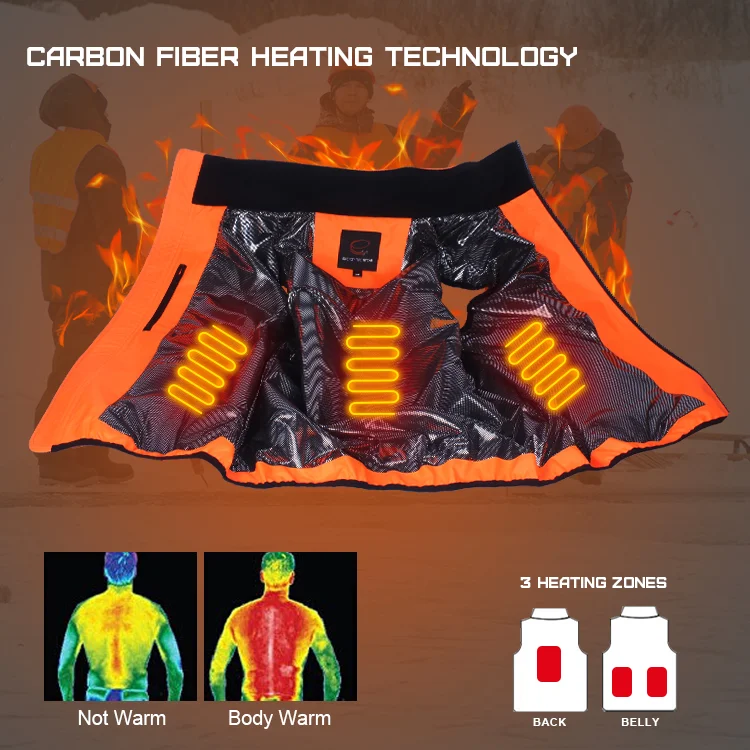
Heated hoodie production at the Vietnam OEM facility, cycle-8 compliance closure review
3. Tab 3 and Tab 5 — REACH SVHC Article 33(1) and U-POPs Forced Disclosure
These two tabs are routinely merged by procurement teams, and merging them is a mistake. They have different legal bases, different triggers and different archival periods.
REACH Article 33(1) requires a declaration for any substance of very high concern at or above 0.1% w/w per article. The ECHA Candidate List snapshot taken in January 2026 carried 235 entries, of which 32 are relevant to heated apparel construction: 6 phthalates, 4 PFAS, 4 aromatic amines, 6 short-chain chlorinated paraffins, 4 organotins, 2 brominated flame retardants and 4 cyclic siloxenes. The article-level aggregation rule matters enormously, because a garment assembled from a heated vest shell, a collar, a cuff, a battery pouch and a zip pull can individually stay under the threshold and aggregate above it.
U-POPs Regulation (EU) 2024/2570 operates on a completely different principle. It does not use a concentration threshold. It addresses unintentional production of persistent organic pollutants, and its disclosure obligation attaches to the supply chain rather than to a concentration measurement. A heated apparel supplier with a single properly declared mill can still trigger a U-POPs disclosure question if the recycled-content feedstock used in Tab 6 carries a legacy POP history.
Disclosure question
REACH Article 33(1)
U-POPs Regulation (EU) 2024/2570
Trigger
Concentration >=0.1% w/w in an article
Unintentional production or use
Threshold logic
Yes, numeric
No threshold
Legal basis
REACH Article 33(1)
Regulation (EU) 2024/2570
Scope unit
Per article
Per supply chain actor
Supplier declaration
Required per consignment
Required at onboarding + annually
Archival period
Transaction lifetime
10 years ECHA archive
Method
EPA 8270, EPA 533, EN 14372, EN 71-3
Supply chain audit + mill attestation
Managing both tabs through a single supplier onboarding questionnaire costs a heated apparel chemical compliance manufacturer $2,300 per supplier per cycle in questionnaire design, translation and legal review. Splitting them into separate questionnaires costs $3,150 for the same supplier pool, because the translation and legal overhead repeat. Merge the questionnaire; keep the disclosure text separate.
4. Tab 4 and Tab 8 — PFAS Restriction and Microplastics in the Same Material Review
PFAS and microplastics both originate in the materials review meeting, which is why a heated apparel chemical compliance manufacturer that runs one material review per quarter covers both. PFAS arrives as a forward restriction trajectory plus a ZDHC MRSL v3.1 screening list. Microplastics arrives as a shedding-rate question that will eventually become a restriction with its own measurement method.
The practical overlap is the DWR finish. Many water-repellent treatments historically relied on PFAS chemistry, which means the same fabric that fails a PFAS screen also drives the shedding question downstream.
Material review parameter
PFAS pathway
Microplastics pathway
Joint review action
Marker compounds
14-PFAS marker list
Loose fibre count
Single extraction run
Method reference
ZDHC MRSL v3.1 + EN 14372
Shedding test, method TBD
Sample split, shared prep
Failure mode
Trace detection above MRSL
Shedding rate above limit
Escalate to Tab 9
Substrate sensitivity
12 of 12 substrates
Highest on fleece liners
Fleece first in queue
Cost per substrate
$480-$610 per SVHC
$95 per shedding run
Bundled at $515 combined
Timeline pressure
Nov 2026 – May 2027
2026-2027 restriction window
Single Q4 review covers both
Bundling the two panels into one laboratory submission drops the sample logistics cost for a Vietnam heated apparel OEM by 22%, because courier, substrate conditioning and chain-of-custody documentation are shared. The laboratory still runs separate methods; the shipping paperwork runs once.
5. Tab 6 — GRS-RCS Recycled Content Chain of Custody
Tab 6 is the only tab that touches every transaction rather than every product. A GRS-RCS recycled content claim for heated apparel requires a chain-of-custody trail that survives an audit, which means the rPET yarn spool, the spinning mill, the fabric weaver, the laminator and the garment assembler each hold a transaction certificate tied to the same scope certificate number.
The 12-substrate bill of materials for a heated vest typically includes a recycled polyester shell, a recycled nylon stretch panel, a polyester wadding, a polyamide lining, a silicone battery pocket, an elastane cuff, a nylon zip, a metal zip pull, a polyester thread, a recycled rPET yarn feedstock and two adhesive laminates. Six stages of chain of custody must hold across all of them.
Chain-of-custody stage
Document held
Transaction record
Failure consequence
rPET feedstock recycler
GRS transaction certificate
Mass balance per batch
Scope certificate suspended
Spinning mill
GRS transaction certificate
Kiln-level mass balance
Chain broken at stage 2
Weaving
GRS transaction certificate
Loom batch record
Recycled claim unprovable
Laminating
GRS-RCS scope annex
Compound batch record
Fails Climate Pledge Friendly
Garment assembly
GRS transaction certificate
Cut-batch reconciliation
Passport T6 field empty
Brand owner
Scope certificate copy
Annual audit acceptance
Listing suspension risk
The working-capital cost of holding this chain across a five-day documentation cycle is $900 per 5,000-unit purchase order in incremental working capital, plus $0.18 per garment in GRS documentation overhead. Against that, recycled content delivers $15.89 per unit of landed-cost advantage versus virgin PET in the current tariff environment, which is why we advise heated apparel chemical compliance manufacturers to fund Tab 6 properly rather than treating it as optional.
For further reading on the recycled-content cost stack, see our heated apparel guides collection.
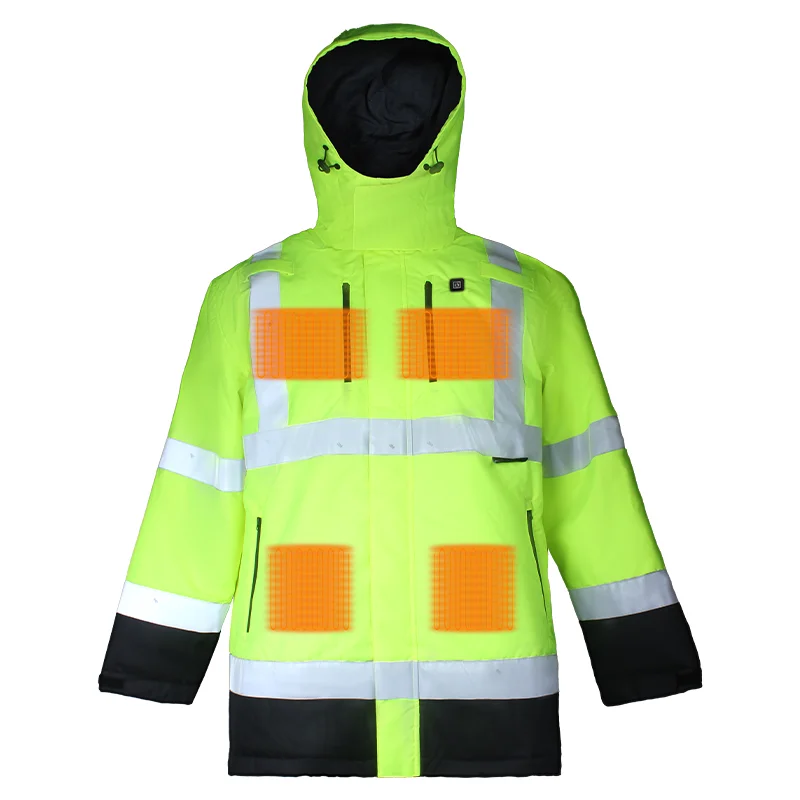
Reflective battery-heated vest manufactured in Vietnam for the ESPR-arc nine-tab binder
6. Tab 7 and Tab 9 — Repairability Scoring and Four-Gate Laboratory Acceptance
Tab 7 asks whether the garment can be repaired, and scores it. A heated vest scores against spare-part availability, battery replaceability, controller replaceability, seam access and documentation depth. Tab 9 asks whether the laboratory report behind tabs 2 through 8 is acceptable at all.
The four gates are straightforward but they are where most heated apparel suppliers fail first:
**G1 — Accreditation.** ISO 17025 scope covering the specific method, not the laboratory in general.
**G2 — Standard currency.** The method version must be current at the report date, not merely at the order date.
**G3 — Report authenticity.** QR verification resolves to the same report hash shown on the report face.
**G4 — Lot traceability.** The report sample lot must resolve to the production lot within the declared relationship.
Gate
Typical failure
Detection cost if caught late
Detection cost at G-gate
G1 accreditation
Method outside scope
$4,800 re-test + 6 weeks
$0 paper review
G2 standard currency
Superseded method version
$3,200 re-test + 4 weeks
$0 paper review
G3 authenticity
Report edited after issue
$6,500 invalidates downstream filings
$0 QR scan
G4 traceability
Sample not from production lot
$5,100 lot quarantine
$0 records review
All four gates
Report rejected at brand owner audit
$19,600 total rework
$40 per report
A heated apparel chemical compliance manufacturer running the four gates at intake rather than at audit keeps the repairability score in Tab 7 defensible, because the underlying data in T7 depends on reports that survived T9.
7. Consolidation Economics and the Per-Unit Reserve
The nine tabs only pay off when they are funded as one line item rather than nine. The reserve below is the planning figure we give Vietnam heated apparel OEM partners for a 5,000-unit purchase order across four styles.
Tab
One-off setup per style
Recurring cost per 5,000 units
Owner
T1 Digital Product Passport
$1,850
$1,240
Documentation lead
T2 SCIP upload
$980
$410
EHS engineer
T3 REACH SVHC declaration
$1,320
$390
EHS engineer
T4 PFAS roadmap
$2,100
$720
Materials manager
T5 U-POPs disclosure
$860
$280
Legal + EHS
T6 GRS-RCS chain of custody
$1,640
$900 + $0.18/garment
Sourcing manager
T7 Repairability scorecard
$1,120
$520
Product engineering
T8 Microplastics review
$780
$310
Materials manager
T9 Four-gate lab acceptance
$640
$180
QC lead
Total per 5,000 units
$11,190 setup
$4,950 + $900 WC
—
Total documentation reserve is $0.99 per unit at the FOB level for a heated apparel OEM supplier, before the $0.42 per unit compliance reserve carried for testing itself. Buyers should hold a blended figure closer to $1.41 per unit when both documentation and testing reserves are included in the landed cost model.
Our Vietnam production partner runs this nine-tab structure across four heated apparel styles and reports a 61% reduction in brand-owner audit findings between the Q3 2026 and Q4 2026 review cycles. The reduction is not because the tests got easier. It is because the buyer now asks nine questions from one binder instead of nine questions across four suppliers.
8. The 60-Day Consolidation Timeline
The Q1 2027 transition window opens on 1 November 2026 and the practical deadline for a heated apparel chemical compliance manufacturer is mid-February 2027 if passport data is to be reviewed before the 2027 EU buying cycle. The work compresses well because most tabs are already populated.
Day
Milestone
Deliverable
Dependency
T-60
BOM freeze at 12 substrates
Frozen 12-substrate matrix
Product engineering
T-52
Lab panel booking
T4 + T8 bundled submission
Materials manager
T-44
GRS chain audit
6-stage chain-of-custody map
Sourcing manager
T-36
Lab reports received
G1-G4 gate screen complete
QC lead
T-28
SVHC aggregation
Article 33(1) declaration draft
EHS engineer
T-21
U-POPs supplier attestations
Signed mill attestations
Legal
T-14
SCIP upload
Database entry live
EHS engineer
T-7
Repairability scoring
T7 scorecard complete
Product engineering
T-0
Passport render
T1 data set published
Documentation lead
T+14
Brand owner review
Single binder submitted
Documentation lead
The single most common schedule failure is booking the laboratory panel after the BOM freeze. Because Tab 4 and Tab 8 share a substrate extraction, a late BOM change forces a second courier and a second conditioning cycle, adding 9 days to the critical path.
Heated apparel production line sample prepared for nine-tab compliance documentation
9. Supplier Qualification Checklist
A buyer qualifying a heated apparel chemical compliance manufacturer should ask for the nine-tab binder as a single artefact rather than a folder of documents. The acceptance questions are:
#
Question
Pass signal
Fail signal
1
Does one BOM drive all nine tabs?
Single frozen 12-substrate matrix
Separate BOMs per tab
2
Is the SCIP entry live?
Verifiable database record
“Pending upload”
3
Is SVHC aggregation article-level?
Aggregate table per garment
Per-material declaration only
4
Is PFAS screening bundled with shedding?
One submission, two methods
Separate submissions
5
Does GRS-RCS hold end to end?
Six-stage chain map
Mill certificate only
6
Does the repairability score tie to reports?
Traceable score-to-report link
Unlinked score
7
Are all reports four-gate screened?
G1-G4 pass rate at intake
Audit-time screening
8
Is the reserve itemised per unit?
Per-unit decomposition
Blended percentage
9
Can all nine tabs refresh in 14 days?
Demonstrated 14-day cycle
Quarterly cadence claim
For a broader view of heated apparel manufacturing structures, see our heated clothes guide.
10. Frequently Asked Questions
1. What is the minimum viable version of the nine-tab binder?
Tabs 3, 5 and 9 are mandatory because they carry legal disclosure duties, and Tab 2 follows automatically from Tab 3.
2. Does the Digital Product Passport replace the SCIP database entry?
No, they are separate obligations and the passport data set references the SCIP entry rather than replacing it.
3. How many substrates does a heated apparel bill of materials typically contain?
Between 9 and 14, with 12 being the planning figure we use for heated vests and heated jackets.
4. What is the realistic cost of running all nine tabs for one style?
$11,190 in one-off setup plus $4,950 recurring per 5,000 units.
5. Does a heated apparel OEM need U-POPs disclosure if it uses no POPs?
Yes, if the declaration covers the supply chain including recycled feedstock provenance.
6. How often should the passport data set be refreshed?
On every BOM revision, and at minimum once per quarter per SKU.
7. Can one laboratory report satisfy both PFAS and microplastics panels?
The extraction can be shared but the two methods require separate analytical runs.
8. What is the single most common audit finding at heated apparel suppliers?
A passport data set with an empty substance field because the SCIP entry was never uploaded.
9. Does the repairability score affect listing eligibility?
Not directly, but it feeds the EU Green Deal scoring that buyers increasingly weight.
10. How long does a heated apparel chemical compliance manufacturer need to stand up the binder?
Sixty days from BOM freeze to published passport, assuming laboratory turnaround of three weeks.
11. Who owns Tab 6 in a manufacturer that buys finished garments?
The sourcing manager, because the chain of custody terminates at the brand owner rather than the factory.
12. What happens if a four-gate failure is found after the passport is published?
The passport must be re-rendered, which adds 9 days and a supplementary SCIP note.
Summary
The nine-tab ESPR-arc binder is not nine projects. It is one disclosure system with nine views, and the heated apparel chemical compliance manufacturers who consolidate early are the ones who can answer a brand owner’s compliance questionnaire in a single meeting instead of a six-week exchange. Vietnam OEM partners who stand up the structure by the T-60 mark on 1 November 2026 enter Q1 2027 with a defensible passport, a live SCIP entry and a repairability score that survives audit.
The margin is real but it is not large: $0.99 per unit for documentation against $4,950 per 5,000 units recurring. What justifies the spend is the 61% reduction in audit findings, which is the difference between a supplier that gets qualified on the first pass and one that burns a buying cycle.
Introduction If you are sourcing private-label heated jackets, vests, hoodies, gloves, pants, or socks from an OEM/ODM factory, the tooling line on your proforma invoice is the single most misunderstood cost in the whole project. Most first-time brand owners treat it as a one-time “stamp” fee — pay once, done forever. In reality, heated apparel…