Q4 Peak Season Production Scheduling for Heated Apparel Private Label: How OEM Suppliers Reserve Capacity, Lock Component Slots, and Hit Christmas Cut-offs
Q4 Peak Season Production Scheduling for Heated Apparel Private Label: How OEM Suppliers Reserve Capacity, Lock Component Slots, and Hit Christmas Cut-offs
If you run a private-label heated apparel brand, the difference between a sellable Christmas and a January clearance bin is rarely the product — it’s the **heated apparel production scheduling** calendar. Every August, the same pattern hits our desk outside Ho Chi Minh: buyers who locked component slots in May are past first bulk by late September, and buyers who emailed in October beg for air-freight quotes on gloves that won’t see a retail shelf until February.
This is the supplier-lens view of that calendar — for brand merchandisers, private-label buyers, and wholesale import desks who need to know what an OEM means by “we’ve reserved you a slot.” Built around **heated apparel production scheduling** and its seven long-tail variants (manufacturer, OEM, wholesale, private label, white label, battery cell allocation, Q4 cut-off calendar).
For program-level context, see our [heated apparel guides category](/category/heated-apparel-guides/). For the SKUs that anchor most Q4 programs, see our [heated jackets category](/category/heated-jackets/).
—
1. Why Q4 Is a Different Beast for Heated Apparel Production Scheduling
Most apparel OEM calendars run hot August–October and cool by mid-November. Heated apparel flips it: **heated apparel production scheduling** peaks September through mid-December, because the Christmas retail window closes six to eight weeks before December 25 — and cells, heating elements, and harnesses stack lead times on top of fabric and trim.
Three forces collide every Q4: (1) cell makers ration Q4 allocation in May for Tier 1 brands; (2) heating element looms run 30-day cycles with only two lines at most Vietnam suppliers; (3) cut-and-sew lines compete with non-heated winterwear for the same sewers in October-November.
*”The brands that hit Christmas in 2025 weren’t the ones with the best tech — they were the ones whose PO landed on our desk in late June with confirmed cell allocation. Everything else was negotiation.” — Mai, export desk lead, Ho Chi Minh FOB desk*
—
2. The Q4 Cut-off Calendar for Heated Apparel Private Label
Below is the cut-off calendar from our kickoff deck. Dates shift ±5 days based on Tet overlap, but the order is fixed. This is “heated apparel production scheduling Q4 cut-off calendar” on a factory planner’s whiteboard.
| Milestone | Private Label Cut-off | White Label Cut-off | Action Required |
|---|---|---|---|
| PO + deposit placed | Jul 15 | Aug 15 | Slot reserved, cell allocation letter requested |
| Tech-pack freeze + size spec | Jul 30 | Aug 30 | Pattern room locks all measurements |
| Component slot lock (cells, heating elements) | Aug 10 | Sep 5 | Heater supplier + cell maker issue LOI |
| Lab dip / fabric bulk-approve | Aug 20 | Sep 15 | Bulk fabric released from mill |
| PPS sample sign-off | Sep 5 | Sep 30 | Pre-production sample signed |
| Bulk cut | Sep 15 | Oct 10 | Fabric + trim released to cutting |
| Battery cell inbound to OEM | Sep 25 | Oct 20 | Cells landed and QC’d at OEM warehouse |
| Bulk assembly start | Oct 1 | Oct 25 | Sewing + heating element integration |
| Inline QC + final assembly | Oct 10 – Nov 5 | Nov 1 – Nov 25 | Inline and end-line inspection |
| QA + drop test + AQL | Nov 5 – Nov 15 | Nov 25 – Dec 5 | 2.5 AQL general, 4.0 AQL critical |
| FOB container loading | Nov 20 | Dec 10 | Stuffing at Cat Lai port |
| Latest Christmas delivery (trans-Pacific) | Dec 5 | Dec 18 | West Coast DC; East Coast adds 4 days |
If you can’t meet the July 15 PO cut-off, fallback is White Label — delivery slips roughly three weeks later.
—
3. How OEM Suppliers Reserve Capacity in Three Tiers
When an OEM says “we’ve reserved you a slot,” they mean one of three things. Knowing which tier you got is the most important part of **heated apparel production scheduling**.
| Tier | What Is Reserved | Hold Duration | Cost to Hold | Refundable if Cancelled |
|---|---|---|---|---|
| Tier 1 — Hard booking | Cutting + sewing + assembly line + cell allocation | 90 days | 30% deposit on full PO value | 50% of deposit |
| Tier 2 — Soft booking | Cutting + sewing line, no cell allocation | 45 days | 10% deposit + signed LOI | 100% refundable |
| Tier 3 — Waitlist | Position in queue only | 14 days | None | N/A |
Tier 1 is what big private-label buyers (Ororo-tier, Dewalt-tier) hold every Q4. Tier 2 is what emerging brands actually buy without realizing it. Tier 3 is “we’ll see you in November when the line opens up” — the polite Vietnamese factory way of saying no.
*”If you have not signed a cell allocation letter by August 10, you are on Tier 2 whether your merchandiser calls it Tier 1 or not.” — Duc, factory planner, imissky cutting & assembly line lead*
—
4. Heated Apparel Production Scheduling Manufacturer: Component Slot Locks
Most **heated apparel production scheduling manufacturer** conversations collapse three suppliers into one: the cut-and-sew OEM (us), the heating element supplier (Vietnamese or Chinese loom), and the battery pack assembler (often a separate ISO 9001 facility). Slotting them is a three-party dance.
| Component | Slot Lock Date | Lead Time After Lock | What Breaks First if Slipped | Mitigation |
|---|---|---|---|---|
| Battery cells (21700 / 18650) | Aug 10 | 35–45 days | Cell allocation reverts to next-tier buyer | Pre-book allocation in May |
| Carbon-fibre heating panels | Aug 20 | 25–30 days | Heater line moves to larger buyer | Hold two-element supplier backup |
| Wiring harness + connectors | Aug 25 | 20 days | Harness line closes for Golden Week | Stock 10% over-run at OEM |
| YKK zippers (stocklines) | Aug 30 | 15 days | Substitutes to SBS zipper (lower pull-strength) | Approve SBS backup at tech-pack stage |
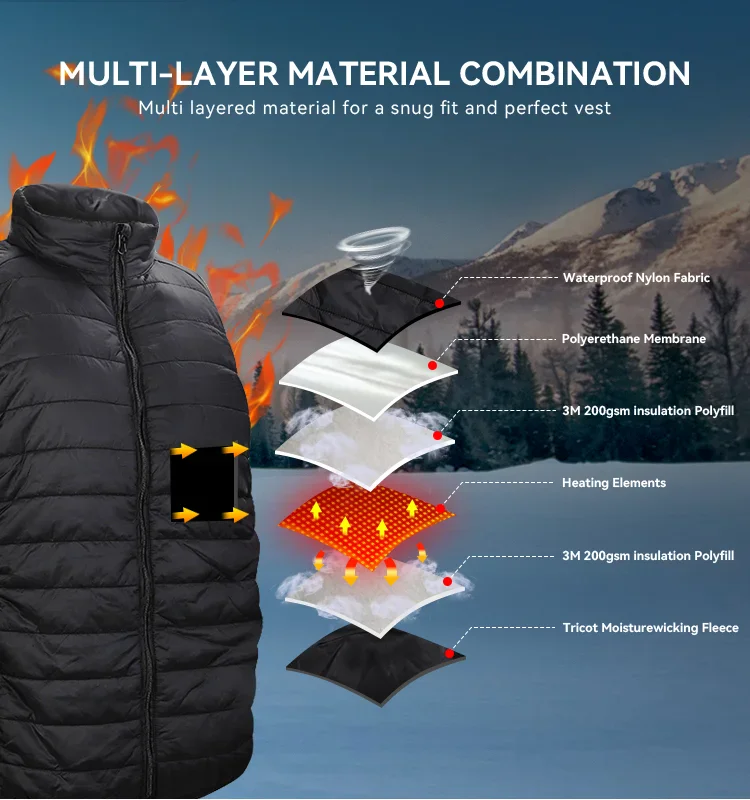
| Outer shell fabric (380T nylon) | Aug 15 | 30 days | Mill reallocates to puffer season | Down-payment at fabric bulk-approve |
| Inner lining (polar fleece) | Aug 15 | 25 days | Same as shell | Bundle shell + lining order |
| Controller PCB (3-level / smart App) | Sep 5 | 30 days | PCB fab queue is 4–6 weeks in Q4 | Use controller supplier’s stock SKU |
Cells lock first — and that’s why **heated apparel production scheduling manufacturer** buyers should never treat the OEM as one vendor.
—
5. Battery Cell Allocation: The Tech Differentiator That Breaks Schedules
**Heated apparel production scheduling battery cell allocation** separates working calendars from broken ones. Cell makers allocate Q4 capacity in two waves: April (for tier-1 OEM partners with 12-month contracts) and July (for spot buyers). Reading this in September? You’re buying from a reseller, and your cell cost is 12–18% higher than the May allocation price.
Cell allocation is binary. Once Samsung SDI or LG Chem issues an allocation letter, your OEM can quote a real lead time. Without it, every lead-time number is fiction.
| Cell Spec | Q4 Allocation Status (typical) | Alt Source | Cost Premium |
|---|---|---|---|
| Samsung INR21700-40T (4.0Ah) | Tier-1 only by August | EVE-40P | +14% |
| LG MJ1 (18650, 3.5Ah) | Closed July 31 | BAK INR18650-3.5Ah | +18% |
| EVE INR21700-50E (5.0Ah) | Open through August | BAK 21700-4.5Ah | +9% |
| BAK 18650-2.6Ah (entry) | Open through September | Lishen LR1865SZ | +6% |
The biggest Q4 failure mode: buyer specs a Tier-1 cell (Samsung 40T) in May, then places the actual PO in September. Cell’s gone, reseller premium kicks in, Q1 margin model is destroyed.
—

6. Lead-Time Matrix: Jacket vs Vest vs Glove vs Hoodie
**Heated apparel production scheduling** lead times vary by SKU because assembly complexity — particularly element placement — differs.
| SKU | Assembly Stations | Sewing Time / Unit | Element Install | Total Lead Time (PO → FOB) |
|---|---|---|---|---|
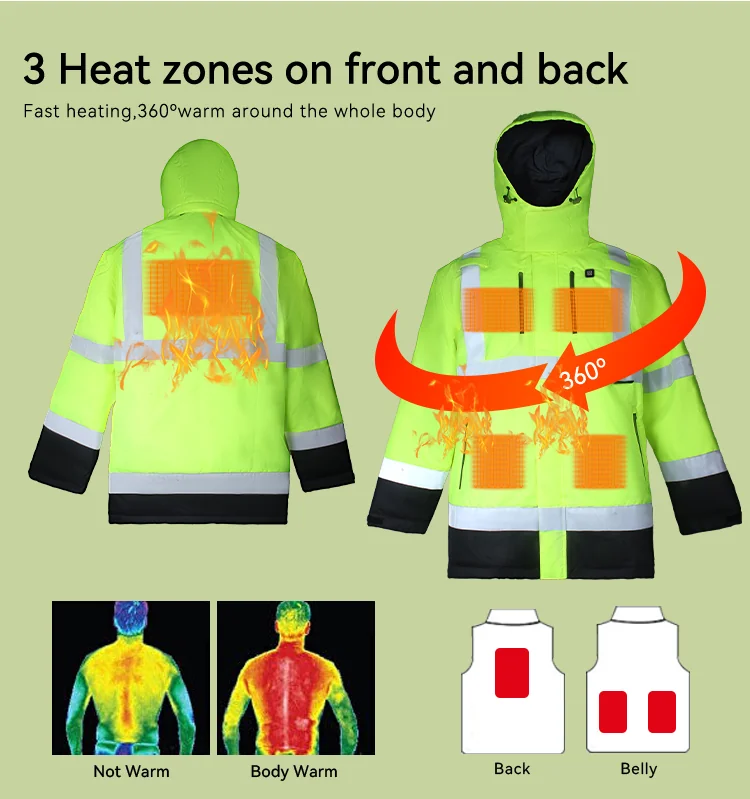
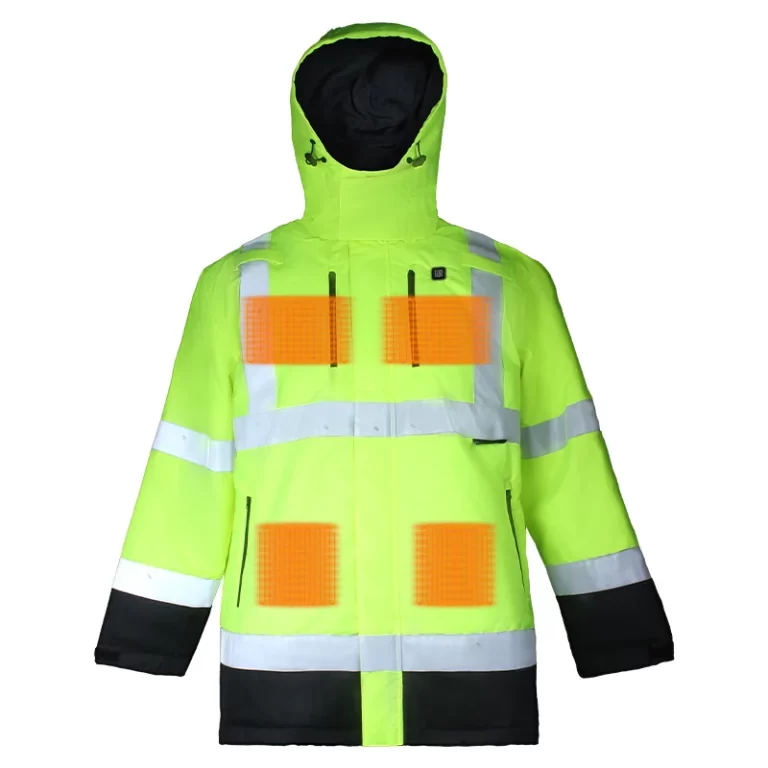
| Heated jacket (3-zone, mid-weight) | 18 | 75 min | 12 min | 75 days |
| Heated vest (4-zone front/back) | 14 | 45 min | 10 min | 65 days |
| Heated hoodie (pull-over, 2-zone) | 16 | 60 min | 8 min | 70 days |
| Heated glove (finger heating) | 22 | 35 min | 18 min | 85 days |
| Heated sock | 20 | 25 min | 22 min | 90 days |
| Heated seat cushion (non-apparel) | 10 | 20 min | 5 min | 50 days |
Gloves and socks look fast at sewing but slow at element install — every finger/toe needs a discrete heating circuit. That’s why the [heated jackets category](/category/heated-jackets/) shows the same Q4 cut-offs as gloves; the glove cycle is actually longer.
—
7. Heated Apparel Production Scheduling OEM: The Booking Window
**Heated apparel production scheduling OEM** is what buyers search when they want to see the factory’s internal capacity book — what weeks are open. We publish a rolling 16-week booking window to confirmed buyers; everyone else gets a 12-week window.
| Booking Window | What’s Open | Typical Deposit | Risk if You Cancel |
|---|---|---|---|
| Weeks 1–8 (Tier 1 buyers) | Hard slot | 30% | 50% forfeit |
| Weeks 9–12 (Tier 2 buyers) | Soft slot | 10% | 100% refundable |
| Weeks 13–16 (Tier 3 waitlist) | Waitlist only | None | N/A |
The 16-week booking window is the most useful document an OEM can give you in Q4. Can’t produce one? The slot they’re “holding” is probably Tier 3.
*”By the time a buyer asks for the booking window in October, the line is gone. The window is a July conversation, not an October one.” — Lin, OEM merchandiser, 8 years Vietnam factory planning desk*
—
8. Private Label vs White Label: Different Schedules, Different Risks
**Heated apparel production scheduling private label** and **heated apparel production scheduling white label** workflows look similar on the surface but diverge at the tech-pack stage.
| Stage | Private Label | White Label |
|---|---|---|
| Tech-pack creation | Buyer creates (or hires agent) | OEM provides stock tech-pack |
| Pattern room | Buyer-owned patterns | OEM stock patterns |
| Heater placement | Custom (zones, wattage) | Stock 3-zone standard |
| Brand labeling | Buyer-specified woven labels, hangtags, packaging | Co-branded or blank |
| Cell spec | Buyer-specified (typically Samsung or LG) | OEM stock (EVE or BAK) |
| Lead time | 75–90 days | 45–60 days |
| MOQ | 300–500 units/SKU | 100–200 units/SKU |
| Q4 risk | Cell allocation slip | Stock heater line sold out |
Private label gives margin and brand control; white label gives speed. In Q4, that speed advantage is real — but so is the margin gap.
—
9. MOQ Ladder for Q4 Peak Season
MOQs creep up 20–30% in Q4 because the OEM is paying overtime and the cell allocation letter costs more.
| SKU Category | Standard MOQ | Q4 MOQ | Why Q4 MOQ Rises |
|---|---|---|---|
| Heated jacket | 300 | 500 | Cell allocation minimum bundle |
| Heated vest | 300 | 500 | Same |
| Heated hoodie | 300 | 500 | Same |
| Heated glove | 500 pairs | 800 pairs | Element loom minimum run |
| Heated sock | 500 pairs | 1,000 pairs | Same |
| Mixed-SKU container | 600 units | 1,000 units | Setup cost amortization |
Sub-MOQ volume in Q4: 35–50% surcharge, or a polite no.
—
10. Payment Milestones That Hold the Slot
Verbal commitments don’t hold a cell allocation. Milestone table we issue with every Q4 PO:
| Milestone | % of PO | Trigger | What It Locks |
|---|---|---|---|
| Deposit | 30% | PO confirmed | Cell allocation + fabric mill PO |
| Net-30 against B/L | 0% (credit-terms buyer) | B/L copy | N/A |
| Pre-shipment | 60% | QA passed, container booked | Container slot at port |
| Balance | 10% | Net-15 after B/L | Final reconciliation |
Negotiating the 30% deposit down to 20% in Q4 signals you’re shopping the slot — the cell allocation letter won’t be requested until the deposit clears.
—
11. Defect Rate vs Peak Season Pressure
Defect rates rise 0.8–1.5 points in Q4 industry-wide. OEM job: hold 2.5 AQL general / 4.0 AQL critical. Buyer job: budget 3.0–3.5%, not the 2.0% modeled in Q1.
| Month | Industry Avg Defect Rate | Our Line Target | Inline QC Stations |
|---|---|---|---|
| August | 2.1% | 2.0% | 4 |
| September | 2.4% | 2.2% | 5 |
| October | 2.9% | 2.5% | 6 |
| November | 3.4% | 2.8% | 7 |
| December | 3.8% | 3.0% | 8 (overtime shifts) |
Two levers hold defect rate in peak season: extra inline QC stations (above) and a 48-hour pilot run before bulk cut. That’s why our November rate sits at 2.8% while the industry average is 3.4%.
—
12. Heated Apparel Production Scheduling Wholesale: Container-Level Planning
**Heated apparel production scheduling wholesale** buyers (importing 1,000–10,000 units per SKU across retailers) think in containers, not units.
| Container Type | Unit Capacity (jackets) | FOB Ho Chi Minh Cost | Latest Cut-off for Dec 25 West Coast DC |
|---|---|---|---|
| 20′ FCL | ~1,200 jackets | $14–18/unit | Nov 20 |
| 40′ FCL | ~2,800 jackets | $12–15/unit | Nov 20 |
| 40′ HC | ~3,100 jackets | $11–14/unit | Nov 20 |
| LCL (mixed SKU) | 300–800 units | +$2–4/unit LCL fee | Nov 10 (consolidation buffer) |
| Air-freight (emergency) | 50–200 units | +$8–12/unit | Dec 5 (peak air rates) |
Miss Nov 20 and you have three bad options: LCL with buffer, air-freight at peak rates, or January delivery.
—
13. Risk Flags: When to Walk Away From a Slot
Five red flags:
1. **No cell allocation letter by August 10** — the slot is fictional.
2. **Lead time under 60 days for a private-label jacket in Q4** — someone is lying about heater lead time.
3. **Deposit under 20% in peak season** — the OEM is shopping the slot.
4. **No published booking window** — you’re on Tier 3.
5. **Tech-pack freeze offered in October for December delivery** — QA + AQL won’t fit.
See two of five? Walk. The next Tier-1 private-label slot is January production for March shipment — still better than a botched December.
—
14. FAQ
**Q1. When should we book Q4 capacity for private-label heated apparel?**
July 15 for a guaranteed November FOB slot. After August 15, you’re on white-label timing.
**Q2. Private label vs white label production scheduling — what’s the difference?**
Private label runs 75–90 days with custom tech-packs and buyer cells. White label runs 45–60 days on OEM stock tech-packs.
**Q3. Why does battery cell allocation matter for Q4?**
Cell makers ration Q4 supply in two waves (April for tier-1, July for spot). Without an allocation letter, every lead-time quote is fiction.
**Q4. How far in advance should tech packs be submitted for Christmas cut-off?**
July 30 for private-label tech-pack freeze. PPS sign-off by September 5.
**Q5. Can we add SKUs mid-peak season?**
Only if your Tier-1 slot is still under-booked. Otherwise mid-season adds ship in February at earliest.
**Q6. Typical MOQ for Q4 OEM heated jacket runs?**
500 units/SKU for jackets in Q4 (vs 300 shoulder season). Heated gloves require 800 pairs.
**Q7. How do OEM suppliers handle defect rates during peak season?**
Inline QC stations double in Q4 (4 → 8). Tier-1 OEMs hold 2.5–3.0% via 48-hour pilot runs.
**Q8. What payment milestones hold a Q4 capacity slot?**
30% deposit to confirm cell allocation, 60% pre-shipment after QA, 10% net-15 after B/L.
**Q9. Do you ship FOB Ho Chi Minh or DDP for Q4 wholesale orders?**
Both. FOB Cat Lai is standard; DDP at +$2–4/unit for buyers without a US broker.
**Q10. What happens if we miss the component slot lock date?**
Cell allocation reverts to the next buyer. OEM quotes an alternate cell at +9–18%; lead time slips 10–14 days.
**Q11. How do heated glove and heated vest schedules differ from jackets?**
Gloves have longer element-install (18 min vs 12 min) so total cycle is 85 days vs 75 for jackets. Vests are 65 days.
**Q12. Latest cut-off for guaranteed Christmas delivery?**
Private label: Nov 20 FOB Cat Lai for Dec 24–25 West Coast DC. White label: Dec 10. Air emergency: Dec 5.
—
15. The Bottom Line
**Heated apparel production scheduling** in Q4 is a three-supplier coordination problem (OEM + heater loom + cell maker) compressed into 90 days. November shippers placed their PO in late June with a confirmed cell allocation letter. February shippers waited until the booking window closed.
Your 2026 Christmas window has already closed if you’re starting a private-label program this Q4 — start now for March 2027 production. Established brand with a Tier-1 slot? Protect it: the next seller’s market is Q4 2027, and the allocation letter you sign in May 2027 decides whether you ship in November.
See the [heated apparel guides category](/category/heated-apparel-guides/) for program workflows. See the [heated jackets category](/category/heated-jackets/) for SKUs.